

246
Mackensen and Bickert
1990) that the sill depth ofthe submarine ridge systems reduces the deep water advection to the eastern Atlantic basins during glacials. Instead, the
somewhat higher ODC values and less indications
of carbonate dissolution in Core GeoB 110 I during
the warmer glacial substages 3.3, 8.3, and 8.5
suggest that due to a slightly sinking water mass
boundary between the upper and lower part of the
glacial southern component waters, the eastern basins were again filled with a less corrosive and more
oxygenated deep water than the western basins.
Late Quaternary Productivity Shifts at the
Antarctic Polar Front
In a second example we use the O'lC composition
of foraminiferal tests to interpret down-core
changes on Site PS2082 at 43°S (Fig. 8), north of
the present-day Polar Frontal Zone and reconstruct
glacial/interglacial contrasts in paleoproductivity.
The age model is derived by graphic correlation of
11 12 1
3 1
4 1, 121~ 14 lsi
6
1.2
1
0.8
- 0.6
m
C
0.4
£:L
0.2
0
~
0
- U -0.2
M ,....
-0.4
<-0
-0.6
-0.8
-1
0
100
the 0\80 records to the SPECMAP standard
record (Mackensen et al. 1994).
Core PS2082-1 was chosen from a suite of
gravity cores crossing the eastern Atlantic Polar
Front region because of its undisturbed calcareous
record of the last 400,000 years, with the exception of some dissolution during glacial periods. According to our knowledge, Core PS2082-1 is, except for Core MD84-S27 (Labracherie et al. 1989),
the southernmost core with almost complete
Cibicidoides ODC record. At Site PS2082, benthic
and planktic ODC values vary between approximately + 1.2 %0 and -1.3 %0 during the last 390,000
years (Fig. 13) such that low values coincide with
oxygen isotope stages 10, 8, 7.4, 6, 4, and 2. An
overall trend of increasing values with decreasing
age or depth in core is clearly visible. The ODC
record of Cibicidoides shows a shift of ca 1.1 %0
between glacials and interglacials; this is one ofthe
greatest shifts reported from the deep sea.
To document changes in surface ocean productivity at Site PS2082 we calculated paleoproducI, 121 ~ 14 lsi
8
9
1
10
I
11
1112
200
300
400
age (ka)
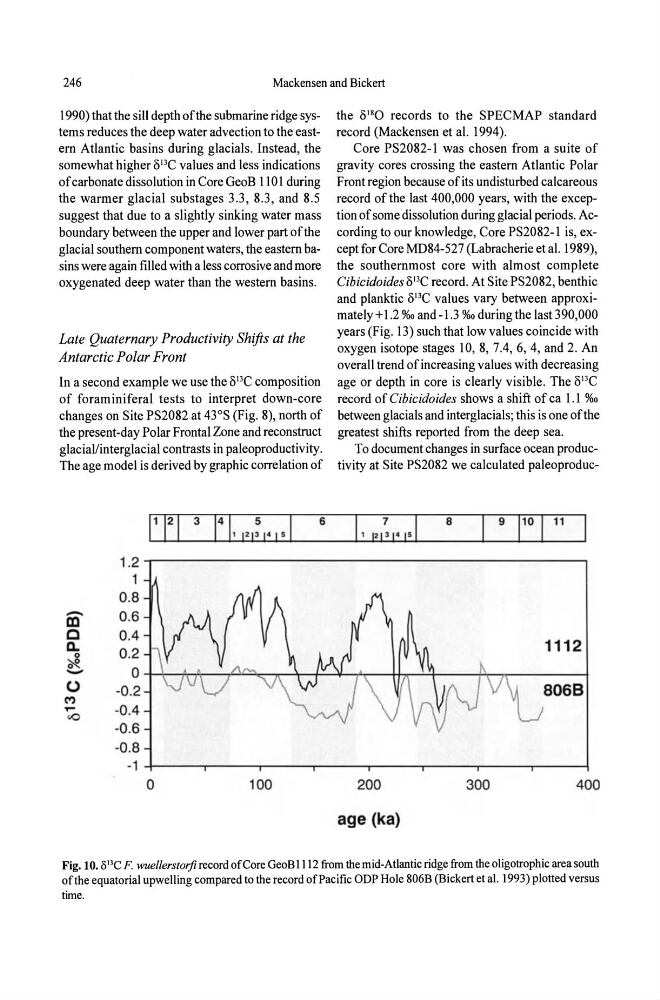
Fig. 10. Ol3C F. wuellerstorfi record of Core GeoB 1112 from the mid-Atlantic ridge from the oligotrophic area south
of the equatorial upwelling compared to the record of Pacific ODP Hole 806B (Bickert et al. 1993) plotted versus
time.
Mackensen and Bickert
1990) that the sill depth ofthe submarine ridge systems reduces the deep water advection to the eastern Atlantic basins during glacials. Instead, the
somewhat higher ODC values and less indications
of carbonate dissolution in Core GeoB 110 I during
the warmer glacial substages 3.3, 8.3, and 8.5
suggest that due to a slightly sinking water mass
boundary between the upper and lower part of the
glacial southern component waters, the eastern basins were again filled with a less corrosive and more
oxygenated deep water than the western basins.
Late Quaternary Productivity Shifts at the
Antarctic Polar Front
In a second example we use the O'lC composition
of foraminiferal tests to interpret down-core
changes on Site PS2082 at 43°S (Fig. 8), north of
the present-day Polar Frontal Zone and reconstruct
glacial/interglacial contrasts in paleoproductivity.
The age model is derived by graphic correlation of
11 12 1
3 1
4 1, 121~ 14 lsi
6
1.2
1
0.8
- 0.6
m
C
0.4
£:L
0.2
0
~
0
- U -0.2
M ,....
-0.4
<-0
-0.6
-0.8
-1
0
100
the 0\80 records to the SPECMAP standard
record (Mackensen et al. 1994).
Core PS2082-1 was chosen from a suite of
gravity cores crossing the eastern Atlantic Polar
Front region because of its undisturbed calcareous
record of the last 400,000 years, with the exception of some dissolution during glacial periods. According to our knowledge, Core PS2082-1 is, except for Core MD84-S27 (Labracherie et al. 1989),
the southernmost core with almost complete
Cibicidoides ODC record. At Site PS2082, benthic
and planktic ODC values vary between approximately + 1.2 %0 and -1.3 %0 during the last 390,000
years (Fig. 13) such that low values coincide with
oxygen isotope stages 10, 8, 7.4, 6, 4, and 2. An
overall trend of increasing values with decreasing
age or depth in core is clearly visible. The ODC
record of Cibicidoides shows a shift of ca 1.1 %0
between glacials and interglacials; this is one ofthe
greatest shifts reported from the deep sea.
To document changes in surface ocean productivity at Site PS2082 we calculated paleoproducI, 121 ~ 14 lsi
8
9
1
10
I
11
1112
200
300
400
age (ka)
Fig. 10. Ol3C F. wuellerstorfi record of Core GeoB 1112 from the mid-Atlantic ridge from the oligotrophic area south
of the equatorial upwelling compared to the record of Pacific ODP Hole 806B (Bickert et al. 1993) plotted versus
time.