

Stable Carbon Isotopes in Benthic Foraminifera
243
Basins, these values are higher than 0.9 %0, slightly
decreasing along the flow path ofNADW to the
south.
Late Quaternary Deep Water Circulation in
the South Atlantic
In the first example we concentrate on reconstructing the late Quaternary deep circulation in the
eastern South Atlantic Ocean. We focus on seven
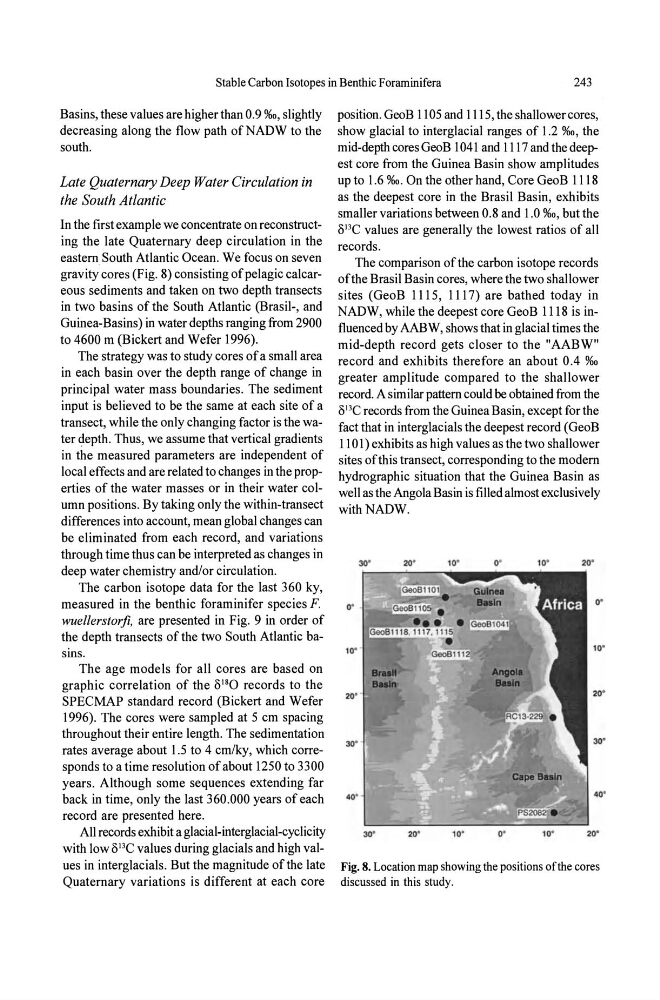
gravity cores (Fig. 8) consisting of pelagic calcareous sediments and taken on two depth transects
in two basins of the South Atlantic (Brasil-, and
Guinea-Basins) in water depths ranging from 2900
to 4600 m (Bickert and Wefer 1996).
The strategy was to study cores of a small area
in each basin over the depth range of change in
principal water mass boundaries. The sediment
input is believed to be the same at each site of a
transect, while the only changing factor is the water depth. Thus, we assume that vertical gradients
in the measured parameters are independent of
local effects and are related to changes in the properties of the water masses or in their water column positions. By taking only the within-transect
differences into account, mean global changes can
be eliminated from each record, and variations
through time thus can be interpreted as changes in
deep water chemistry and/or circulation.
The carbon isotope data for the last 360 ky,
measured in the benthic foraminifer species F.
wuellerstorfi, are presented in Fig. 9 in order of
the depth transects of the two South Atlantic baSinS.
The age models for all cores are based on
graphic correlation of the 1) 18 0 records to the
SPECMAP standard record (Bickert and Wefer
1996). The cores were sampled at 5 cm spacing
throughout their entire length. The sedimentation
rates average about 1.5 to 4 cm/ky, which corresponds to a time resolution of about 1250 to 3300
years. Although some sequences extending far
back in time, only the last 360.000 years of each
record are presented here.
All records exhibit a glacial-interglacial-cyclicity
with low I)I3C values during glacials and high values in interglacials. But the magnitude ofthe late
Quaternary variations is different at each core
position. GeoB 1105 and 1115, the shallower cores,
show glacial to interglacial ranges of 1.2 %0, the
mid-depth cores GeoB 1041 and 1117 and the deepest core from the Guinea Basin show amplitudes
up to 1.6 %0. On the other hand, Core GeoB 1118
as the deepest core in the Brasil Basin, exhibits
smaller variations between 0.8 and 1.00/00, but the
I)I3C values are generally the lowest ratios of all
records.
The comparison of the carbon isotope records
of the Brasil Basin cores, where the two shallower
sites (GeoB IllS, 1117) are bathed today in
NADW, while the deepest core GeoB 1118 is influenced by AABW, shows that in glacial times the
mid-depth record gets closer to the "AABW"
record and exhibits therefore an about 0.4 %0
greater amplitude compared to the shallower
record. A similar pattern could be obtained from the
I) I3C records from the Guinea Basin, except for the
fact that in interglacials the deepest record (GeoB
1101) exhibits as high values as the two shallower
sites of this transect, corresponding to the modern
hydrographic situation that the Guinea Basin as
well as the Angola Basin is filled almost exclusively
withNADW.
30'
20'
10'
o·
10'
20'
o·
10'
20'
30'
40'
30"
20'
10'
o·
10'
20'
Fig. 8. Location map showing the positions of the cores
discussed in this study.
243
Basins, these values are higher than 0.9 %0, slightly
decreasing along the flow path ofNADW to the
south.
Late Quaternary Deep Water Circulation in
the South Atlantic
In the first example we concentrate on reconstructing the late Quaternary deep circulation in the
eastern South Atlantic Ocean. We focus on seven
gravity cores (Fig. 8) consisting of pelagic calcareous sediments and taken on two depth transects
in two basins of the South Atlantic (Brasil-, and
Guinea-Basins) in water depths ranging from 2900
to 4600 m (Bickert and Wefer 1996).
The strategy was to study cores of a small area
in each basin over the depth range of change in
principal water mass boundaries. The sediment
input is believed to be the same at each site of a
transect, while the only changing factor is the water depth. Thus, we assume that vertical gradients
in the measured parameters are independent of
local effects and are related to changes in the properties of the water masses or in their water column positions. By taking only the within-transect
differences into account, mean global changes can
be eliminated from each record, and variations
through time thus can be interpreted as changes in
deep water chemistry and/or circulation.
The carbon isotope data for the last 360 ky,
measured in the benthic foraminifer species F.
wuellerstorfi, are presented in Fig. 9 in order of
the depth transects of the two South Atlantic baSinS.
The age models for all cores are based on
graphic correlation of the 1) 18 0 records to the
SPECMAP standard record (Bickert and Wefer
1996). The cores were sampled at 5 cm spacing
throughout their entire length. The sedimentation
rates average about 1.5 to 4 cm/ky, which corresponds to a time resolution of about 1250 to 3300
years. Although some sequences extending far
back in time, only the last 360.000 years of each
record are presented here.
All records exhibit a glacial-interglacial-cyclicity
with low I)I3C values during glacials and high values in interglacials. But the magnitude ofthe late
Quaternary variations is different at each core
position. GeoB 1105 and 1115, the shallower cores,
show glacial to interglacial ranges of 1.2 %0, the
mid-depth cores GeoB 1041 and 1117 and the deepest core from the Guinea Basin show amplitudes
up to 1.6 %0. On the other hand, Core GeoB 1118
as the deepest core in the Brasil Basin, exhibits
smaller variations between 0.8 and 1.00/00, but the
I)I3C values are generally the lowest ratios of all
records.
The comparison of the carbon isotope records
of the Brasil Basin cores, where the two shallower
sites (GeoB IllS, 1117) are bathed today in
NADW, while the deepest core GeoB 1118 is influenced by AABW, shows that in glacial times the
mid-depth record gets closer to the "AABW"
record and exhibits therefore an about 0.4 %0
greater amplitude compared to the shallower
record. A similar pattern could be obtained from the
I) I3C records from the Guinea Basin, except for the
fact that in interglacials the deepest record (GeoB
1101) exhibits as high values as the two shallower
sites of this transect, corresponding to the modern
hydrographic situation that the Guinea Basin as
well as the Angola Basin is filled almost exclusively
withNADW.
30'
20'
10'
o·
10'
20'
o·
10'
20'
30'
40'
30"
20'
10'
o·
10'
20'
Fig. 8. Location map showing the positions of the cores
discussed in this study.