

182
Niebler et al.
shallow mean
calcifcation depth
0- 50 m
S. dehiscens
(SG)
P. obliquilocu/ata
(SG)
0. bilobata
(SG)
G. sacculifer
(SG to northern SAl)
G. aequilatera/is
(SG to northern SAl)
G. ruber
(SG to northern SAl)
G. bulloides
(SG toAl)
shallow I intermediate
mean calcifcation depth
0- 200 m
G. cong/obatus
(SG)
0. universa
(SG to northern SAl)
N. dutertrei
(SG to northern SAl)
T quinque/Dba
(SG to PFl)
N. pachyderma
(SGto Al)
deep / intermediate
mean calcifcation depth
100- 250m
G. tumida
(SG)
G. menardii
(SG to northern SAl)
G. calida
(SG to northern SAl)
G. inflata
(SG toAl)
deep mean
calcifcation depth
> 250 m
G. hirsuta
(SG to northern SAl)
G. scitu/a
(SGto SAl)
G. crassaformis
(SG toAl)
G. truncatulinoides
(SGtoAl)
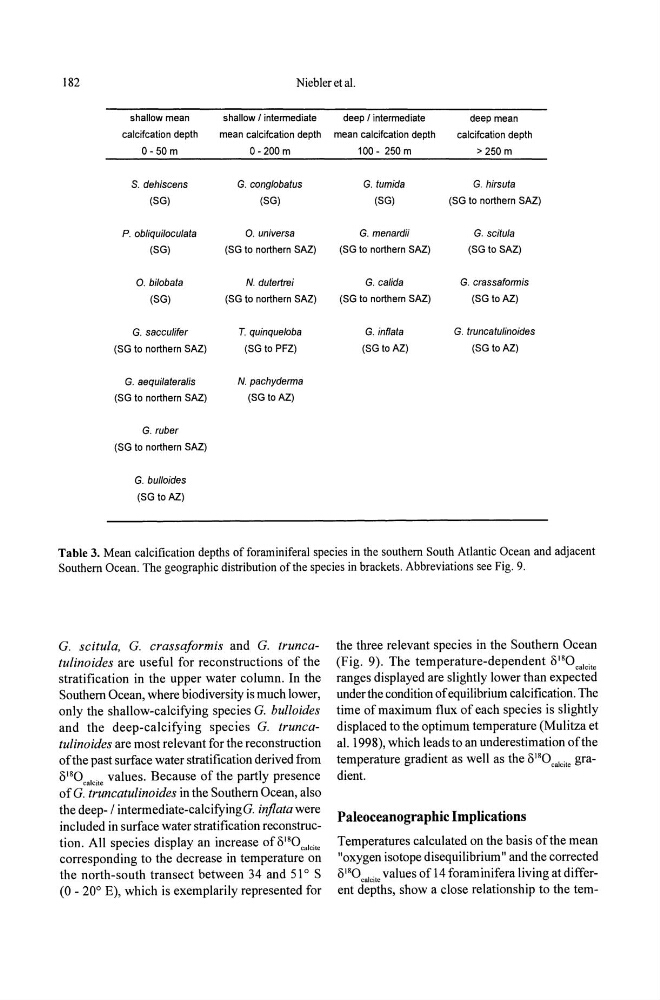
Table 3. Mean calcification depths of foraminiferal species in the southern South Atlantic Ocean and adjacent
Southern Ocean. The geographic distribution of the species in brackets. Abbreviations see Fig. 9.
G. scitula, G. crassaformis and G. truncatulinoides are useful for reconstructions of the
stratification in the upper water column. In the
Southern Ocean, where biodiversity is much lower,
only the shallow-calcifying species G. bulloides
and the deep-calcifying species G. truncatulinoides are most relevant for the reconstruction
ofthe past surface water stratification derived from
8 18 0,.Ic;te values. Because of the partly presence
of G. truncatulinoides in the Southern Ocean, also
the deep- / intermediate-calcifyingG. inflatawere
included in surface water stratification reconstruction. All species display an increase of 8 18 0,.ldte
corresponding to the decrease in temperature on
the north-south transect between 34 and 51 ° S
(0 - 20° E), which is exemplarily represented for
the three relevant species in the Southern Ocean
(Fig. 9). The temperature-dependent 8180c.ldte
ranges displayed are slightly lower than expected
under the condition of equilibrium calcification. The
time of maximum flux of each species is slightly
displaced to the optimum temperature (Mulitza et
al. 1998), which leads to an underestimation ofthe
temperature gradient as well as the 8 18 0,.ie;te gradient.
Paleoceanographic Implications
Temperatures calculated on the basis of the mean
"oxygen isotope disequilibrium" and the corrected
8180 oaldle values of 14 foraminifera living at different depths, show a close relationship to the tem-
Niebler et al.
shallow mean
calcifcation depth
0- 50 m
S. dehiscens
(SG)
P. obliquilocu/ata
(SG)
0. bilobata
(SG)
G. sacculifer
(SG to northern SAl)
G. aequilatera/is
(SG to northern SAl)
G. ruber
(SG to northern SAl)
G. bulloides
(SG toAl)
shallow I intermediate
mean calcifcation depth
0- 200 m
G. cong/obatus
(SG)
0. universa
(SG to northern SAl)
N. dutertrei
(SG to northern SAl)
T quinque/Dba
(SG to PFl)
N. pachyderma
(SGto Al)
deep / intermediate
mean calcifcation depth
100- 250m
G. tumida
(SG)
G. menardii
(SG to northern SAl)
G. calida
(SG to northern SAl)
G. inflata
(SG toAl)
deep mean
calcifcation depth
> 250 m
G. hirsuta
(SG to northern SAl)
G. scitu/a
(SGto SAl)
G. crassaformis
(SG toAl)
G. truncatulinoides
(SGtoAl)
Table 3. Mean calcification depths of foraminiferal species in the southern South Atlantic Ocean and adjacent
Southern Ocean. The geographic distribution of the species in brackets. Abbreviations see Fig. 9.
G. scitula, G. crassaformis and G. truncatulinoides are useful for reconstructions of the
stratification in the upper water column. In the
Southern Ocean, where biodiversity is much lower,
only the shallow-calcifying species G. bulloides
and the deep-calcifying species G. truncatulinoides are most relevant for the reconstruction
ofthe past surface water stratification derived from
8 18 0,.Ic;te values. Because of the partly presence
of G. truncatulinoides in the Southern Ocean, also
the deep- / intermediate-calcifyingG. inflatawere
included in surface water stratification reconstruction. All species display an increase of 8 18 0,.ldte
corresponding to the decrease in temperature on
the north-south transect between 34 and 51 ° S
(0 - 20° E), which is exemplarily represented for
the three relevant species in the Southern Ocean
(Fig. 9). The temperature-dependent 8180c.ldte
ranges displayed are slightly lower than expected
under the condition of equilibrium calcification. The
time of maximum flux of each species is slightly
displaced to the optimum temperature (Mulitza et
al. 1998), which leads to an underestimation ofthe
temperature gradient as well as the 8 18 0,.ie;te gradient.
Paleoceanographic Implications
Temperatures calculated on the basis of the mean
"oxygen isotope disequilibrium" and the corrected
8180 oaldle values of 14 foraminifera living at different depths, show a close relationship to the tem-