

Calcareous Dinoflagellate Cysts as Paleo-Environmental Tools
155
Dale and Dale (1992) and Dale (1992a) observed
that calcareous cysts formed only 12% of the total
cyst accumulation rates in the Northern North
Atlantic in comparison to 82% to 100% of the accumulation rates in the Equatorial Atlantic, Central
Pacific and Panama Basin. They did not recover
calcareous cysts from traps below the cold East
Greenland Current and the cysts observed in traps
from the Lofoten Basin and Aegir Ridge were
considered to originate from the North Atlantic
Ocean. This suggests that calcareous cysts are not
formed in arctic regions. However, Mudie (1992)
documents (although does not specify) findings of
calcareous cyst of Scrippsiella sp . in recent
sediments from the Arctic. To date, information on
Arctic regions is rather limited and the absence of
calcareous cyst records could, therefore, also be
the result of the absence of studies in these regions.
This suspicion is strengthened by the observation
of Gilbert and Clark (1983), who observed high
amounts of Sphaerodinella arctica (Gilbert and
Clark) Keupp and Versteegh in Pliocene and
Pleistocene sediments of the Amerasian Basin near
the North Pole.
Comparison of the cyst-association of the Late
Quaternary western Equatorial Atlantic (Core
GeoB 2204-2) with that of the eastern Equatorial
Atlantic (Core GeoB 1105-4) shows accumulation
rates of calcareous cysts in the western Atlantic
which are one order of magnitude higher (Fig. 8).
In the eastern Equatorial Atlantic increased calcareous cysts accumulation rates can be observed in
interglacial intervals when productivity was
believed to have been lowered, whereas in the
western part (Core GeoB 2204-2) variations in cyst
accumulation rates are less obvious (Fig. 8).
Both visual examination and the results of the
RDA analysis show that the distribution of the calcareous cyst species in the combined dataset is
negatively correlated to TOC accumulation (Figs.
8,9). Variations in TOC concentrations in the eastern Equatorial Atlantic and differences in concentrations between the eastern and western Equatorial Atlantic could be related to relative changes in
paleoproductivity in surface waters (Bickert 1992;
Meinecke 1992; Riihlemann 1996). Consequently,
the present results suggest that high calcareous cyst
accumulation rates can be related to low
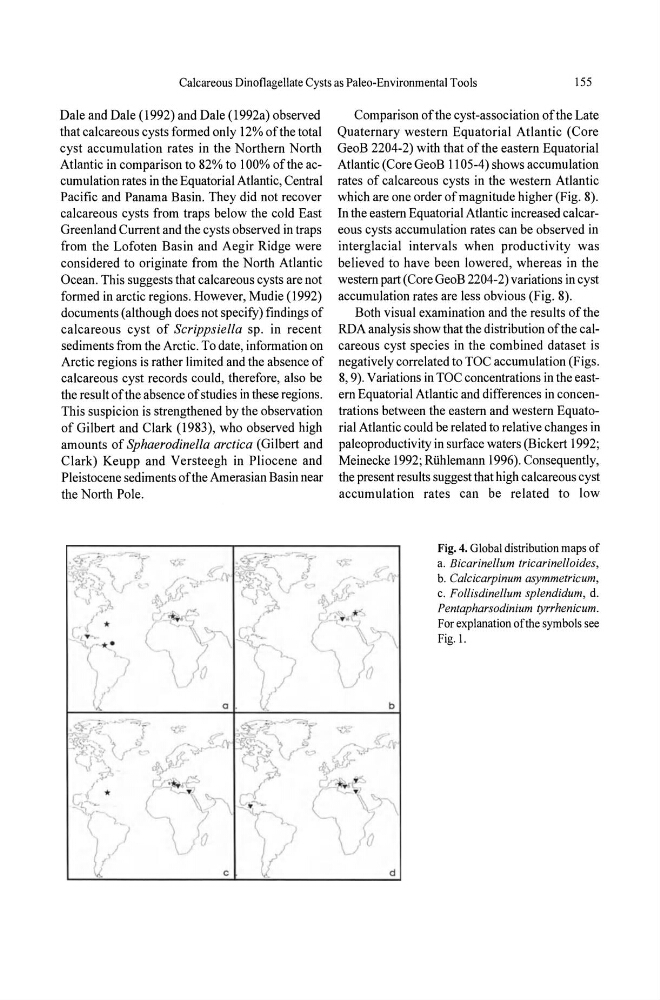
Fig. 4. Global distribution maps of
a. Bicarinellum tricarinelloides,
b. Calcicarpinum asymmetricum,
c. Follisdinellum splendidum, d.
Pentapharsodinium tyrrhenicum.
For explanation ofthe symbols see
Fig. 1.
155
Dale and Dale (1992) and Dale (1992a) observed
that calcareous cysts formed only 12% of the total
cyst accumulation rates in the Northern North
Atlantic in comparison to 82% to 100% of the accumulation rates in the Equatorial Atlantic, Central
Pacific and Panama Basin. They did not recover
calcareous cysts from traps below the cold East
Greenland Current and the cysts observed in traps
from the Lofoten Basin and Aegir Ridge were
considered to originate from the North Atlantic
Ocean. This suggests that calcareous cysts are not
formed in arctic regions. However, Mudie (1992)
documents (although does not specify) findings of
calcareous cyst of Scrippsiella sp . in recent
sediments from the Arctic. To date, information on
Arctic regions is rather limited and the absence of
calcareous cyst records could, therefore, also be
the result of the absence of studies in these regions.
This suspicion is strengthened by the observation
of Gilbert and Clark (1983), who observed high
amounts of Sphaerodinella arctica (Gilbert and
Clark) Keupp and Versteegh in Pliocene and
Pleistocene sediments of the Amerasian Basin near
the North Pole.
Comparison of the cyst-association of the Late
Quaternary western Equatorial Atlantic (Core
GeoB 2204-2) with that of the eastern Equatorial
Atlantic (Core GeoB 1105-4) shows accumulation
rates of calcareous cysts in the western Atlantic
which are one order of magnitude higher (Fig. 8).
In the eastern Equatorial Atlantic increased calcareous cysts accumulation rates can be observed in
interglacial intervals when productivity was
believed to have been lowered, whereas in the
western part (Core GeoB 2204-2) variations in cyst
accumulation rates are less obvious (Fig. 8).
Both visual examination and the results of the
RDA analysis show that the distribution of the calcareous cyst species in the combined dataset is
negatively correlated to TOC accumulation (Figs.
8,9). Variations in TOC concentrations in the eastern Equatorial Atlantic and differences in concentrations between the eastern and western Equatorial Atlantic could be related to relative changes in
paleoproductivity in surface waters (Bickert 1992;
Meinecke 1992; Riihlemann 1996). Consequently,
the present results suggest that high calcareous cyst
accumulation rates can be related to low
Fig. 4. Global distribution maps of
a. Bicarinellum tricarinelloides,
b. Calcicarpinum asymmetricum,
c. Follisdinellum splendidum, d.
Pentapharsodinium tyrrhenicum.
For explanation ofthe symbols see
Fig. 1.