

154
Zonneveld et al.
SooW
40·W
30·W
20·W
10·W
O·
10· E
'"
200N
NEe
...
/)
Africa
NEee
10·N
~
~
.....
SEC
. . . -
•
!> Eue
O·
GeoB 1105-4 ... - -
~
SEc
~
C.
.\ GeOB 2204·2
SECC
- A.
S-America
C
..
10·S
J
SEC
...
20· S
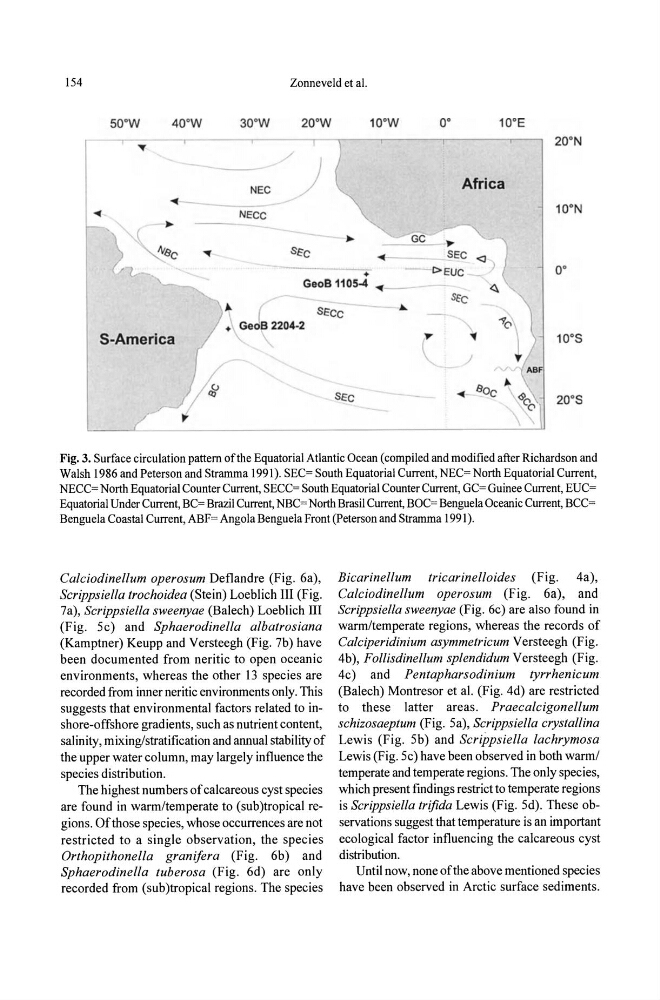
Fig. 3. Surface circulation pattern of the Equatorial Atlantic Ocean (compiled and modified after Richardson and
Walsh 1986 and Peterson and Stramma 1991). SEC= South Equatorial Current, NEC= North Equatorial Current,
NECC= North Equatorial Counter Current, SECC= South Equatorial Counter Current, GC= Guinee Current, EUC=
Equatorial Under Current, BC= Brazil Current, NBC= North Brasil Current, BOC= Benguela Oceanic Current, BCC=
Benguela Coastal Current, ABF= Angola Benguela Front (Peterson and Stramma 1991).
Calciodinellum operosum Deflandre (Fig. 6a),
Scrippsiella trochoidea (Stein) Loeblich III (Fig.
7a), Scrippsiella sweenyae (Balech) Loeblich III
(Fig. 5c) and Sphaerodinella albatrosiana
(Kamptner) Keupp and Versteegh (Fig. 7b) have
been documented from neritic to open oceanic
environments, whereas the other 13 species are
recorded from inner neritic environments only. This
suggests that environmental factors related to in·
shore·offshore gradients, such as nutrient content,
salinity, mixing/stratification and annual stability of
the upper water column, may largely influence the
species distribution.
The highest numbers of calcareous cyst species
are found in warm/temperate to (sub)tropical reo
gions. Of those species, whose occurrences are not
restricted to a single observation, the species
Orthopithonella granifera (Fig. 6b) and
Sphaerodinella tuberosa (Fig . 6d) are only
recorded from (sub)tropical regions. The species
Bicarinellum tricarinelloides (Fig. 4a),
Calciodinellum operosum (Fig. 6a), and
Scrippsiella sweenyae (Fig. 6c) are also found in
warm/temperate regions, whereas the records of
Calciperidinium asymmetricum Versteegh (Fig.
4b), Follisdinellum splendidum Versteegh (Fig.
4c) and Pentapharsodinium tyrrhenicum
(Balech) Montresor et al. (Fig. 4d) are restricted
to these latter areas. Praecalcigonellum
schizosaeptum (Fig. 5a), Scrippsiella crystallina
Lewis (Fig. 5b) and ScripPsiella lachrymosa
Lewis (Fig. 5c) have been observed in both warm/
temperate and temperate regions. The only species,
which present fmdings restrict to temperate regions
is Scrippsiella trifida Lewis (Fig. 5d). These observations suggest that temperature is an important
ecological factor influencing the calcareous cyst
distribution.
Until now, none of the above mentioned species
have been observed in Arctic surface sediments.
Zonneveld et al.
SooW
40·W
30·W
20·W
10·W
O·
10· E
'"
200N
NEe
...
/)
Africa
NEee
10·N
~
~
.....
SEC
. . . -
•
!> Eue
O·
GeoB 1105-4 ... - -
~
SEc
~
C.
.\ GeOB 2204·2
SECC
- A.
S-America
C
..
10·S
J
SEC
...
20· S
Fig. 3. Surface circulation pattern of the Equatorial Atlantic Ocean (compiled and modified after Richardson and
Walsh 1986 and Peterson and Stramma 1991). SEC= South Equatorial Current, NEC= North Equatorial Current,
NECC= North Equatorial Counter Current, SECC= South Equatorial Counter Current, GC= Guinee Current, EUC=
Equatorial Under Current, BC= Brazil Current, NBC= North Brasil Current, BOC= Benguela Oceanic Current, BCC=
Benguela Coastal Current, ABF= Angola Benguela Front (Peterson and Stramma 1991).
Calciodinellum operosum Deflandre (Fig. 6a),
Scrippsiella trochoidea (Stein) Loeblich III (Fig.
7a), Scrippsiella sweenyae (Balech) Loeblich III
(Fig. 5c) and Sphaerodinella albatrosiana
(Kamptner) Keupp and Versteegh (Fig. 7b) have
been documented from neritic to open oceanic
environments, whereas the other 13 species are
recorded from inner neritic environments only. This
suggests that environmental factors related to in·
shore·offshore gradients, such as nutrient content,
salinity, mixing/stratification and annual stability of
the upper water column, may largely influence the
species distribution.
The highest numbers of calcareous cyst species
are found in warm/temperate to (sub)tropical reo
gions. Of those species, whose occurrences are not
restricted to a single observation, the species
Orthopithonella granifera (Fig. 6b) and
Sphaerodinella tuberosa (Fig . 6d) are only
recorded from (sub)tropical regions. The species
Bicarinellum tricarinelloides (Fig. 4a),
Calciodinellum operosum (Fig. 6a), and
Scrippsiella sweenyae (Fig. 6c) are also found in
warm/temperate regions, whereas the records of
Calciperidinium asymmetricum Versteegh (Fig.
4b), Follisdinellum splendidum Versteegh (Fig.
4c) and Pentapharsodinium tyrrhenicum
(Balech) Montresor et al. (Fig. 4d) are restricted
to these latter areas. Praecalcigonellum
schizosaeptum (Fig. 5a), Scrippsiella crystallina
Lewis (Fig. 5b) and ScripPsiella lachrymosa
Lewis (Fig. 5c) have been observed in both warm/
temperate and temperate regions. The only species,
which present fmdings restrict to temperate regions
is Scrippsiella trifida Lewis (Fig. 5d). These observations suggest that temperature is an important
ecological factor influencing the calcareous cyst
distribution.
Until now, none of the above mentioned species
have been observed in Arctic surface sediments.