

Coccolithophores as Indicators of Ocean Water Masses
135
A
B
100
80
~
o
.5
1
60
40
.D
'"
20
o
sample
month
o
_
Others
_
U",b,l,aJSphoero sIbogoe
C==:1 CaicldisclJS leproporu.r
~ Gl!phyrOC(1p.ra oceanIca
~ Emillanialua/ey,
5
10
o
5
10
1989 1990
15
20
15 I
20
I D I J IFI M
24
22 ~
o ( / )
8~
20 ~ "6
~~
18 el ~
161 ~
!ir
14
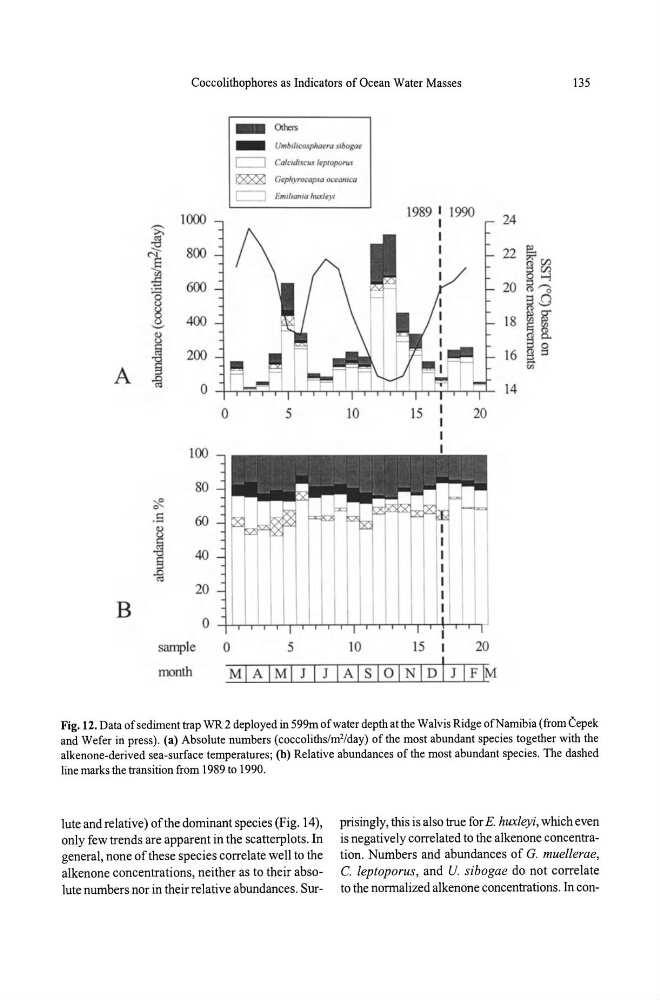
Fig. 12. Data of sediment trap WR 2 deployed in 599m of water depth at the Walvis Ridge of Namibia (from Cepek
and Wefer in press) . (a) Absolute numbers (coccoliths/m2/day) of the most abundant species together with the
alkenone-derived sea-surface temperatures; (b) Relative abundances of the most abundant species. The dashed
line marks the transition from 1989 to 1990.
lute and relative) of the dominant species (Fig. 14),
only few trends are apparent in the scatterplots. In
general, none ofthese species correlate well to the
alkenone concentrations, neither as to their absolute numbers nor in their relative abundances. Surprisingly, this is also true for E. huxleyi, which even
is negatively correlated to the alkenone concentration. Numbers and abundances of G. muelierae,
C. leptoporus , and U. sibogae do not correlate
to the normalized alkenone concentrations. In con-
135
A
B
100
80
~
o
.5
1
60
40
.D
'"
20
o
sample
month
o
_
Others
_
U",b,l,aJSphoero sIbogoe
C==:1 CaicldisclJS leproporu.r
~ Gl!phyrOC(1p.ra oceanIca
~ Emillanialua/ey,
5
10
o
5
10
1989 1990
15
20
15 I
20
I D I J IFI M
24
22 ~
o ( / )
8~
20 ~ "6
~~
18 el ~
161 ~
!ir
14
Fig. 12. Data of sediment trap WR 2 deployed in 599m of water depth at the Walvis Ridge of Namibia (from Cepek
and Wefer in press) . (a) Absolute numbers (coccoliths/m2/day) of the most abundant species together with the
alkenone-derived sea-surface temperatures; (b) Relative abundances of the most abundant species. The dashed
line marks the transition from 1989 to 1990.
lute and relative) of the dominant species (Fig. 14),
only few trends are apparent in the scatterplots. In
general, none ofthese species correlate well to the
alkenone concentrations, neither as to their absolute numbers nor in their relative abundances. Surprisingly, this is also true for E. huxleyi, which even
is negatively correlated to the alkenone concentration. Numbers and abundances of G. muelierae,
C. leptoporus , and U. sibogae do not correlate
to the normalized alkenone concentrations. In con-