

134
Baumann et al.
GeoB 1028-5
Abundances of coccoliths (°1 09/g sediment)
Alkenone
C)
concentration ~
(normalised) •.
E. huxley;
G.oceanica
G. muellerae
G. ericson;; C. leploporus
U. sibogae
IlglgTOC
~
o 2 4 6 810 0 2 4 6 810 0 I 2 3 o I 2 3 4 0 2 4 6 8 0.0 0.5 1.0 o 200 400.§
50
~
>.
~IOO
C)
co
<
ISO
200
Id,I , l d "
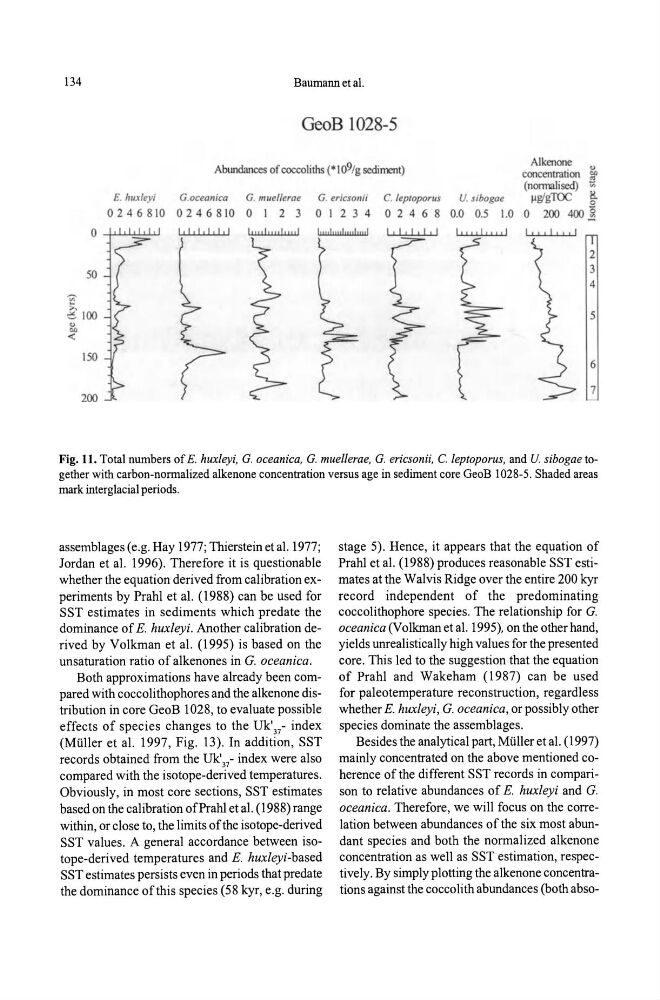
Fig. II. Total numbers of E. huxleyi, G. oceanica, G. muellerae, G. ericson ii, C. leptoporus, and U. sihogae together with carbon-normalized alkenone concentration versus age in sediment core GeoB 1028-5. Shaded areas
mark interglacial periods.
assemblages (e.g. Hay 1977; Thierstein et al. 1977;
Jordan et al. 1996). Therefore it is questionable
whether the equation derived from calibration experiments by Prahl et al. (1988) can be used for
SST estimates in sediments which predate the
dominance of E. huxleyi. Another calibration derived by Volkman et al. (1995) is based on the
unsaturation ratio of alkenones in G. oceanica.
Both approximations have already been compared with coccolithophores and the alkenone distribution in core GeoB 1028, to evaluate possible
effects of species changes to the Uk'37- index
(Muller et al. 1997, Fig. 13). In addition, SST
records obtained from the Uk'37- index were also
compared with the isotope-derived temperatures.
Obviously, in most core sections, SST estimates
based on the calibration of Prahl et al. (\ 988) range
within, or close to, the limits of the isotope-derived
SST values. A general accordance between isotope-derived temperatures and E. huxleyi-based
SST estimates persists even in periods that predate
the dominance ofthis species (58 kyr, e.g. during
stage 5). Hence, it appears that the equation of
Prahl et al. (1988) produces reasonable SST estimates at the Walvis Ridge over the entire 200 kyr
record independent of the predominating
coccolithophore species. The relationship for G.
oceanica (Volkman et al. 1995), on the other hand,
yields unrealistically high values for the presented
core. This led to the suggestion that the equation
of Prahl and Wakeham (1987) can be used
for paleotemperature reconstruction, regardless
whether E. huxleyi, G. oceanica, or possibly other
species dominate the assemblages.
Besides the analytical part, Muller et al. (1997)
mainly concentrated on the above mentioned coherence of the different SST records in comparison to relative abundances of E. huxleyi and G.
oceanica. Therefore, we will focus on the correlation between abundances of the six most abundant species and both the normalized alkenone
concentration as well as SST estimation, respectively. By simply plotting the alkenone concentrations against the coccolith abundances (both abso-
Baumann et al.
GeoB 1028-5
Abundances of coccoliths (°1 09/g sediment)
Alkenone
C)
concentration ~
(normalised) •.
E. huxley;
G.oceanica
G. muellerae
G. ericson;; C. leploporus
U. sibogae
IlglgTOC
~
o 2 4 6 810 0 2 4 6 810 0 I 2 3 o I 2 3 4 0 2 4 6 8 0.0 0.5 1.0 o 200 400.§
50
~
>.
~IOO
C)
co
<
ISO
200
Id,I , l d "
Fig. II. Total numbers of E. huxleyi, G. oceanica, G. muellerae, G. ericson ii, C. leptoporus, and U. sihogae together with carbon-normalized alkenone concentration versus age in sediment core GeoB 1028-5. Shaded areas
mark interglacial periods.
assemblages (e.g. Hay 1977; Thierstein et al. 1977;
Jordan et al. 1996). Therefore it is questionable
whether the equation derived from calibration experiments by Prahl et al. (1988) can be used for
SST estimates in sediments which predate the
dominance of E. huxleyi. Another calibration derived by Volkman et al. (1995) is based on the
unsaturation ratio of alkenones in G. oceanica.
Both approximations have already been compared with coccolithophores and the alkenone distribution in core GeoB 1028, to evaluate possible
effects of species changes to the Uk'37- index
(Muller et al. 1997, Fig. 13). In addition, SST
records obtained from the Uk'37- index were also
compared with the isotope-derived temperatures.
Obviously, in most core sections, SST estimates
based on the calibration of Prahl et al. (\ 988) range
within, or close to, the limits of the isotope-derived
SST values. A general accordance between isotope-derived temperatures and E. huxleyi-based
SST estimates persists even in periods that predate
the dominance ofthis species (58 kyr, e.g. during
stage 5). Hence, it appears that the equation of
Prahl et al. (1988) produces reasonable SST estimates at the Walvis Ridge over the entire 200 kyr
record independent of the predominating
coccolithophore species. The relationship for G.
oceanica (Volkman et al. 1995), on the other hand,
yields unrealistically high values for the presented
core. This led to the suggestion that the equation
of Prahl and Wakeham (1987) can be used
for paleotemperature reconstruction, regardless
whether E. huxleyi, G. oceanica, or possibly other
species dominate the assemblages.
Besides the analytical part, Muller et al. (1997)
mainly concentrated on the above mentioned coherence of the different SST records in comparison to relative abundances of E. huxleyi and G.
oceanica. Therefore, we will focus on the correlation between abundances of the six most abundant species and both the normalized alkenone
concentration as well as SST estimation, respectively. By simply plotting the alkenone concentrations against the coccolith abundances (both abso-