

122
Baumann et al.
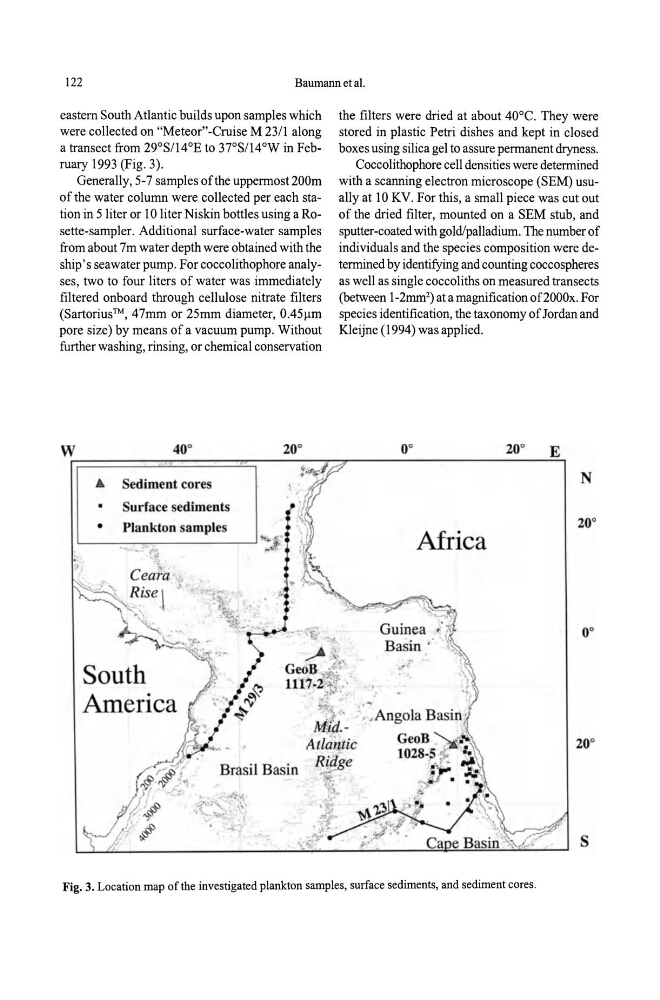
eastern South Atlantic builds upon samples which
were collected on "Meteor"-Cruise M 2311 along
a transect from 29°SI14°E to 37°S/ 14°W in February 1993 (Fig. 3).
Generally, 5-7 samples ofthe uppermost 200m
of the water column were collected per each station in 5 liter or 10 liter Niskin bottles using a Rosette-sampler. Additional surface-water samples
from about 7m water depth were obtained with the
ship's seawater pump. For coccolithophore analyses, two to four liters of water was immediately
filtered onboard through cellulose nitrate filters
(Sartorius™, 47mm or 25mm diameter, OA5J.lm
pore size) by means of a vacuum pump. Without
further washing, rinsing, or chemical conservation
W
40°
20°
... Sediment cores
Surface sediments
• Plankton samples
~
~ .- :.~
South
the filters were dried at about 40°C. They were
stored in plastic Petri dishes and kept in closed
boxes using silica gel to assure permanent dryness.
Coccolithophore cell densities were determined
with a scanning electron microscope (SEM) usually at 10 KV. For this, a small piece was cut out
of the dried filter, mounted on a SEM stub, and
sputter-coated with gold/palladium. The number of
individuals and the species composition were determined by identifying and counting coccospheres
as well as single coccoliths on measured transects
(between 1-2mm2) at a magnification of2000x. For
species identification, the taxonomy of Jordan and
Kleijne (1994) was applied.
0°
20° E
N
20°
Africa
Mid. -
Atlantic
Rid' e
s
Fig. 3. Location map of the investigated plankton samples, surface sediments, and sediment cores.
Baumann et al.
eastern South Atlantic builds upon samples which
were collected on "Meteor"-Cruise M 2311 along
a transect from 29°SI14°E to 37°S/ 14°W in February 1993 (Fig. 3).
Generally, 5-7 samples ofthe uppermost 200m
of the water column were collected per each station in 5 liter or 10 liter Niskin bottles using a Rosette-sampler. Additional surface-water samples
from about 7m water depth were obtained with the
ship's seawater pump. For coccolithophore analyses, two to four liters of water was immediately
filtered onboard through cellulose nitrate filters
(Sartorius™, 47mm or 25mm diameter, OA5J.lm
pore size) by means of a vacuum pump. Without
further washing, rinsing, or chemical conservation
W
40°
20°
... Sediment cores
Surface sediments
• Plankton samples
~
~ .- :.~
South
the filters were dried at about 40°C. They were
stored in plastic Petri dishes and kept in closed
boxes using silica gel to assure permanent dryness.
Coccolithophore cell densities were determined
with a scanning electron microscope (SEM) usually at 10 KV. For this, a small piece was cut out
of the dried filter, mounted on a SEM stub, and
sputter-coated with gold/palladium. The number of
individuals and the species composition were determined by identifying and counting coccospheres
as well as single coccoliths on measured transects
(between 1-2mm2) at a magnification of2000x. For
species identification, the taxonomy of Jordan and
Kleijne (1994) was applied.
0°
20° E
N
20°
Africa
Mid. -
Atlantic
Rid' e
s
Fig. 3. Location map of the investigated plankton samples, surface sediments, and sediment cores.