

Coccolithophores as Indicators of Ocean Water Masses
121
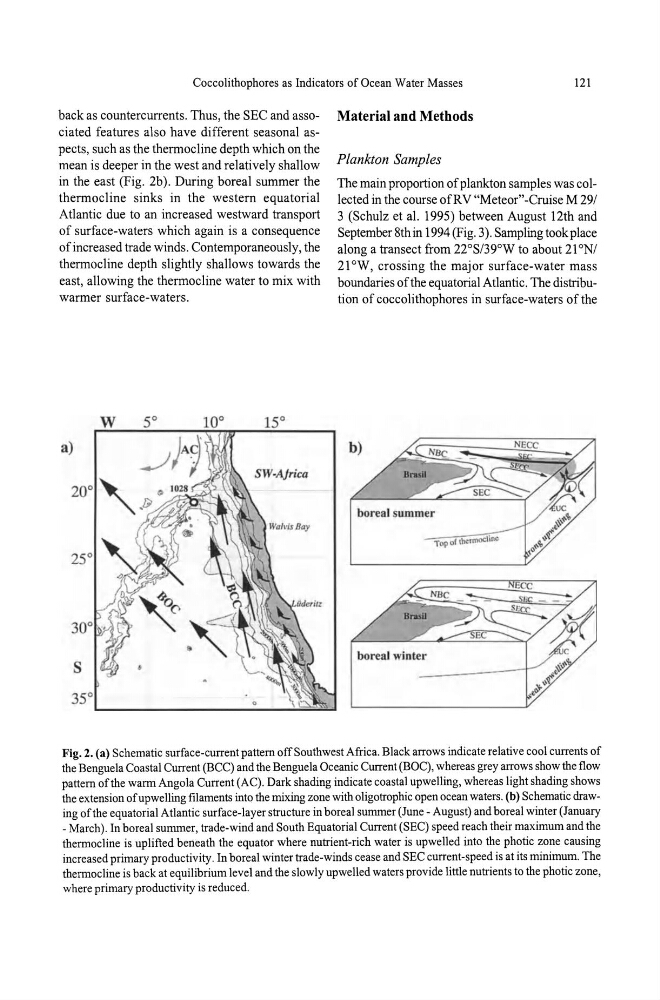
back as countercurrents. Thus, the SEC and associated features also have different seasonal aspects, such as the thermocline depth which on the
mean is deeper in the west and relatively shallow
in the east (Fig. 2b) . During boreal summer the
thermocline sinks in the western equatorial
Atlantic due to an increased westward transport
of surface-waters which again is a consequence
of increased trade winds. Contemporaneously, the
thermocline depth slightly shallows towards the
east, allowing the thermocline water to mix with
warmer surface-waters.
w
a)
s
Material and Methods
Plankton Samples
The main proportion of plankton samples was collected in the course ofRV "Meteor"-Cruise M 29/
3 (Schulz et al. 1995) between August 12th and
September 8th in 1994 (Fig. 3). Sampling took place
along a transect from 22°S/39°W to about 21 oN!
21 oW, crossing the major surface-water mass
boundaries of the equatorial Atlantic. The distribution of coccolithophores in surface-waters of the
Top of thermOCline
Fig. 2. (a) Schematic surface-current pattern off Southwest Africa. Black arrows indicate relative cool currents of
the Benguela Coastal Current (BCC) and the Benguela Oceanic Current (BOC), whereas grey arrows show the flow
pattern of the warm Angola Current (AC). Dark shading indicate coastal upwelling, whereas light shading shows
the extension of upwelling filaments into the mixing zone with oligotrophic open ocean waters. (b) Schematic drawing ofthe equatorial Atlantic surface-layer structure in boreal summer (June - August) and boreal winter (January
- March). In boreal summer, trade-wind and South Equatorial Current (SEC) speed reach their maximum and the
thermocline is uplifted beneath the equator where nutrient-rich water is upwelled into the photic zone causing
increased primary productivity. In boreal winter trade-winds cease and SEC current-speed is at its minimum. The
thermocline is back at equilibrium level and the slowly upwelled waters provide little nutrients to the photic zone,
where primary productivity is reduced.
121
back as countercurrents. Thus, the SEC and associated features also have different seasonal aspects, such as the thermocline depth which on the
mean is deeper in the west and relatively shallow
in the east (Fig. 2b) . During boreal summer the
thermocline sinks in the western equatorial
Atlantic due to an increased westward transport
of surface-waters which again is a consequence
of increased trade winds. Contemporaneously, the
thermocline depth slightly shallows towards the
east, allowing the thermocline water to mix with
warmer surface-waters.
w
a)
s
Material and Methods
Plankton Samples
The main proportion of plankton samples was collected in the course ofRV "Meteor"-Cruise M 29/
3 (Schulz et al. 1995) between August 12th and
September 8th in 1994 (Fig. 3). Sampling took place
along a transect from 22°S/39°W to about 21 oN!
21 oW, crossing the major surface-water mass
boundaries of the equatorial Atlantic. The distribution of coccolithophores in surface-waters of the
Top of thermOCline
Fig. 2. (a) Schematic surface-current pattern off Southwest Africa. Black arrows indicate relative cool currents of
the Benguela Coastal Current (BCC) and the Benguela Oceanic Current (BOC), whereas grey arrows show the flow
pattern of the warm Angola Current (AC). Dark shading indicate coastal upwelling, whereas light shading shows
the extension of upwelling filaments into the mixing zone with oligotrophic open ocean waters. (b) Schematic drawing ofthe equatorial Atlantic surface-layer structure in boreal summer (June - August) and boreal winter (January
- March). In boreal summer, trade-wind and South Equatorial Current (SEC) speed reach their maximum and the
thermocline is uplifted beneath the equator where nutrient-rich water is upwelled into the photic zone causing
increased primary productivity. In boreal winter trade-winds cease and SEC current-speed is at its minimum. The
thermocline is back at equilibrium level and the slowly upwelled waters provide little nutrients to the photic zone,
where primary productivity is reduced.