

112
Kemle-von Mticke and Oberhansli
species
calcification depth
vital effect
main season in
remarks
(0/00)
flux
C. ruber (red)
0-30 ml, 0-30 m 2 , 0-25 m 3 o to -0.4 1 ,-0.35 3 ,
-0.5 4 ,
boreal summe~
max. frequency in the mixcd laye~,
austral, (Feb.max flux rate in June, min. in July,
-0.35 to _0.5 2
June), May-June
Aug. Jan 5
(SeptOc1.Dec.)5
N.dutertrei
30-70 m l ,25-75 m 2 ,
01, 04, _0.23, 02
boreal, Mar 3 ,
frequent in the thermocline, at the deep
- 30 m4, 0-75 m 3 , 30-40
austral, May-June,
chlorophyll maximum (DCM)4
m 6
(SeptOc1.)5
C. infloto
25-75 m 2 , 0-75 m 3
-0.23, 0 2 ,
borcal, Mar 3
prefers well mixed waters and lives in
austral, May,(Apr.the thermocline, if there is a DCM7,
Oc1.)5,
shows a high seasonality in its depth
distribution 2,7
C. crossofarmis
a) 250-355 J.lm,
a) 300 ml, 125-200 m2,
01,02
boreal, June 3 ,
G. crassa! dominates the fauna in
b) 425-500 J.lm
b) 100-150 m l
austral, May, JuneS May 7 , it reaches max. frequency in the
oxygen minum zone within the
SACW I
l(this work), 2(Ravelo and Fairbanks, 1992), 3(Deuser and Ross, 1989) , 4(Fairbanks et aI., 1982), 5(Barbara
Donner, University Bremen unpubl. data), 6(Thunell and Sautter, 1992), 7 (Ottens, 1992). Brackets indicate
minor flux maxima.
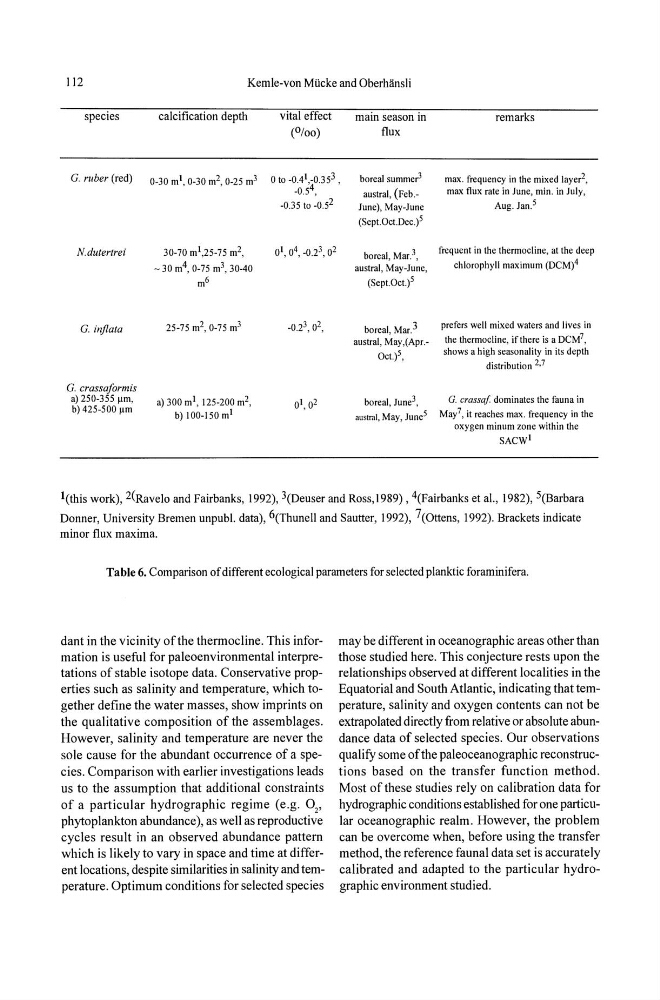
Table 6. Comparison of different ecological parameters for selected planktic foraminifera.
dant in the vicinity ofthe thermocline. This information is useful for paleoenvironmental interpretations of stable isotope data. Conservative properties such as salinity and temperature, which together define the water masses, show imprints on
the qualitative composition of the assemblages.
However, salinity and temperature are never the
sole cause for the abundant occurrence of a species. Comparison with earlier investigations leads
us to the assumption that additional constraints
of a particular hydrographic regime (e.g. 02'
phytoplankton abundance), as well as reproductive
cycles result in an observed abundance pattern
which is likely to vary in space and time at different locations, despite similarities in salinity and temperature. Optimum conditions for selected species
may be different in oceanographic areas other than
those studied here. This conjecture rests upon the
relationships observed at different localities in the
Equatorial and South Atlantic, indicating that temperature, salinity and oxygen contents can not be
extrapolated directly from relative or absolute abundance data of selected species. Our observations
qualify some ofthe paleoceanographic reconstructions based on the transfer function method.
Most of these studies rely on calibration data for
hydrographic conditions established for one particular oceanographic realm. However, the problem
can be overcome when, before using the transfer
method, the reference faunal data set is accurately
calibrated and adapted to the particular hydrographic environment studied.
Kemle-von Mticke and Oberhansli
species
calcification depth
vital effect
main season in
remarks
(0/00)
flux
C. ruber (red)
0-30 ml, 0-30 m 2 , 0-25 m 3 o to -0.4 1 ,-0.35 3 ,
-0.5 4 ,
boreal summe~
max. frequency in the mixcd laye~,
austral, (Feb.max flux rate in June, min. in July,
-0.35 to _0.5 2
June), May-June
Aug. Jan 5
(SeptOc1.Dec.)5
N.dutertrei
30-70 m l ,25-75 m 2 ,
01, 04, _0.23, 02
boreal, Mar 3 ,
frequent in the thermocline, at the deep
- 30 m4, 0-75 m 3 , 30-40
austral, May-June,
chlorophyll maximum (DCM)4
m 6
(SeptOc1.)5
C. infloto
25-75 m 2 , 0-75 m 3
-0.23, 0 2 ,
borcal, Mar 3
prefers well mixed waters and lives in
austral, May,(Apr.the thermocline, if there is a DCM7,
Oc1.)5,
shows a high seasonality in its depth
distribution 2,7
C. crossofarmis
a) 250-355 J.lm,
a) 300 ml, 125-200 m2,
01,02
boreal, June 3 ,
G. crassa! dominates the fauna in
b) 425-500 J.lm
b) 100-150 m l
austral, May, JuneS May 7 , it reaches max. frequency in the
oxygen minum zone within the
SACW I
l(this work), 2(Ravelo and Fairbanks, 1992), 3(Deuser and Ross, 1989) , 4(Fairbanks et aI., 1982), 5(Barbara
Donner, University Bremen unpubl. data), 6(Thunell and Sautter, 1992), 7 (Ottens, 1992). Brackets indicate
minor flux maxima.
Table 6. Comparison of different ecological parameters for selected planktic foraminifera.
dant in the vicinity ofthe thermocline. This information is useful for paleoenvironmental interpretations of stable isotope data. Conservative properties such as salinity and temperature, which together define the water masses, show imprints on
the qualitative composition of the assemblages.
However, salinity and temperature are never the
sole cause for the abundant occurrence of a species. Comparison with earlier investigations leads
us to the assumption that additional constraints
of a particular hydrographic regime (e.g. 02'
phytoplankton abundance), as well as reproductive
cycles result in an observed abundance pattern
which is likely to vary in space and time at different locations, despite similarities in salinity and temperature. Optimum conditions for selected species
may be different in oceanographic areas other than
those studied here. This conjecture rests upon the
relationships observed at different localities in the
Equatorial and South Atlantic, indicating that temperature, salinity and oxygen contents can not be
extrapolated directly from relative or absolute abundance data of selected species. Our observations
qualify some ofthe paleoceanographic reconstructions based on the transfer function method.
Most of these studies rely on calibration data for
hydrographic conditions established for one particular oceanographic realm. However, the problem
can be overcome when, before using the transfer
method, the reference faunal data set is accurately
calibrated and adapted to the particular hydrographic environment studied.