

The Distribution of Living Planktic Foraminifera in Relation to Southeast Atlantic Oceanography
109
8180oalcito using the 8 18 0-salinity relationship for
surface water from Craig and Gordon (1965).
Despite different treatments and data sources, the
calculations show good agreement (Fig. 15a-d).
The predicted 8180caloi,e difference between
surface and 500 m water depth is nearly 5 %0 in
the study area. The foraminifera reflect a 8180
range of only 3.7 %0 (Fig. 15a-d). This indicates
that calcification is restricted to the upper 300 m,
although 'living' individuals were found in deeper
water.
A clear succession of foraminifera is observable along the predicted 8180 profiles (Fig. 15). The
species G. ruber and G. sacculifer calcify in the
upper 30 m, N dutertrei and G. menardii somewhat deeper. Globigerinella siphonifera approaches equilibrium between 50 and 100 m,
whereas G. crassaformis and H. pelagica secrete the main portion of their shells below the
thermocline (100-300 m) (Figs. 2, 15).
The results show that the calcification depths
correspond very well to the observed frequency
maxIma of 'living' foraminifera (Fig. 6).
Globigerinoides ruber and G. sacculifer document an offset from the calcite equilibrium value
of surface water varying from 0 to -0.4 %0. This
is in accordance with previous studies reporting
"vital effects" ranging from -0.35 to -0.5 0/00
(Fairbanks eta!. 1982; Williams eta!. 1981; Deuser
1987; Table 6). To determine the calcification depth
of G. ruber and G. sacculifer we applied a
+0.4 %0 correction of the oxygen isotope values
shown in Fig. 15 for a better comparability with
these studies.
In contrast to previous sedimentary analyses
(Vincent and Berger 1981; Ravelo and Fairbanks;
1992), G. ruber (red) does not exhibit lighter oxygen isotope values than the 'white' variety ofG.
ruber (Fig. l5a, b). This should also be valid for
the entire year, because our sediment-trap results
(Table 6; ref. 5) document a flux maximum of both
phenotypes in the warm season. Thus the 8180
values of G. ruber (white) do not reflect the lower
surface-water temperature of the cold season as
reported from other ocean areas (Deuser and Ross
1989), but are similar to the values of G. ruber
(red) here.
Station
Size (I,m)
Depth (m)
Species
S 180 Foram.
GeoB 1404·5
500·600
0·50
G. men
-2,5535
GeoB 1404·5
500·600
50·100
G. men.
-0,8674
GeoB 1404·5
250·355
0·50
G. sac,
-2,4917
GeoB 1404·5
355·425
0-50
G. rub.r.
-2,4686
GeoB 1404-5
355-425
0-50
N. dul.
-1.8151
GeoB 1405-5
355-425
0-50
G.mh.w.
-2,5146
GeoB 1405-5
250-355
0-50
G. sac,
-2,403
GeoB 1405-5
425-500
0-50
N. dul.
-1.6502
GeoB 1405-5
500-600
50-100
G. men.
-0,7873
GeoB 1405-5
425-500
300-500
G. crass.
0.7873
GeoB 1406-5
250-355
0-50
G. sac.
-2,48
GeoB 1406-5
250-355
0-50
G.rub. w.
-2,288
GeoB 1406-5
425-500
0-50
G . .I'iph.
-0,2113
GeoB 1406-5
425-500
100-300
G. crass.
0,6423
GeoB 1406-5
250-355
300-500
G. crass.
1,288
GeoB 1407-5
250-355
0-50
G. ruh.r.
-2,0903
GeoB 1407-5
355-425
0-50
G . .I'ac.
-1,9989
GeoB 1407-5
500-600
0-50
N. JUl.
-1,2656
GeoB 1407-5
500-600
100-300
N. dUI.
-0,746
GeoB 1407-5
500-600
300-500
H. pel.
1,663
Species abbreviation see Tab. 2.
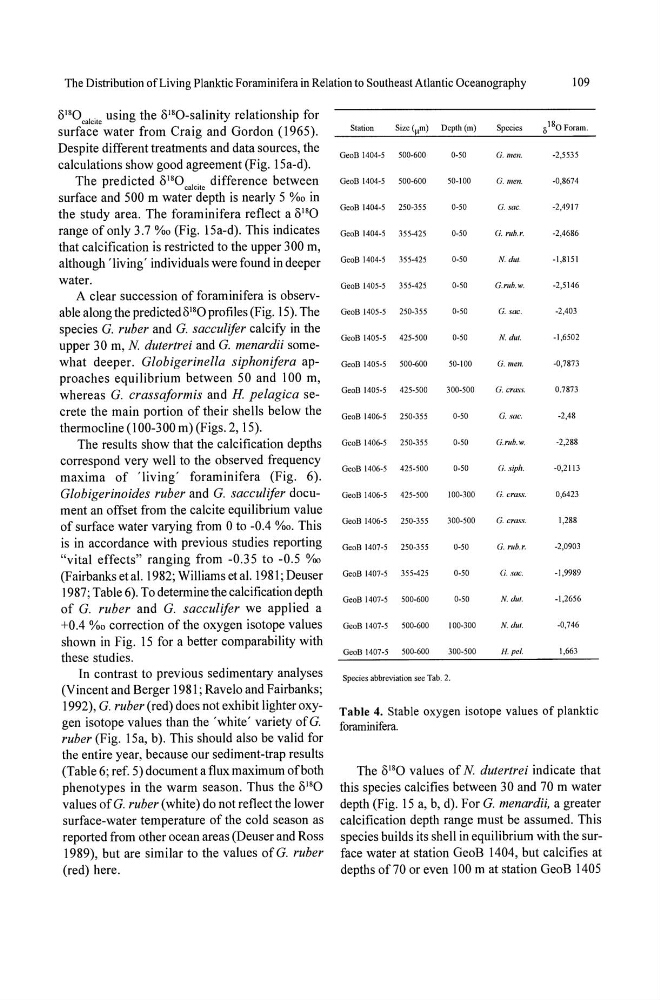
Table 4. Stable oxygen isotope values of planktic
foraminifera.
The 8180 values of N dutertrei indicate that
this species calcifies between 30 and 70 m water
depth (Fig. 15 a, b, d). For G. menardii, a greater
calcification depth range must be assumed. This
species builds its shell in equilibrium with the surface water at station GeoB 1404, but calcifies at
depths of 70 or even 100 m at station GeoB 1405
109
8180oalcito using the 8 18 0-salinity relationship for
surface water from Craig and Gordon (1965).
Despite different treatments and data sources, the
calculations show good agreement (Fig. 15a-d).
The predicted 8180caloi,e difference between
surface and 500 m water depth is nearly 5 %0 in
the study area. The foraminifera reflect a 8180
range of only 3.7 %0 (Fig. 15a-d). This indicates
that calcification is restricted to the upper 300 m,
although 'living' individuals were found in deeper
water.
A clear succession of foraminifera is observable along the predicted 8180 profiles (Fig. 15). The
species G. ruber and G. sacculifer calcify in the
upper 30 m, N dutertrei and G. menardii somewhat deeper. Globigerinella siphonifera approaches equilibrium between 50 and 100 m,
whereas G. crassaformis and H. pelagica secrete the main portion of their shells below the
thermocline (100-300 m) (Figs. 2, 15).
The results show that the calcification depths
correspond very well to the observed frequency
maxIma of 'living' foraminifera (Fig. 6).
Globigerinoides ruber and G. sacculifer document an offset from the calcite equilibrium value
of surface water varying from 0 to -0.4 %0. This
is in accordance with previous studies reporting
"vital effects" ranging from -0.35 to -0.5 0/00
(Fairbanks eta!. 1982; Williams eta!. 1981; Deuser
1987; Table 6). To determine the calcification depth
of G. ruber and G. sacculifer we applied a
+0.4 %0 correction of the oxygen isotope values
shown in Fig. 15 for a better comparability with
these studies.
In contrast to previous sedimentary analyses
(Vincent and Berger 1981; Ravelo and Fairbanks;
1992), G. ruber (red) does not exhibit lighter oxygen isotope values than the 'white' variety ofG.
ruber (Fig. l5a, b). This should also be valid for
the entire year, because our sediment-trap results
(Table 6; ref. 5) document a flux maximum of both
phenotypes in the warm season. Thus the 8180
values of G. ruber (white) do not reflect the lower
surface-water temperature of the cold season as
reported from other ocean areas (Deuser and Ross
1989), but are similar to the values of G. ruber
(red) here.
Station
Size (I,m)
Depth (m)
Species
S 180 Foram.
GeoB 1404·5
500·600
0·50
G. men
-2,5535
GeoB 1404·5
500·600
50·100
G. men.
-0,8674
GeoB 1404·5
250·355
0·50
G. sac,
-2,4917
GeoB 1404·5
355·425
0-50
G. rub.r.
-2,4686
GeoB 1404-5
355-425
0-50
N. dul.
-1.8151
GeoB 1405-5
355-425
0-50
G.mh.w.
-2,5146
GeoB 1405-5
250-355
0-50
G. sac,
-2,403
GeoB 1405-5
425-500
0-50
N. dul.
-1.6502
GeoB 1405-5
500-600
50-100
G. men.
-0,7873
GeoB 1405-5
425-500
300-500
G. crass.
0.7873
GeoB 1406-5
250-355
0-50
G. sac.
-2,48
GeoB 1406-5
250-355
0-50
G.rub. w.
-2,288
GeoB 1406-5
425-500
0-50
G . .I'iph.
-0,2113
GeoB 1406-5
425-500
100-300
G. crass.
0,6423
GeoB 1406-5
250-355
300-500
G. crass.
1,288
GeoB 1407-5
250-355
0-50
G. ruh.r.
-2,0903
GeoB 1407-5
355-425
0-50
G . .I'ac.
-1,9989
GeoB 1407-5
500-600
0-50
N. JUl.
-1,2656
GeoB 1407-5
500-600
100-300
N. dUI.
-0,746
GeoB 1407-5
500-600
300-500
H. pel.
1,663
Species abbreviation see Tab. 2.
Table 4. Stable oxygen isotope values of planktic
foraminifera.
The 8180 values of N dutertrei indicate that
this species calcifies between 30 and 70 m water
depth (Fig. 15 a, b, d). For G. menardii, a greater
calcification depth range must be assumed. This
species builds its shell in equilibrium with the surface water at station GeoB 1404, but calcifies at
depths of 70 or even 100 m at station GeoB 1405