

The Distribution of Living Planktic Foraminifera in Relation to Southeast Atlantic Oceanography
107
G. bulloides (from surface sediment)
%
55
0
50
C.
45
-'0/
••
,
35
(~)
30
25
-201
~
-30]
.5
••
S
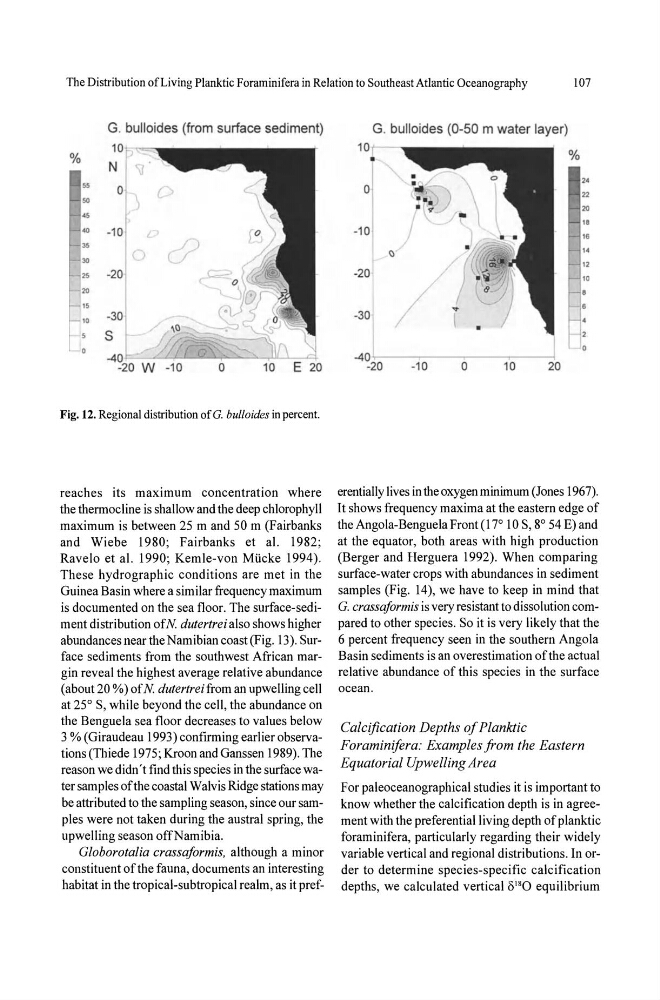
Fig. 12_ Regional distribution of G. bulloides in percent.
reaches its maximum concentration where
the thermocline is shallow and the deep chlorophyll
maximum is between 25 m and 50 m (Fairbanks
and Wiebe 1980; Fairbanks et al. 1982;
Ravelo et al. 1990; Kemle-von MUcke 1994).
These hydrographic conditions are met in the
Guinea Basin where a similar frequency maximum
is documented on the sea floor. The surface-sediment distribution ofN. dutertrei also shows higher
abundances near the Namibian coast (Fig. 13). Surface sediments from the southwest African margin reveal the highest average relative abundance
(about 20 %) of N. dutertrei from an upwelling cell
at 25° S, while beyond the cell, the abundance on
the Benguela sea floor decreases to values below
3 % (Giraudeau 1993) confirming earlier observations (Thiede 1975; Kroon and Ganssen 1989). The
reason we didn't find this species in the surfacewater samples ofthe coastal Walvis Ridge stations may
be attributed to the sampling season, since our samples were not taken during the austral spring, the
upwelling season off Namibia.
Globorotalia crassaformis, although a minor
constituent of the fauna, documents an interesting
habitat in the tropical-subtropical realm, as it prefG. bulloides (0-50 m water layer)
••
-1 0
.6
, / 1
••
'2
-20
/
\.~
••
-30
/
T .q
-40
-20
-10
0
erentially lives in the oxygen minimum (Jones 1967).
It shows frequency maxima at the eastern edge of
the Angola-Benguela Front (17° lOS, 8° 54 E) and
at the equator, both areas with high production
(Berger and Herguera 1992). When comparing
surface-water crops with abundances in sediment
samples (Fig. 14), we have to keep in mind that
G. crassaformis is very resistant to dissolution compared to other species. So it is very likely that the
6 percent frequency seen in the southern Angola
Basin sediments is an overestimation of the actual
relative abundance of this species in the surface
ocean.
Calcification Depths of Planktic
Foraminifera: Examples from the Eastern
Equatorial Upwelling Area
For paleoceanographical studies it is important to
know whether the calcification depth is in agreementwith the preferential living depth of planktic
foraminifera, particularly regarding their widely
variable vertical and regional distributions. In order to determine species-specific calcification
depths, we calculated vertical 8 18 0 equilibrium
107
G. bulloides (from surface sediment)
%
55
0
50
C.
45
-'0/
••
,
35
(~)
30
25
-201
~
-30]
.5
••
S
Fig. 12_ Regional distribution of G. bulloides in percent.
reaches its maximum concentration where
the thermocline is shallow and the deep chlorophyll
maximum is between 25 m and 50 m (Fairbanks
and Wiebe 1980; Fairbanks et al. 1982;
Ravelo et al. 1990; Kemle-von MUcke 1994).
These hydrographic conditions are met in the
Guinea Basin where a similar frequency maximum
is documented on the sea floor. The surface-sediment distribution ofN. dutertrei also shows higher
abundances near the Namibian coast (Fig. 13). Surface sediments from the southwest African margin reveal the highest average relative abundance
(about 20 %) of N. dutertrei from an upwelling cell
at 25° S, while beyond the cell, the abundance on
the Benguela sea floor decreases to values below
3 % (Giraudeau 1993) confirming earlier observations (Thiede 1975; Kroon and Ganssen 1989). The
reason we didn't find this species in the surfacewater samples ofthe coastal Walvis Ridge stations may
be attributed to the sampling season, since our samples were not taken during the austral spring, the
upwelling season off Namibia.
Globorotalia crassaformis, although a minor
constituent of the fauna, documents an interesting
habitat in the tropical-subtropical realm, as it prefG. bulloides (0-50 m water layer)
••
-1 0
.6
, / 1
••
'2
-20
/
\.~
••
-30
/
T .q
-40
-20
-10
0
erentially lives in the oxygen minimum (Jones 1967).
It shows frequency maxima at the eastern edge of
the Angola-Benguela Front (17° lOS, 8° 54 E) and
at the equator, both areas with high production
(Berger and Herguera 1992). When comparing
surface-water crops with abundances in sediment
samples (Fig. 14), we have to keep in mind that
G. crassaformis is very resistant to dissolution compared to other species. So it is very likely that the
6 percent frequency seen in the southern Angola
Basin sediments is an overestimation of the actual
relative abundance of this species in the surface
ocean.
Calcification Depths of Planktic
Foraminifera: Examples from the Eastern
Equatorial Upwelling Area
For paleoceanographical studies it is important to
know whether the calcification depth is in agreementwith the preferential living depth of planktic
foraminifera, particularly regarding their widely
variable vertical and regional distributions. In order to determine species-specific calcification
depths, we calculated vertical 8 18 0 equilibrium