

The Distribution of Living Planktic Foraminifera in Relation to Southeast Atlantic Oceanography
97
depth a
20
ind.lm'
40
60
80
100
M,J
o
20
40
60
80
100
~~ , M",~I
1000 "' 11=-"' - _________ --'.
o
20
40
60
80
100
~~~. ,.
I
MN 1404
1000 ....... --'-_ _ _ _ _ _ _ _ _ _ --'.
a
20
40
60
80
100
.. 1
50
100
150
20~r
MN 1407
400§"j
6 0 0 1 l _ J
800
1000
total ind.lm" >100 ~m living ind'/m' ind./m" = 100-128 ~m
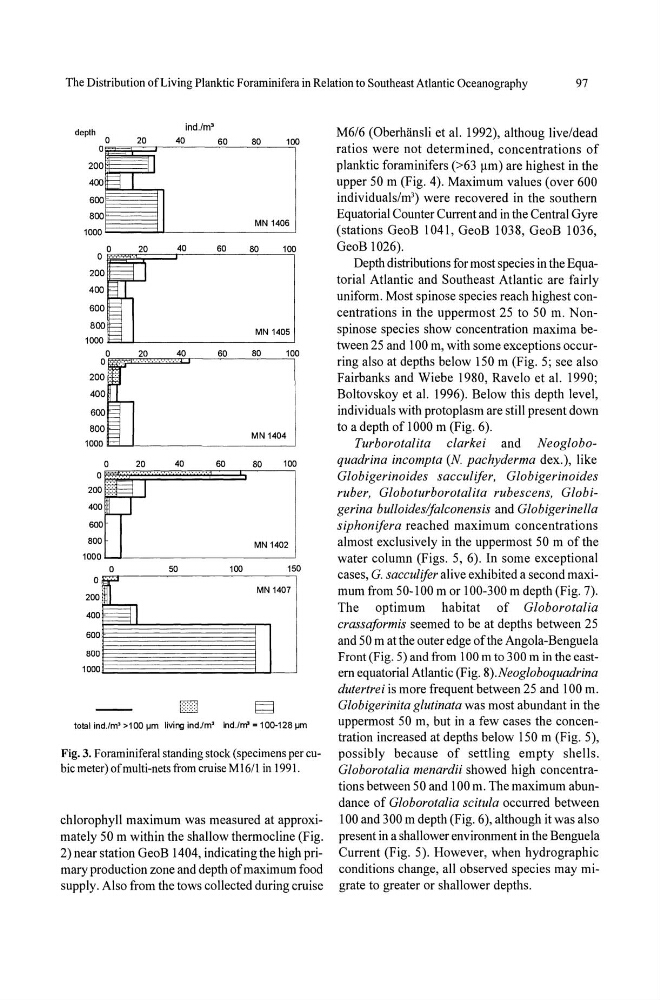
Fig_ 3. Foraminiferal standing stock (specimens per cubicmeter) of multi-nets from cruiseMl6/1 in 1991.
chlorophyll maximum was measured at approximately 50 m within the shallow thermocline (Fig.
2) near station GeoB 1404, indicating the high primary production zone and depth of maximum food
supply. Also from the tows collected during cruise
M6/6 (Oberhansli et al. 1992), althoug live/dead
ratios were not determined, concentrations of
planktic foraminifers (>63 !lm) are highest in the
upper 50 m (Fig. 4). Maximum values (over 600
individuals/m') were recovered in the southern
Equatorial Counter Current and in the Central Gyre
(stations GeoB 1041, GeoB 1038, GeoB 1036,
GeoB 1026).
Depth distributions for most species in the Equatorial Atlantic and Southeast Atlantic are fairly
uniform. Most spinose species reach highest concentrations in the uppermost 25 to 50 m. Nonspinose species show concentration maxima between 25 and 100 m, with some exceptions occurring also at depths below 150 m (Fig. 5; see also
Fairbanks and Wiebe 1980, Ravelo et al. 1990;
Boltovskoy et al. 1996). Below this depth level,
individuals with protoplasm are still present down
to a depth of 1000 m (Fig. 6).
Turborotalita clarkei and Neogloboquadrina incompta (N. pachyderma dex.), like
Globigerinoides sacculifer, Globigerinoides
ruber, Globoturborotalita rubescens, Globigerina bulloideslfalconensis and Globigerinella
siphonifera reached maximum concentrations
almost exclusively in the uppermost 50 m of the
water column (Figs. 5, 6). In some exceptional
cases, G. sacculifer alive exhibited a second maximum from 50-100 m or 100-300m depth (Fig. 7).
The optimum habitat of Globorotalia
crassaformis seemed to be at depths between 25
and 50 m at the outer edge of the Angola-Benguela
Front (Fig. 5) and from 100 m to 300 m in the eastern equatorial Atlantic (Fig. 8).Neogloboquadrina
dutertrei is more frequent between 25 and 100 m.
Globigerinita glutinata was most abundant in the
uppermost 50 m, but in a few cases the concentration increased at depths below 150 m (Fig. 5),
possibly because of settling empty shells.
Globorotalia menardii showed high concentrations between 50 and 100 m. The maximum abundance of Globorotalia scitula occurred between
100 and 300 m depth (Fig. 6), although it was also
present in a shallower environment in the Benguela
Current (Fig. 5). However, when hydrographic
conditions change, all observed species may migrate to greater or shallower depths.
97
depth a
20
ind.lm'
40
60
80
100
M,J
o
20
40
60
80
100
~~ , M",~I
1000 "' 11=-"' - _________ --'.
o
20
40
60
80
100
~~~. ,.
I
MN 1404
1000 ....... --'-_ _ _ _ _ _ _ _ _ _ --'.
a
20
40
60
80
100
.. 1
50
100
150
20~r
MN 1407
400§"j
6 0 0 1 l _ J
800
1000
total ind.lm" >100 ~m living ind'/m' ind./m" = 100-128 ~m
Fig_ 3. Foraminiferal standing stock (specimens per cubicmeter) of multi-nets from cruiseMl6/1 in 1991.
chlorophyll maximum was measured at approximately 50 m within the shallow thermocline (Fig.
2) near station GeoB 1404, indicating the high primary production zone and depth of maximum food
supply. Also from the tows collected during cruise
M6/6 (Oberhansli et al. 1992), althoug live/dead
ratios were not determined, concentrations of
planktic foraminifers (>63 !lm) are highest in the
upper 50 m (Fig. 4). Maximum values (over 600
individuals/m') were recovered in the southern
Equatorial Counter Current and in the Central Gyre
(stations GeoB 1041, GeoB 1038, GeoB 1036,
GeoB 1026).
Depth distributions for most species in the Equatorial Atlantic and Southeast Atlantic are fairly
uniform. Most spinose species reach highest concentrations in the uppermost 25 to 50 m. Nonspinose species show concentration maxima between 25 and 100 m, with some exceptions occurring also at depths below 150 m (Fig. 5; see also
Fairbanks and Wiebe 1980, Ravelo et al. 1990;
Boltovskoy et al. 1996). Below this depth level,
individuals with protoplasm are still present down
to a depth of 1000 m (Fig. 6).
Turborotalita clarkei and Neogloboquadrina incompta (N. pachyderma dex.), like
Globigerinoides sacculifer, Globigerinoides
ruber, Globoturborotalita rubescens, Globigerina bulloideslfalconensis and Globigerinella
siphonifera reached maximum concentrations
almost exclusively in the uppermost 50 m of the
water column (Figs. 5, 6). In some exceptional
cases, G. sacculifer alive exhibited a second maximum from 50-100 m or 100-300m depth (Fig. 7).
The optimum habitat of Globorotalia
crassaformis seemed to be at depths between 25
and 50 m at the outer edge of the Angola-Benguela
Front (Fig. 5) and from 100 m to 300 m in the eastern equatorial Atlantic (Fig. 8).Neogloboquadrina
dutertrei is more frequent between 25 and 100 m.
Globigerinita glutinata was most abundant in the
uppermost 50 m, but in a few cases the concentration increased at depths below 150 m (Fig. 5),
possibly because of settling empty shells.
Globorotalia menardii showed high concentrations between 50 and 100 m. The maximum abundance of Globorotalia scitula occurred between
100 and 300 m depth (Fig. 6), although it was also
present in a shallower environment in the Benguela
Current (Fig. 5). However, when hydrographic
conditions change, all observed species may migrate to greater or shallower depths.