

Part D | 33.2
750 Part D Offshore Technologies
hydrocarbons [33.13]. Initial spars were depth-limited
to 1300 m.
33.2.2 Floating Offshore Platforms
As was mentioned before, floating offshore platforms,
shown in Fig. 33.6 [33.16], consist of improved spars
and TLPs, semi-submersibles, floating production storage and off-loading units (FPSO), moored ship-type
platforms, and barges. In using these structures for water depths deeper than 1300 m, the previous limitation
on the bending stresses in marine conductors is removed by using large diameter conductor pipes with
increased wall thicknesses; the use of large diameter
pipes increases their fatigue lives 5 to 10 times [33.13].
The blow-out-preventer (BOP) stacks provided at the
top of the conductors have reduced lengths, along with
the stick-up length (viz., the distance between the ocean
bottom and the bottom of BOP stacks) of the conductors, to optimize the permitted stress levels. In addition,
buoyancy provided at riser joints is increased by using
syntactic foam elements with embedded micro glass or
ceramic spheres. Along with an increase of the tension
provided for riser strings, the risers are also provided
with strakes to minimize or suppress vortex-induced vibration stresses; moreover the riser joints are provided
with choke and kill lines made of titanium to minimize
corrosion problems. These improvements have enabled
spar platforms and other floating structures to operate
efficiently at depths greater than 3000 m.
Floating production storage and off-loading (FPSO)
units may be semi-submersibles or ship-shaped ves10°W
5°W
5°E
10°E
15°E
0°
10°W
5°W
5°E
10°E
15°E
0°
60°N
60°N
55°N
55°N
50°N
50°N
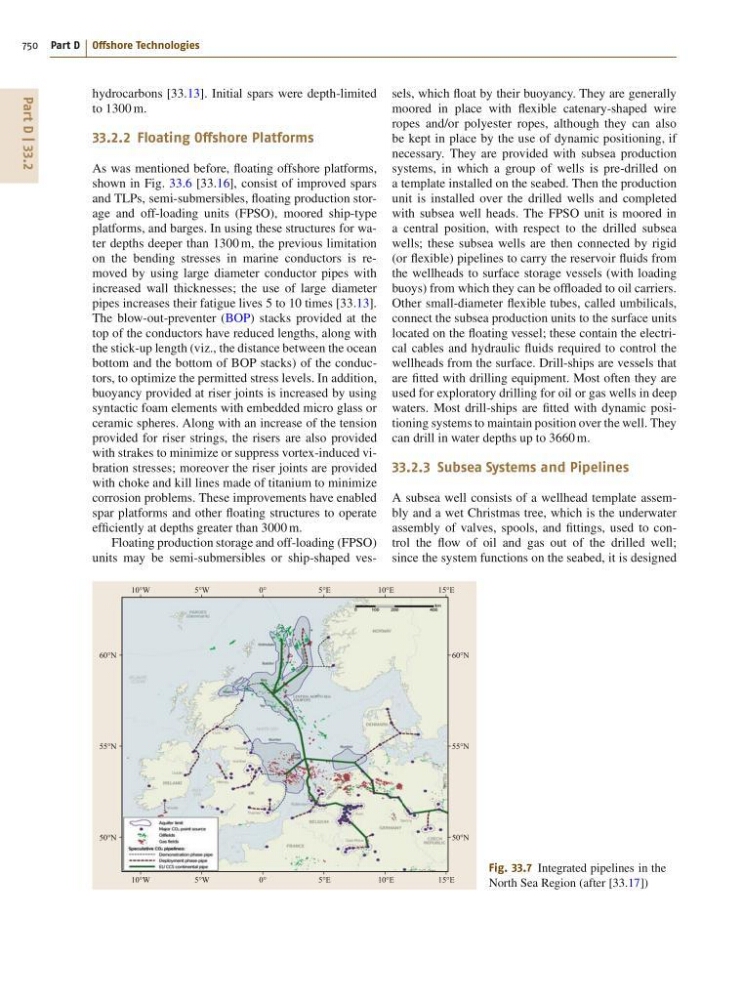
Fig. 33.7 Integrated pipelines in the
North Sea Region (after [33.17])
sels, which float by their buoyancy. They are generally
moored in place with flexible catenary-shaped wire
ropes and/or polyester ropes, although they can also
be kept in place by the use of dynamic positioning, if
necessary. They are provided with subsea production
systems, in which a group of wells is pre-drilled on
a template installed on the seabed. Then the production
unit is installed over the drilled wells and completed
with subsea well heads. The FPSO unit is moored in
a central position, with respect to the drilled subsea
wells; these subsea wells are then connected by rigid
(or flexible) pipelines to carry the reservoir fluids from
the wellheads to surface storage vessels (with loading
buoys) from which they can be offloaded to oil carriers.
Other small-diameter flexible tubes, called umbilicals,
connect the subsea production units to the surface units
located on the floating vessel; these contain the electrical cables and hydraulic fluids required to control the
wellheads from the surface. Drill-ships are vessels that
are fitted with drilling equipment. Most often they are
used for exploratory drilling for oil or gas wells in deep
waters. Most drill-ships are fitted with dynamic positioning systems to maintain position over the well. They
can drill in water depths up to 3660 m.
33.2.3 Subsea Systems and Pipelines
A subsea well consists of a wellhead template assembly and a wet Christmas tree, which is the underwater
assembly of valves, spools, and fittings, used to control the flow of oil and gas out of the drilled well;
since the system functions on the seabed, it is designed