

Offshore Platforms 33.2 Types of Offshore Platforms 747
Part D | 33.2
Brazil’s Campos Basin, and the Gulf of Mexico. Exploiting and transporting oil and gas reserves in the
harsh and inhospitable Arctic regions, containing nearly
30% of world’s undiscovered hydrocarbons, would require innovative structural development and management strategies [33.9].
33.2 Types of Offshore Platforms
At the present juncture, more than 9500 offshore platforms are being used worldwide, operating in water
depths ranging from 10 ft to nearly 10 000 ft. Topside
weights range from 5 to 50 000 t, producing oil, gas, or
both. Some of the major offshore oil and gas platforms,
used in the context of ocean oil and gas exploitation, are
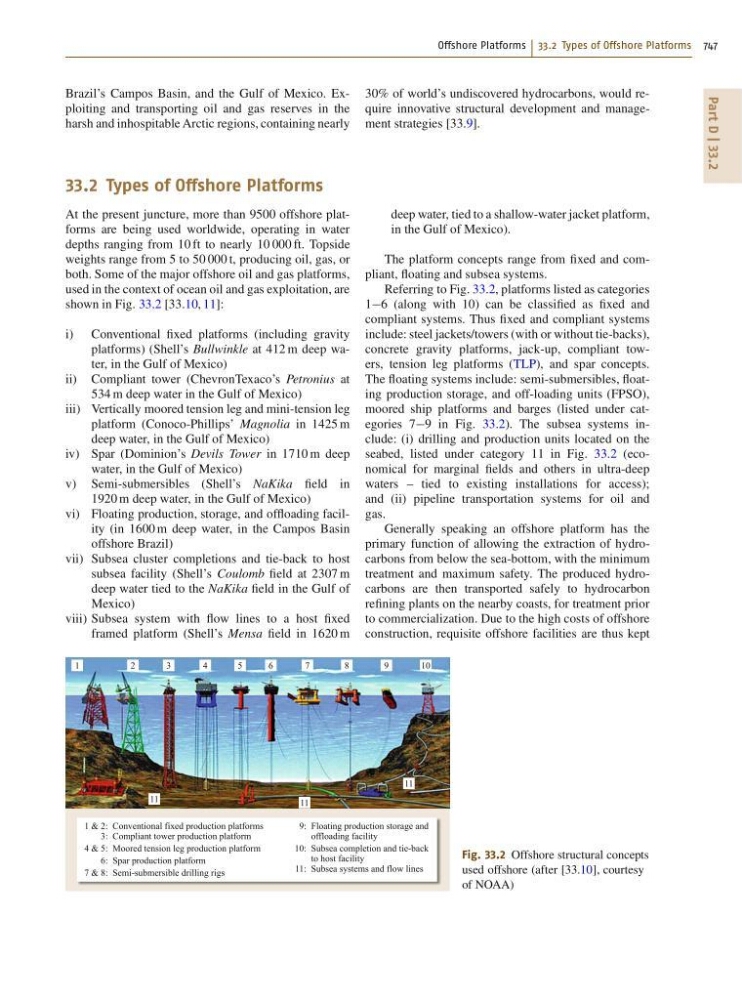
shown in Fig. 33.2 [33.10, 11]:
i) Conventional fixed platforms (including gravity
platforms) (Shell’s Bullwinkle at 412 m deep water, in the Gulf of Mexico)
ii) Compliant tower (ChevronTexaco’s Petronius at
534 m deep water in the Gulf of Mexico)
iii) Vertically moored tension leg and mini-tension leg
platform (Conoco-Phillips’ Magnolia in 1425 m
deep water, in the Gulf of Mexico)
iv) Spar (Dominion’s Devils Tower in 1710 m deep
water, in the Gulf of Mexico)
v) Semi-submersibles (Shell’s NaKika field in
1920 m deep water, in the Gulf of Mexico)
vi) Floating production, storage, and offloading facility (in 1600 m deep water, in the Campos Basin
offshore Brazil)
vii) Subsea cluster completions and tie-back to host
subsea facility (Shell’s Coulomb field at 2307 m
deep water tied to the NaKika field in the Gulf of
Mexico)
viii) Subsea system with flow lines to a host fixed
framed platform (Shell’s Mensa field in 1620 m
1 & 2: Conventional fixed production platforms
3: Compliant tower production platform
4 & 5: Moored tension leg production platform
6: Spar production platform
7 & 8: Semi-submersible drilling rigs
9: Floating production storage and
offloading facility
10: Subsea completion and tie-back
to host facility
11: Subsea systems and flow lines
1
2
3
4
5
6
7
8
9
1 0
11
11
11
Fig. 33.2 Offshore structural concepts
used offshore (after [33.10], courtesy
of NOAA)
deep water, tied to a shallow-water jacket platform,
in the Gulf of Mexico).
The platform concepts range from fixed and compliant, floating and subsea systems.
Referring to Fig. 33.2, platforms listed as categories
16 (along with 10) can be classified as fixed and
compliant systems. Thus fixed and compliant systems
include: steel jackets/towers (with or without tie-backs),
concrete gravity platforms, jack-up, compliant towers, tension leg platforms (TLP), and spar concepts.
The floating systems include: semi-submersibles, floating production storage, and off-loading units (FPSO),
moored ship platforms and barges (listed under categories 79 in Fig. 33.2). The subsea systems include: (i) drilling and production units located on the
seabed, listed under category 11 in Fig. 33.2 (economical for marginal fields and others in ultra-deep
waters – tied to existing installations for access);
and (ii) pipeline transportation systems for oil and
gas.
Generally speaking an offshore platform has the
primary function of allowing the extraction of hydrocarbons from below the sea-bottom, with the minimum
treatment and maximum safety. The produced hydrocarbons are then transported safely to hydrocarbon
refining plants on the nearby coasts, for treatment prior
to commercialization. Due to the high costs of offshore
construction, requisite offshore facilities are thus kept