

Elements of Physical Oceanography References 45
Part A | 2
The distribution of internal wave energy is determined by the nature of the different forcing mechanisms
including winds and interactions between the surface
tidal currents and bathymetry.
Temperature measurements made in the deep ocean
(e.g., off Southern California and in the South China
Sea) show significant concentrations of energy at
semidiurnal frequencies. These temperature fluctuations were due to internal waves of tidal frequency (i. e.,
internal tides) with vertical displacement amplitudes of
nearly 100 m and wavelengths of about 100 km. Evidence indicates that these energetic internal tides were
generated at nearby bathymetric slopes.
Widespread evidence indicates that these internal
tides represent an important component in the internal
wave field many places in the world’s oceans. In particular, subsequent interactions between (a) propagating
internal tides from multiple generation sites, (b) the normally variable and heterogeneous oceanic density field,
and (c) complex bottom bathymetry can lead to evolution and scattering that contribute to a general oceanic
internal waves field with a range in periods that range
between the local buoyancy (N) and inertial (f ) frequencies. Other contributors to the oceanic internal wave
field, include natural and well as ocean vehicle interactions with upper ocean stratification, with amplitudes
that depend on the specific energetics of their generation processes.
The internal tide is an importantly energetic component of the internal wave field – particularly in the
coastal ocean. One important and well-studied example of the internal wave being generated by surface (or
external) tidal currents impinging on the bathymetric
slopes is found on Stellwagen Bank in Massachusetts
·
·
·
·
·
·
·
·
·
·
·
·
·
·
·
·
0
0
0/2
33/2
22
100
200
300
400
2 cm/s
500
600
700
Depth (m)
Tidal period
Time (lunar min)
0
10
20
30
40
50
60
70
80
90
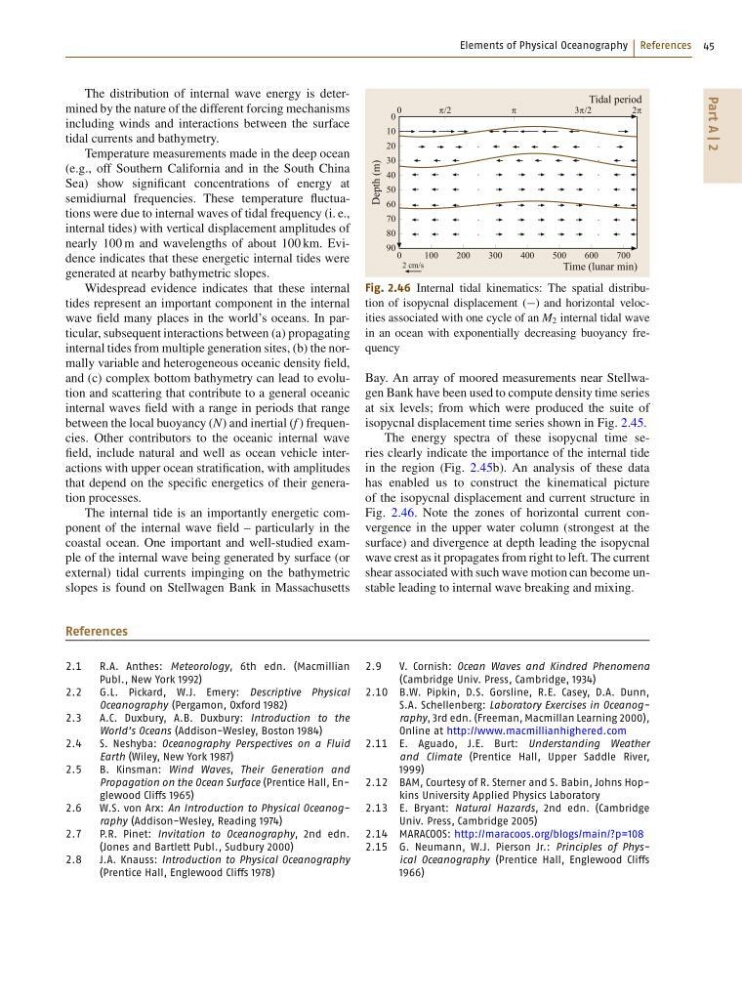
Fig. 2.46 Internal tidal kinematics: The spatial distribution of isopycnal displacement () and horizontal velocities associated with one cycle of an M 2 internal tidal wave
in an ocean with exponentially decreasing buoyancy frequency
Bay. An array of moored measurements near Stellwagen Bank have been used to compute density time series
at six levels; from which were produced the suite of
isopycnal displacement time series shown in Fig. 2.45.
The energy spectra of these isopycnal time series clearly indicate the importance of the internal tide
in the region (Fig. 2.45b). An analysis of these data
has enabled us to construct the kinematical picture
of the isopycnal displacement and current structure in
Fig. 2.46. Note the zones of horizontal current convergence in the upper water column (strongest at the
surface) and divergence at depth leading the isopycnal
wave crest as it propagates from right to left. The current
shear associated with such wave motion can become unstable leading to internal wave breaking and mixing.
References
2.1
R.A. Anthes: Meteorology, 6th edn. (Macmillian
Publ., New York 1992)
2.2
G.L. Pickard, W.J. Emery: Descriptive Physical
Oceanography (Pergamon, Oxford 1982)
2.3
A.C. Duxbury, A.B. Duxbury: Introduction to the
World’s Oceans (Addison-Wesley, Boston 1984)
2.4
S. Neshyba: Oceanography Perspectives on a Fluid
Earth (Wiley, New York 1987)
2.5
B. Kinsman: Wind Waves, Their Generation and
Propagation on the Ocean Surface (Prentice Hall, Englewood Cliffs 1965)
2.6
W.S. von Arx: An Introduction to Physical Oceanography (Addison-Wesley, Reading 1974)
2.7
P.R. Pinet: Invitation to Oceanography, 2nd edn.
(Jones and Bartlett Publ., Sudbury 2000)
2.8
J.A. Knauss: Introduction to Physical Oceanography
(Prentice Hall, Englewood Cliffs 1978)
2.9
V. Cornish: Ocean Waves and Kindred Phenomena
(Cambridge Univ. Press, Cambridge, 1934)
2.10 B.W. Pipkin, D.S. Gorsline, R.E. Casey, D.A. Dunn,
S.A. Schellenberg: Laboratory Exercises in Oceanography, 3rd edn. (Freeman, Macmillan Learning 2000),
Online at http://www.macmillianhighered.com
2.11 E. Aguado, J.E. Burt: Understanding Weather
and Climate (Prentice Hall, Upper Saddle River,
1999)
2.12 BAM, Courtesy of R. Sterner and S. Babin, Johns Hopkins University Applied Physics Laboratory
2.13 E. Bryant: Natural Hazards, 2nd edn. (Cambridge
Univ. Press, Cambridge 2005)
2.14 MARACOOS: http://maracoos.org/blogs/main/?p=108
2.15 G. Neumann, W.J. Pierson Jr.: Principles of Physical Oceanography (Prentice Hall, Englewood Cliffs
1966)
Part A | 2
The distribution of internal wave energy is determined by the nature of the different forcing mechanisms
including winds and interactions between the surface
tidal currents and bathymetry.
Temperature measurements made in the deep ocean
(e.g., off Southern California and in the South China
Sea) show significant concentrations of energy at
semidiurnal frequencies. These temperature fluctuations were due to internal waves of tidal frequency (i. e.,
internal tides) with vertical displacement amplitudes of
nearly 100 m and wavelengths of about 100 km. Evidence indicates that these energetic internal tides were
generated at nearby bathymetric slopes.
Widespread evidence indicates that these internal
tides represent an important component in the internal
wave field many places in the world’s oceans. In particular, subsequent interactions between (a) propagating
internal tides from multiple generation sites, (b) the normally variable and heterogeneous oceanic density field,
and (c) complex bottom bathymetry can lead to evolution and scattering that contribute to a general oceanic
internal waves field with a range in periods that range
between the local buoyancy (N) and inertial (f ) frequencies. Other contributors to the oceanic internal wave
field, include natural and well as ocean vehicle interactions with upper ocean stratification, with amplitudes
that depend on the specific energetics of their generation processes.
The internal tide is an importantly energetic component of the internal wave field – particularly in the
coastal ocean. One important and well-studied example of the internal wave being generated by surface (or
external) tidal currents impinging on the bathymetric
slopes is found on Stellwagen Bank in Massachusetts
·
·
·
·
·
·
·
·
·
·
·
·
·
·
·
·
0
0
0/2
33/2
22
100
200
300
400
2 cm/s
500
600
700
Depth (m)
Tidal period
Time (lunar min)
0
10
20
30
40
50
60
70
80
90
Fig. 2.46 Internal tidal kinematics: The spatial distribution of isopycnal displacement () and horizontal velocities associated with one cycle of an M 2 internal tidal wave
in an ocean with exponentially decreasing buoyancy frequency
Bay. An array of moored measurements near Stellwagen Bank have been used to compute density time series
at six levels; from which were produced the suite of
isopycnal displacement time series shown in Fig. 2.45.
The energy spectra of these isopycnal time series clearly indicate the importance of the internal tide
in the region (Fig. 2.45b). An analysis of these data
has enabled us to construct the kinematical picture
of the isopycnal displacement and current structure in
Fig. 2.46. Note the zones of horizontal current convergence in the upper water column (strongest at the
surface) and divergence at depth leading the isopycnal
wave crest as it propagates from right to left. The current
shear associated with such wave motion can become unstable leading to internal wave breaking and mixing.
References
2.1
R.A. Anthes: Meteorology, 6th edn. (Macmillian
Publ., New York 1992)
2.2
G.L. Pickard, W.J. Emery: Descriptive Physical
Oceanography (Pergamon, Oxford 1982)
2.3
A.C. Duxbury, A.B. Duxbury: Introduction to the
World’s Oceans (Addison-Wesley, Boston 1984)
2.4
S. Neshyba: Oceanography Perspectives on a Fluid
Earth (Wiley, New York 1987)
2.5
B. Kinsman: Wind Waves, Their Generation and
Propagation on the Ocean Surface (Prentice Hall, Englewood Cliffs 1965)
2.6
W.S. von Arx: An Introduction to Physical Oceanography (Addison-Wesley, Reading 1974)
2.7
P.R. Pinet: Invitation to Oceanography, 2nd edn.
(Jones and Bartlett Publ., Sudbury 2000)
2.8
J.A. Knauss: Introduction to Physical Oceanography
(Prentice Hall, Englewood Cliffs 1978)
2.9
V. Cornish: Ocean Waves and Kindred Phenomena
(Cambridge Univ. Press, Cambridge, 1934)
2.10 B.W. Pipkin, D.S. Gorsline, R.E. Casey, D.A. Dunn,
S.A. Schellenberg: Laboratory Exercises in Oceanography, 3rd edn. (Freeman, Macmillan Learning 2000),
Online at http://www.macmillianhighered.com
2.11 E. Aguado, J.E. Burt: Understanding Weather
and Climate (Prentice Hall, Upper Saddle River,
1999)
2.12 BAM, Courtesy of R. Sterner and S. Babin, Johns Hopkins University Applied Physics Laboratory
2.13 E. Bryant: Natural Hazards, 2nd edn. (Cambridge
Univ. Press, Cambridge 2005)
2.14 MARACOOS: http://maracoos.org/blogs/main/?p=108
2.15 G. Neumann, W.J. Pierson Jr.: Principles of Physical Oceanography (Prentice Hall, Englewood Cliffs
1966)