

Marine Outfalls 32.4 Hydraulic Analysis and Design 731
Part C | 32.4
a hydraulic break is usually required for certain process
schemes such as removal of entrained air or settlement
of suspended particles; refer to Sects. 32.4.5 and 32.4.6
for a discussion of these issues.
The range of piezometric heads in the outfall shaft
should first be considered in relation to the vertical
alignment of the outfall conduit and ground surface
level at the shaft location. Given the complexity associated with installing an outfall conduit, the key factors
in selecting its vertical alignment typically include suitability of ground conditions, constructability, cost, and
construction scheduling. For example, a trenched solution which follows site topography and bathymetry
is often desired as it can be the cheapest and easiest
to build. However, this alignment may cause adverse
hydraulic conditions such as hydraulic jumps and accumulation of air at localized high points. The potential
for such conditions should be assessed before finalizing
the outfall conduit alignment.
In general, the entrance to the outfall conduit should
be fully submerged for all flow rates and sea levels
in order to prevent operational instabilities. Otherwise,
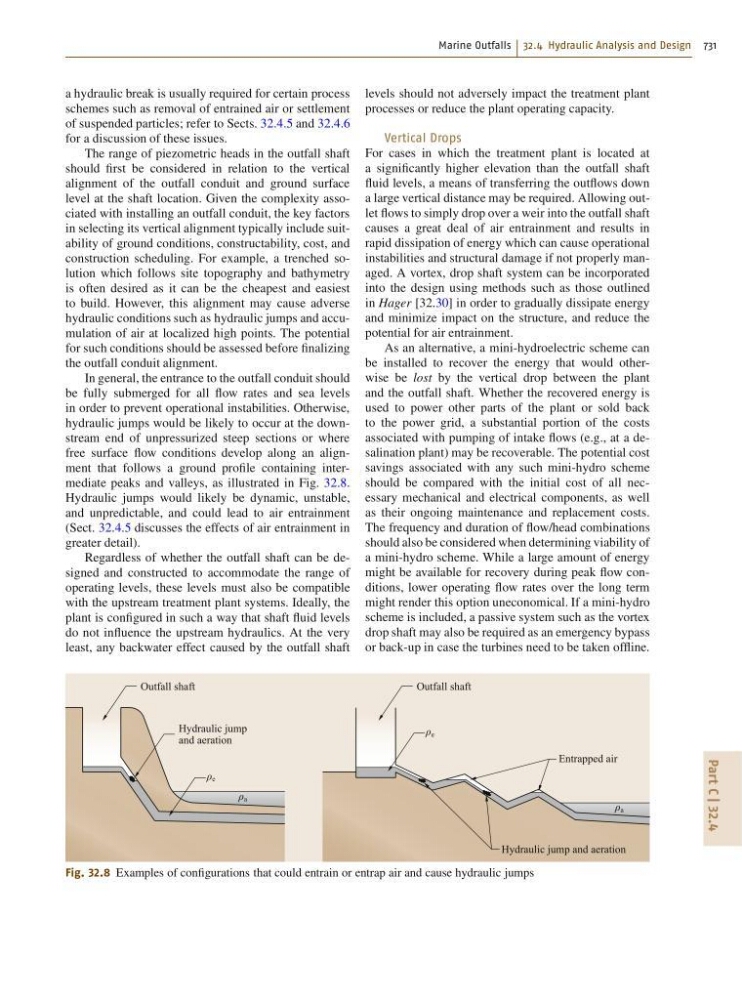
hydraulic jumps would be likely to occur at the downstream end of unpressurized steep sections or where
free surface flow conditions develop along an alignment that follows a ground profile containing intermediate peaks and valleys, as illustrated in Fig. 32.8.
Hydraulic jumps would likely be dynamic, unstable,
and unpredictable, and could lead to air entrainment
(Sect. 32.4.5 discusses the effects of air entrainment in
greater detail).
Regardless of whether the outfall shaft can be designed and constructed to accommodate the range of
operating levels, these levels must also be compatible
with the upstream treatment plant systems. Ideally, the
plant is configured in such a way that shaft fluid levels
do not influence the upstream hydraulics. At the very
least, any backwater effect caused by the outfall shaft
Hydraulic jump
and aeration
Hydraulic jump and aeration
Entrapped air
ρ e
ρ e
ρ a
ρ a
Outfall shaft
Outfall shaft
Fig. 32.8 Examples of configurations that could entrain or entrap air and cause hydraulic jumps
levels should not adversely impact the treatment plant
processes or reduce the plant operating capacity.
Vertical Drops
For cases in which the treatment plant is located at
a significantly higher elevation than the outfall shaft
fluid levels, a means of transferring the outflows down
a large vertical distance may be required. Allowing outlet flows to simply drop over a weir into the outfall shaft
causes a great deal of air entrainment and results in
rapid dissipation of energy which can cause operational
instabilities and structural damage if not properly managed. A vortex, drop shaft system can be incorporated
into the design using methods such as those outlined
in Hager [32.30] in order to gradually dissipate energy
and minimize impact on the structure, and reduce the
potential for air entrainment.
As an alternative, a mini-hydroelectric scheme can
be installed to recover the energy that would otherwise be lost by the vertical drop between the plant
and the outfall shaft. Whether the recovered energy is
used to power other parts of the plant or sold back
to the power grid, a substantial portion of the costs
associated with pumping of intake flows (e.g., at a desalination plant) may be recoverable. The potential cost
savings associated with any such mini-hydro scheme
should be compared with the initial cost of all necessary mechanical and electrical components, as well
as their ongoing maintenance and replacement costs.
The frequency and duration of flow/head combinations
should also be considered when determining viability of
a mini-hydro scheme. While a large amount of energy
might be available for recovery during peak flow conditions, lower operating flow rates over the long term
might render this option uneconomical. If a mini-hydro
scheme is included, a passive system such as the vortex
drop shaft may also be required as an emergency bypass
or back-up in case the turbines need to be taken offline.