

Port and Harbor Design 31.1 Port and Harbor Layout and Design 691
Part C | 31.1
Table 31.1 Example of vessel class
Vessel class
DWT [t]
Other capacity
measurement
Beam [m]
Length [m]
Draft [m]
Handymax
30 00050 000
–
27–
150200
10–
LNG a
60 000160 000C 75 000175 000 m 3
3548
260300
1012
Panamax
65 00080 000
5000 TEU
32:3
294:1
12
Post-Panamax
–
12 000 TEU
49
366
15
Suezmax
150 000
10 000 TEU
48
274
16
Capesize
150 000C
–
> 32
–
> 20
VLCC (very large crude carriers) 200 000300 000 –
58
330
22
ULCC (ultra large crude carriers) 300 00055 000
–
68
380
–
Malaccamax
–
–
60
470
24
ULCS (ultra large container ship) 200 000C
18 000 TEU
57
–
16:4
a Representing approximately 80% of world’s fleet in 2009
Panamax
4500
12 000
postPanamax
Capacity:
Containers (TEUs)
32 m (106′) 49 m (160′)
Dimensions:
Beam
294 m (965′) 366 m (1200′)
Length
12 m (39.5′) 15 m (50′)
Draft
post-Panamax
Draft: 15 m
post-Panamax
Draft: 15 m
Beam:
49 m
Panamax
Draft: 12 m
Beam:
32 m
Length of post-Panamax vessel: 366 m
Panamax
Draft: 12 m
Length of Panamax vessel: 294 m
post-Panamax
Beam: 49 m
Length of post-Panamax vessel: 366 m
Panamax
Beam: 32 m
Length of Panamax vessel: 294 m
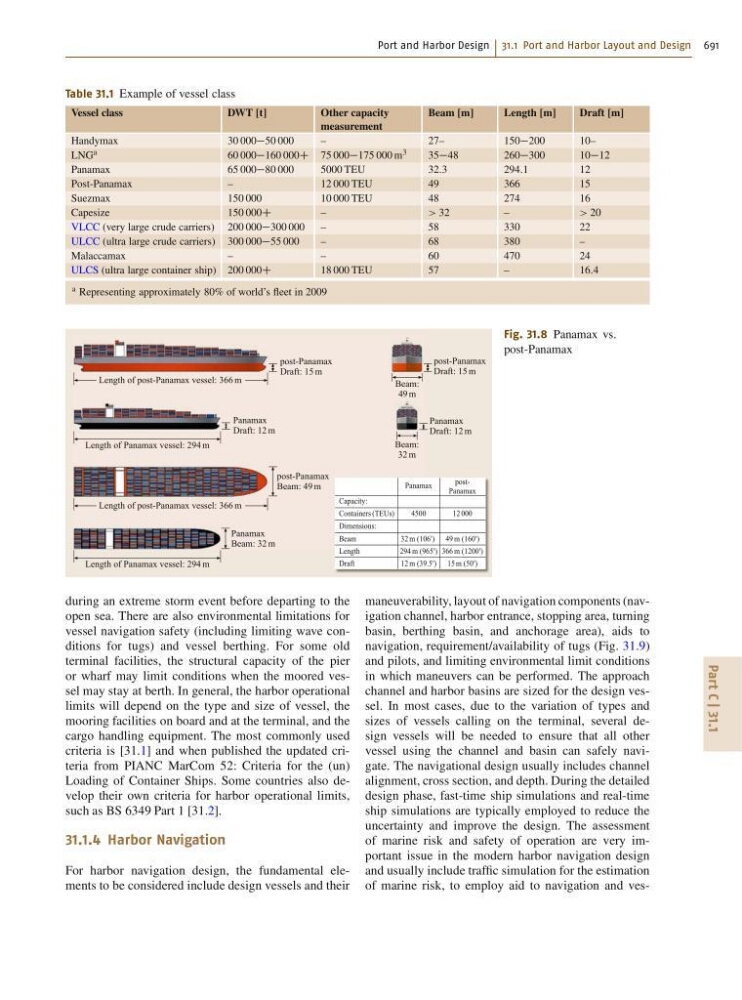
Fig. 31.8 Panamax vs.
post-Panamax
during an extreme storm event before departing to the
open sea. There are also environmental limitations for
vessel navigation safety (including limiting wave conditions for tugs) and vessel berthing. For some old
terminal facilities, the structural capacity of the pier
or wharf may limit conditions when the moored vessel may stay at berth. In general, the harbor operational
limits will depend on the type and size of vessel, the
mooring facilities on board and at the terminal, and the
cargo handling equipment. The most commonly used
criteria is [31.1] and when published the updated criteria from PIANC MarCom 52: Criteria for the (un)
Loading of Container Ships. Some countries also develop their own criteria for harbor operational limits,
such as BS 6349 Part 1 [31.2].
31.1.4 Harbor Navigation
For harbor navigation design, the fundamental elements to be considered include design vessels and their
maneuverability, layout of navigation components (navigation channel, harbor entrance, stopping area, turning
basin, berthing basin, and anchorage area), aids to
navigation, requirement/availability of tugs (Fig. 31.9)
and pilots, and limiting environmental limit conditions
in which maneuvers can be performed. The approach
channel and harbor basins are sized for the design vessel. In most cases, due to the variation of types and
sizes of vessels calling on the terminal, several design vessels will be needed to ensure that all other
vessel using the channel and basin can safely navigate. The navigational design usually includes channel
alignment, cross section, and depth. During the detailed
design phase, fast-time ship simulations and real-time
ship simulations are typically employed to reduce the
uncertainty and improve the design. The assessment
of marine risk and safety of operation are very important issue in the modern harbor navigation design
and usually include traffic simulation for the estimation
of marine risk, to employ aid to navigation and ves-