

Part C | 31.1
686 Part C Coastal Design
discuss the geometric layout of various harbor facilities
as well as the vessels that call on them. These factors
will dictate the design effort that coastal and ocean engineers will have to put in during the overall design of
such facilities and harbors. Figure 31.1 illustrates typical features found within a harbor and includes the
design of the following elements:
Navigation channel – A channel deep enough and
wide enough to allow for vessels to access the port
and pass if two-way traffic is required or demanded.
Turning basin – An area at the end of the navigation
channel that allows for the vessels to turn around
and maneuver into and out of the harbor. Typically,
the basin is at a preferred minimum, twice the length
of the largest vessels calling on the terminal.
Berthing basin – A dredged area adjacent to the
wharf structure that allows for the berthing and
mooring of vessels.
Berth – A dock structure with sufficient length and
lateral capacity to support berthing and mooring
loads. Principal types include:
– Wharf, quay, pier, or jetty structure: Wharves
or quays are typically oriented parallel to shore
while piers or jetties project out from shores
and include decks for loading and unloading
commodities. Terminology varies with locale.
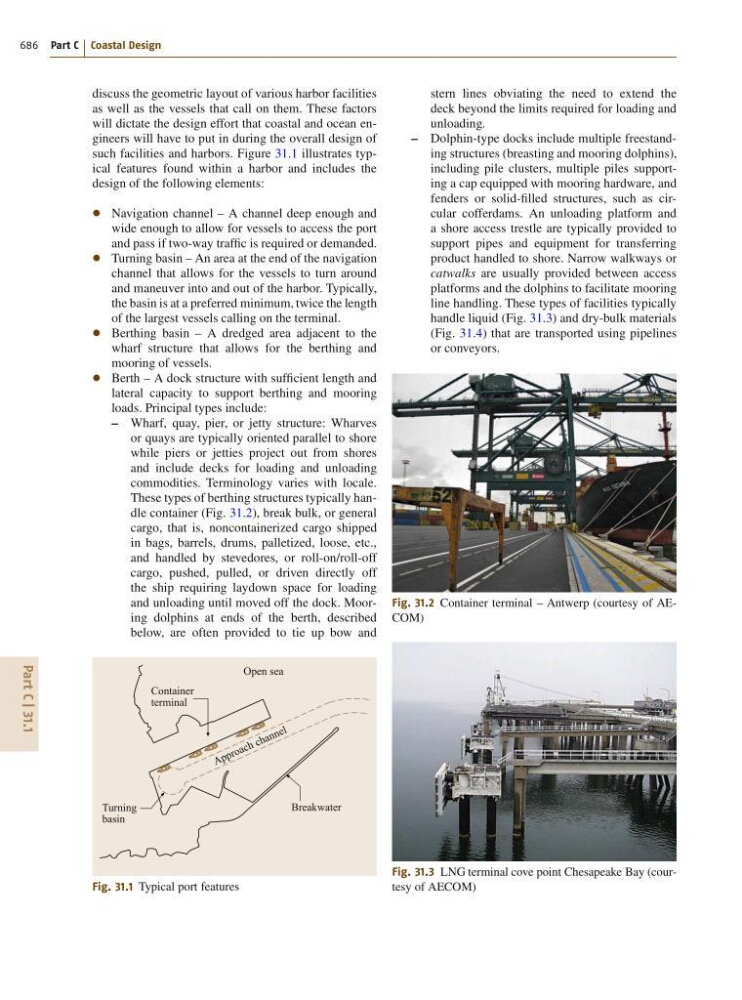
These types of berthing structures typically handle container (Fig. 31.2), break bulk, or general
cargo, that is, noncontainerized cargo shipped
in bags, barrels, drums, palletized, loose, etc.,
and handled by stevedores, or roll-on/roll-off
cargo, pushed, pulled, or driven directly off
the ship requiring laydown space for loading
and unloading until moved off the dock. Mooring dolphins at ends of the berth, described
below, are often provided to tie up bow and
Container
terminal
Turning
basin
Open sea
Breakwater
A p p r o a c h c h a n n e l
Fig. 31.1 Typical port features
stern lines obviating the need to extend the
deck beyond the limits required for loading and
unloading.
– Dolphin-type docks include multiple freestanding structures (breasting and mooring dolphins),
including pile clusters, multiple piles supporting a cap equipped with mooring hardware, and
fenders or solid-filled structures, such as circular cofferdams. An unloading platform and
a shore access trestle are typically provided to
support pipes and equipment for transferring
product handled to shore. Narrow walkways or
catwalks are usually provided between access
platforms and the dolphins to facilitate mooring
line handling. These types of facilities typically
handle liquid (Fig. 31.3) and dry-bulk materials
(Fig. 31.4) that are transported using pipelines
or conveyors.
Fig. 31.2 Container terminal – Antwerp (courtesy of AECOM)
Fig. 31.3 LNG terminal cove point Chesapeake Bay (courtesy of AECOM)