

Storm Hazard Mitigation Structures 30.2 Coastal Armoring Structures 673
Part C | 30.2
Life-Cycle Cost Analysis and Balanced Design
All breakwaters will receive some damage (i. e., rock
movements that are greater than that in the original
design and resulting shape changes that may expose
the vulnerable under-layers) when the wave heights are
greater than the design wave height. Repairs can be
made immediately or after the storm season ends when
favorably wave conditions return to the site. These
repairs are the maintenance costs to keep the breakwater shape functional. These maintenance costs are
probabilistic in that they are the product of the exceedance probability curve for the wave heights at the
site (Fig. 30.3) and the damage (fragility) curve as
found from the van der Meer formulation as discussed
above or actual model tests. These annual repair costs
must then be multiplied by the present worth factor
(pwf) to determine the total, present worth maintenance
costs for the design life of the project. (See any standard
engineering economic text for the formula to calculate the pwf for the design interest rate i and estimated
design-life T) The total life-cycle costs for the given design are then simply the sum of the initial costs and the
expected maintenance costs over the design life of the
project.
The above procedure should be repeated for a range
of design wave heights to determine the optimum or
balanced-design. Lower design wave heights will produce lower initial costs but higher, long-term maintenance costs. Very high design waves will increase the
initial construction costs and lower the maintenance
costs. Ideally, a classical, U-shaped, total cost curve
will result with the balanced-design being the lowest
total cost for the structure. This will be different than
the deterministic design as dictated by a selected recurrence interval (e.g., the 1% chance wave height) for the
design.
In many cases, annual repairs of damaged breakwaters are not carried out for a variety of reasons. Melby
and Kobayashi [30.67–70] have developed formulas
to estimate the progression of damage in time from
varying wave and water-level conditions for use in the
life-cycle analysis process. Their recent work [30.58]
extends these earlier efforts to include the nonlinear
wave momentum flux [30.43] as the forcing function
in the time-varying, S.t/, equation for damage progression. The second new variable, K s , discussed above is
needed to handle the initial adjustment of stones places
in unstable patterns. Other formulations for damage
progression are possible, for example, van der Meer
([30.71], who made the direct use of his static stability
formulations (30.21) and (30.22)). Space does not permit more details on this relatively new and interesting
topic.
Final profile
High water
Low water
20 t stones
a)
b)
c)
Armor
Core
High water
Low water
2–8 t stones
Armor
L
Core
High water
Low water
As built profile
Armor
Core
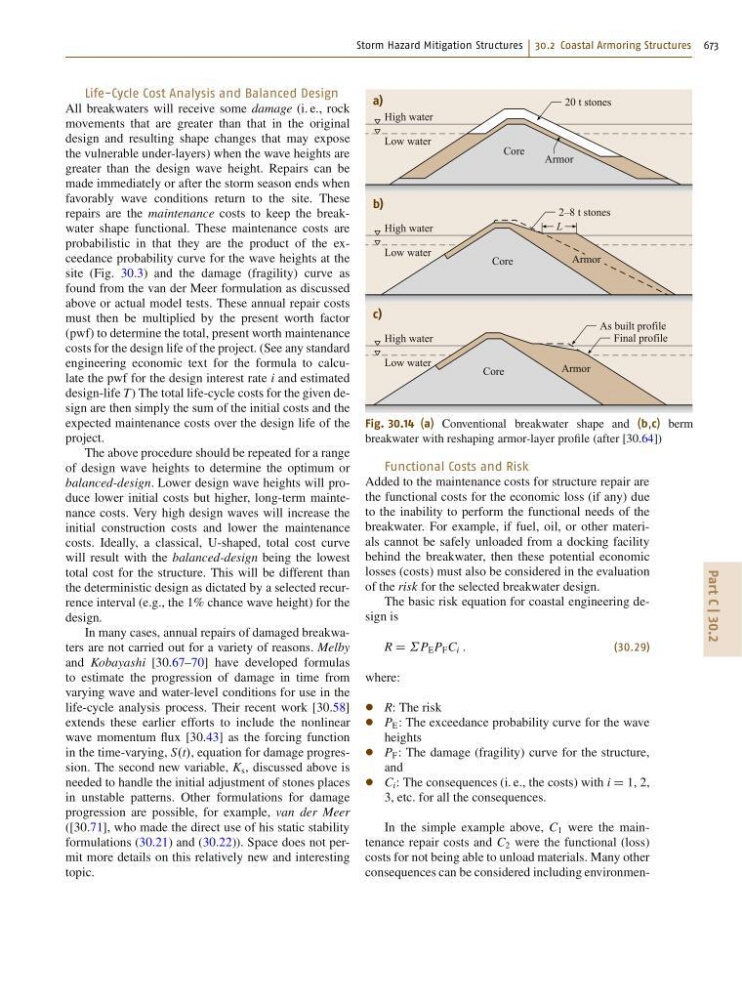
Fig. 30.14 (a) Conventional breakwater shape and (b,c) berm
breakwater with reshaping armor-layer profile (after [30.64])
Functional Costs and Risk
Added to the maintenance costs for structure repair are
the functional costs for the economic loss (if any) due
to the inability to perform the functional needs of the
breakwater. For example, if fuel, oil, or other materials cannot be safely unloaded from a docking facility
behind the breakwater, then these potential economic
losses (costs) must also be considered in the evaluation
of the risk for the selected breakwater design.
The basic risk equation for coastal engineering design is
R D ˙P E P F C i :
(30.29)
where:
R: The risk
P E : The exceedance probability curve for the wave
heights
P F : The damage (fragility) curve for the structure,
and
C i : The consequences (i. e., the costs) with i D 1, 2,
3, etc. for all the consequences.
In the simple example above, C 1 were the maintenance repair costs and C 2 were the functional (loss)
costs for not being able to unload materials. Many other
consequences can be considered including environmen-