

Storm Hazard Mitigation Structures 30.2 Coastal Armoring Structures 659
Part C | 30.2
Vertical walls
Rubble mounds
Sloping walls
Non-energy– absorbing
a)
Energy – absorbing
Jacksonville Beach
Palm Beach
Juniper Island
Miami Beach
Virginia Beach
Europe
Great Britian
Holland
Denmark
Germany
Europe
Belgium
Great Britian
Holland
Denmark
Germany
Great Britian
Spain
Great Britian
Portugal
Scandinavia
Great Britian
Holland
Germany
Great Britian
France
Scandinavia
Great Britian
Holland
Germany
Treated timber
Untreated logs
Concrete
slabs and
king-pile
Sheet piling
Cellular
sheet piling
Railroad ties
and steel
H-piles
Anchor pile
Anchor rod
Anchor rod
Anchor rod
Deadman anchor
Deadman anchor
Scare timber post
Sheet piling
Concrete
king-pile
Timber planking
Tongue-and groove
horizontal
concrete slabs
Granular fill
material with
concrete cap
Cellular sheet
piling
Steel H-pile
Railroad ties
Untreated logs
Untreated round
timber post
b)
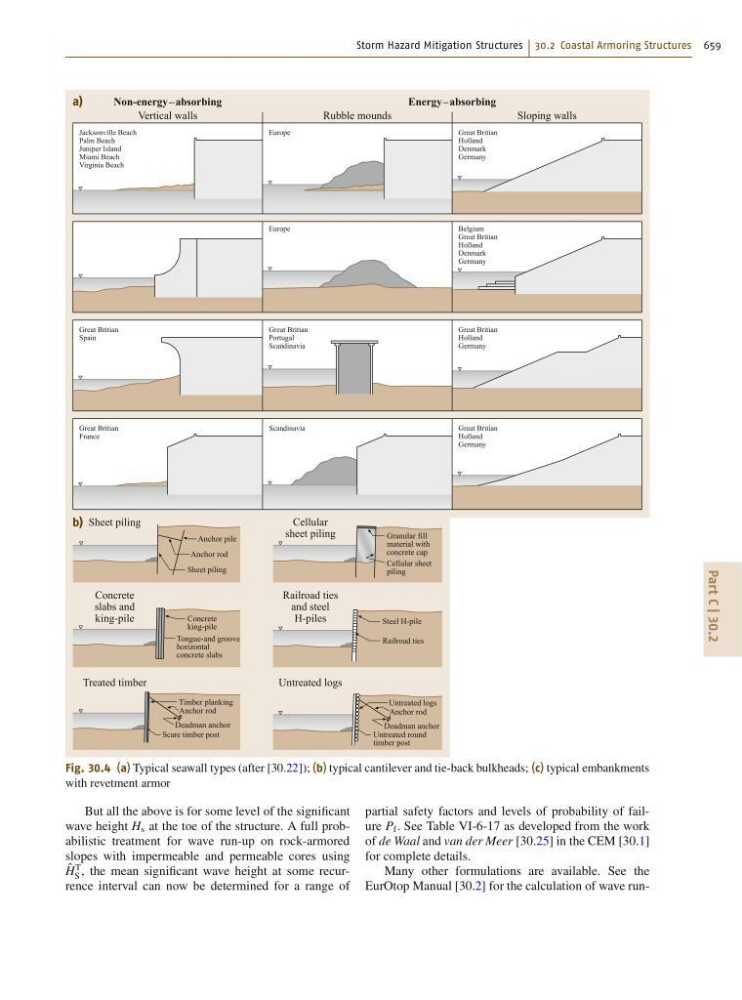
Fig. 30.4 (a) Typical seawall types (after [30.22]); (b) typical cantilever and tie-back bulkheads; (c) typical embankments
with revetment armor
But all the above is for some level of the significant
wave height H s at the toe of the structure. A full probabilistic treatment for wave run-up on rock-armored
slopes with impermeable and permeable cores using
O
H
T
S , the mean significant wave height at some recurrence interval can now be determined for a range of
partial safety factors and levels of probability of failure P f . See Table VI-6-17 as developed from the work
of de Waal and van der Meer [30.25] in the CEM [30.1]
for complete details.
Many other formulations are available. See the
EurOtop Manual [30.2] for the calculation of wave run-