

Part C | 30.1
654 Part C Coastal Design
Alternatives for
storm damage mitigation
(storm surge, sea level rise
coastal erosion)
Today
Adaptive responses:
Accommodation
Protection
Beach nourishment
Retreat
Reference
line
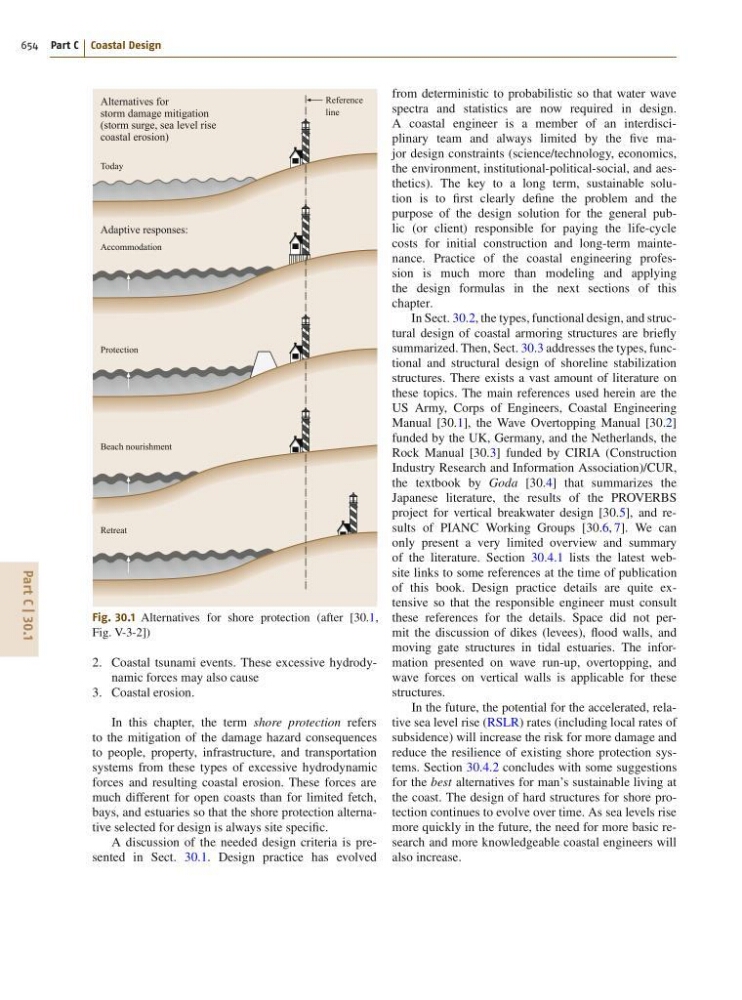
Fig. 30.1 Alternatives for shore protection (after [30.1,
Fig. V-3-2])
2. Coastal tsunami events. These excessive hydrodynamic forces may also cause
3. Coastal erosion.
In this chapter, the term shore protection refers
to the mitigation of the damage hazard consequences
to people, property, infrastructure, and transportation
systems from these types of excessive hydrodynamic
forces and resulting coastal erosion. These forces are
much different for open coasts than for limited fetch,
bays, and estuaries so that the shore protection alternative selected for design is always site specific.
A discussion of the needed design criteria is presented in Sect. 30.1. Design practice has evolved
from deterministic to probabilistic so that water wave
spectra and statistics are now required in design.
A coastal engineer is a member of an interdisciplinary team and always limited by the five major design constraints (science/technology, economics,
the environment, institutional-political-social, and aesthetics). The key to a long term, sustainable solution is to first clearly define the problem and the
purpose of the design solution for the general public (or client) responsible for paying the life-cycle
costs for initial construction and long-term maintenance. Practice of the coastal engineering profession is much more than modeling and applying
the design formulas in the next sections of this
chapter.
In Sect. 30.2, the types, functional design, and structural design of coastal armoring structures are briefly
summarized. Then, Sect. 30.3 addresses the types, functional and structural design of shoreline stabilization
structures. There exists a vast amount of literature on
these topics. The main references used herein are the
US Army, Corps of Engineers, Coastal Engineering
Manual [30.1], the Wave Overtopping Manual [30.2]
funded by the UK, Germany, and the Netherlands, the
Rock Manual [30.3] funded by CIRIA (Construction
Industry Research and Information Association)/CUR,
the textbook by Goda [30.4] that summarizes the
Japanese literature, the results of the PROVERBS
project for vertical breakwater design [30.5], and results of PIANC Working Groups [30.6, 7]. We can
only present a very limited overview and summary
of the literature. Section 30.4.1 lists the latest website links to some references at the time of publication
of this book. Design practice details are quite extensive so that the responsible engineer must consult
these references for the details. Space did not permit the discussion of dikes (levees), flood walls, and
moving gate structures in tidal estuaries. The information presented on wave run-up, overtopping, and
wave forces on vertical walls is applicable for these
structures.
In the future, the potential for the accelerated, relative sea level rise (RSLR) rates (including local rates of
subsidence) will increase the risk for more damage and
reduce the resilience of existing shore protection systems. Section 30.4.2 concludes with some suggestions
for the best alternatives for man’s sustainable living at
the coast. The design of hard structures for shore protection continues to evolve over time. As sea levels rise
more quickly in the future, the need for more basic research and more knowledgeable coastal engineers will
also increase.