

Modeling of Coastal Morphological Processes 28.2 Principles of Process-Based Morphodynamic Modeling 613
Part C | 28.2
28.2 Principles of Process-Based Morphodynamic Modeling
The term morphodynamic model is short for dynamic
morphological model, where morphological means the
study of shapes, in this case of the sea bed, and dynamic indicates that we consider how sea bed changes
as a result of processes acting on it. The basic flowchart
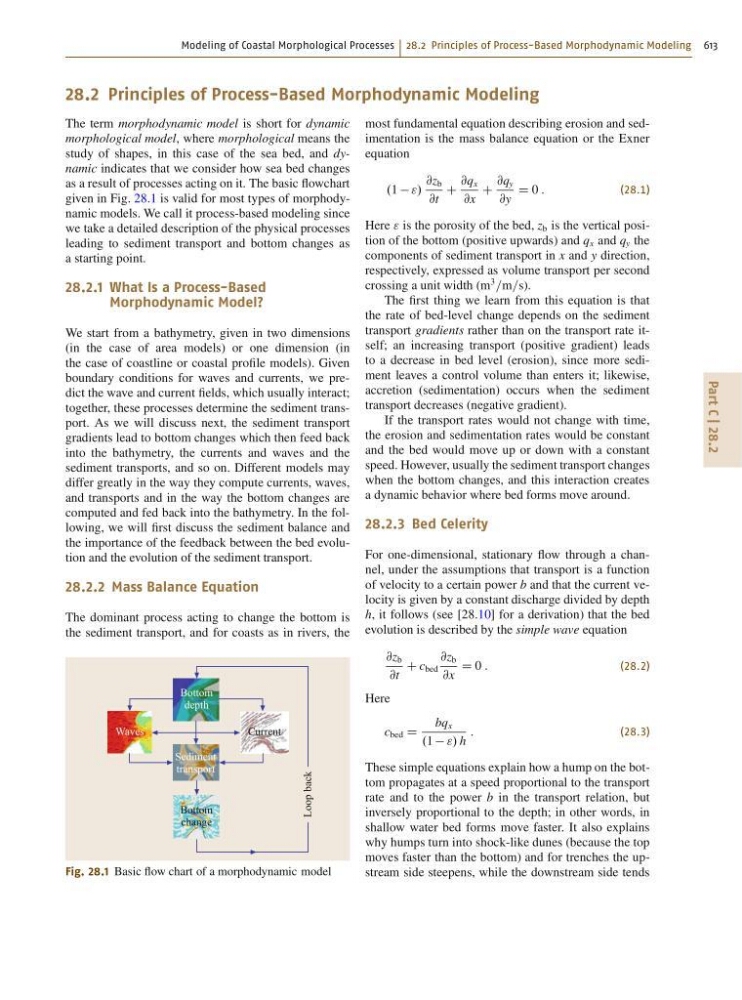
given in Fig. 28.1 is valid for most types of morphodynamic models. We call it process-based modeling since
we take a detailed description of the physical processes
leading to sediment transport and bottom changes as
a starting point.
28.2.1 What Is a Process-Based
Morphodynamic Model?
We start from a bathymetry, given in two dimensions
(in the case of area models) or one dimension (in
the case of coastline or coastal profile models). Given
boundary conditions for waves and currents, we predict the wave and current fields, which usually interact;
together, these processes determine the sediment transport. As we will discuss next, the sediment transport
gradients lead to bottom changes which then feed back
into the bathymetry, the currents and waves and the
sediment transports, and so on. Different models may
differ greatly in the way they compute currents, waves,
and transports and in the way the bottom changes are
computed and fed back into the bathymetry. In the following, we will first discuss the sediment balance and
the importance of the feedback between the bed evolution and the evolution of the sediment transport.
28.2.2 Mass Balance Equation
The dominant process acting to change the bottom is
the sediment transport, and for coasts as in rivers, the
Bottom
depth
Current
Waves
Sediment
transport
Bottom
change
Loop back
Fig. 28.1 Basic flow chart of a morphodynamic model
most fundamental equation describing erosion and sedimentation is the mass balance equation or the Exner
equation
.1 "/
@z b
@t
C
@q x
@x
C
@q y
@y
D 0 :
(28.1)
Here " is the porosity of the bed, z b is the vertical position of the bottom (positive upwards) and q x and q y the
components of sediment transport in x and y direction,
respectively, expressed as volume transport per second
crossing a unit width (m
3
=m=s).
The first thing we learn from this equation is that
the rate of bed-level change depends on the sediment
transport gradients rather than on the transport rate itself; an increasing transport (positive gradient) leads
to a decrease in bed level (erosion), since more sediment leaves a control volume than enters it; likewise,
accretion (sedimentation) occurs when the sediment
transport decreases (negative gradient).
If the transport rates would not change with time,
the erosion and sedimentation rates would be constant
and the bed would move up or down with a constant
speed. However, usually the sediment transport changes
when the bottom changes, and this interaction creates
a dynamic behavior where bed forms move around.
28.2.3 Bed Celerity
For one-dimensional, stationary flow through a channel, under the assumptions that transport is a function
of velocity to a certain power b and that the current velocity is given by a constant discharge divided by depth
h, it follows (see [28.10] for a derivation) that the bed
evolution is described by the simple wave equation
@z b
@t
C c bed
@z b
@x
D 0 :
(28.2)
Here
c bed D
bq x
.1 "/ h
:
(28.3)
These simple equations explain how a hump on the bottom propagates at a speed proportional to the transport
rate and to the power b in the transport relation, but
inversely proportional to the depth; in other words, in
shallow water bed forms move faster. It also explains
why humps turn into shock-like dunes (because the top
moves faster than the bottom) and for trenches the upstream side steepens, while the downstream side tends