

Modeling of Coastal Waves and Hydrodynamics 27.4 Summary of Model Properties 607
Part C | 27.4
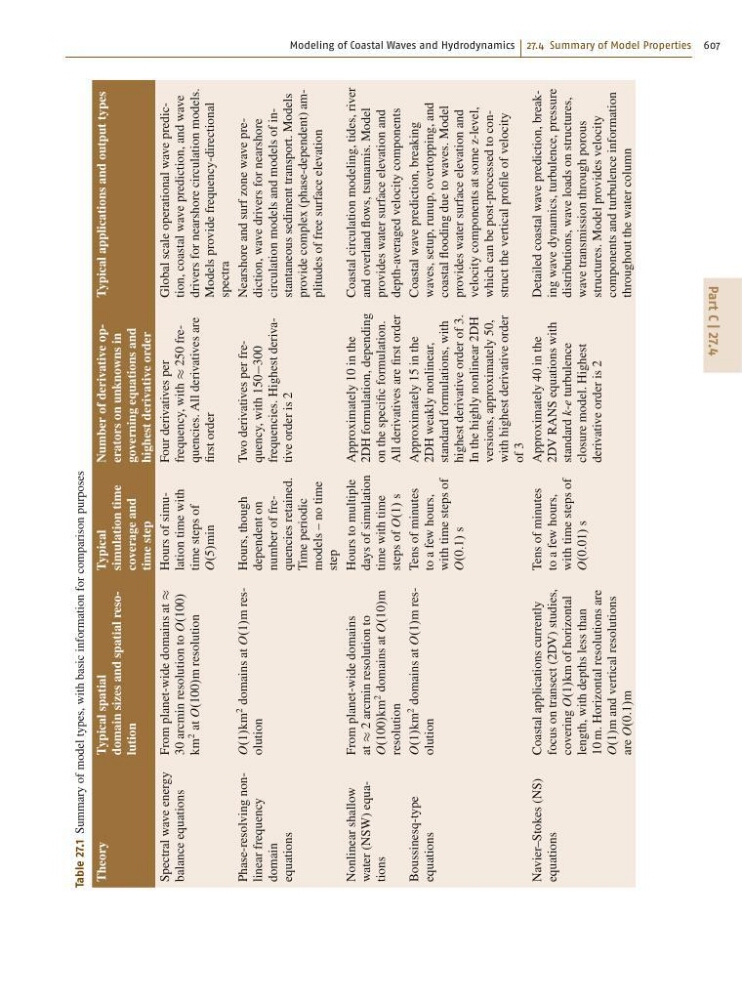
Table 27.1
Summary of model types, with basic information for comparison purposes
Theory
Typical spatial
domain sizes and spatial resolution
Typical
simulation time
coverage and
time step
Number of derivative operators on unknowns in
governing equations and
highest derivative order
Typical applications and output types
Spectral wave energy
balance equations
From planet-wide domains at
30 arcmin resolution to O.100/
km
2
at O.100/m
resolution
Hours of simulation time with
time steps of
O.5/min
Four derivatives per
frequency, with
250 frequencies. All derivatives are
first order
Global scale operational wave prediction, coastal wave prediction, and wave
drivers for nearshore circulation models.
Models provide frequency-directional
spectra
Phase-resolving nonlinear frequency
domain
equations
O.1/km
2
domains at O.1/m
resolution
Hours, though
dependent on
number of frequencies retained.
Time periodic
models – no time
step
Two derivatives per frequency, with 150300
frequencies. Highest derivative order is 2
Nearshore and surf zone wave prediction, wave drivers for nearshore
circulation models and models of instantaneous sediment transport. Models
provide complex (phase-dependent) amplitudes of free surface elevation
Nonlinear shallow
water (NSW) equations
From planet-wide domains
at
2 arcmin resolution to
O.100/km
2
domains at O.10/m
resolution
Hours to multiple
days of simulation
time with time
steps of O.1/
s
Approximately 10 in the
2DH formulation, depending
on the specific formulation.
All derivatives are first order
Coastal circulation modeling, tides, river
and overland flows, tsunamis. Model
provides water surface elevation and
depth-averaged velocity components
Boussinesq-type
equations
O.1/km
2
domains at O.1/m
resolution
Tens of minutes
to a few hours,
with time steps of
O.0:1/
s
Approximately 15 in the
2DH weakly nonlinear,
standard formulations, with
highest derivative order of 3.
In the highly nonlinear 2DH
versions, approximately 50,
with highest derivative order
of 3
Coastal wave prediction, breaking
waves, setup, runup, overtopping, and
coastal flooding due to waves. Model
provides water surface elevation and
velocity components at some z-level,
which can be post-processed to construct the vertical profile of velocity
Navier–Stokes (NS)
equations
Coastal applications currently
focus on transect (2DV) studies,
covering O.1/km
of horizontal
length, with depths less than
10 m. Horizontal resolutions are
O.1/m
and vertical resolutions
are O.0:1/m
Tens of minutes
to a few hours,
with time steps of
O.0:01/
s
Approximately 40 in the
2DV RANS equations with
standard k-e
turbulence
closure model. Highest
derivative order is 2
Detailed coastal wave prediction, breaking wave dynamics, turbulence, pressure
distributions, wave loads on structures,
wave transmission through porous
structures. Model provides velocity
components and turbulence information
throughout the water column