

Part C | 26.3
576 Part C Coastal Design
cost/benefits for a project. In fact, NWS goes on to say
that this revised
concept of the SPH has been developed for Gulf
and Atlantic coasts as a benchmark against which
to judge the hazards for a particular community.
Also in NWS 23 [26.37], the concept of a probable
maximum hurricane (PMH) was introduced as:
a hypothetical steady-state hurricane having a combination of values of meteorological parameters
that will give the highest sustained wind speed that
can probably occur at a specified coastal location.
It is clear from this definition that the PMH was intended to be an event that was much rarer than the SPH;
but it is not clear that an objective definition can be
gleaned from what is written in NWS 23. In its executive summary, NWS 23 states that the central pressure
of the PMH is simply the lowest sea-level pressure at
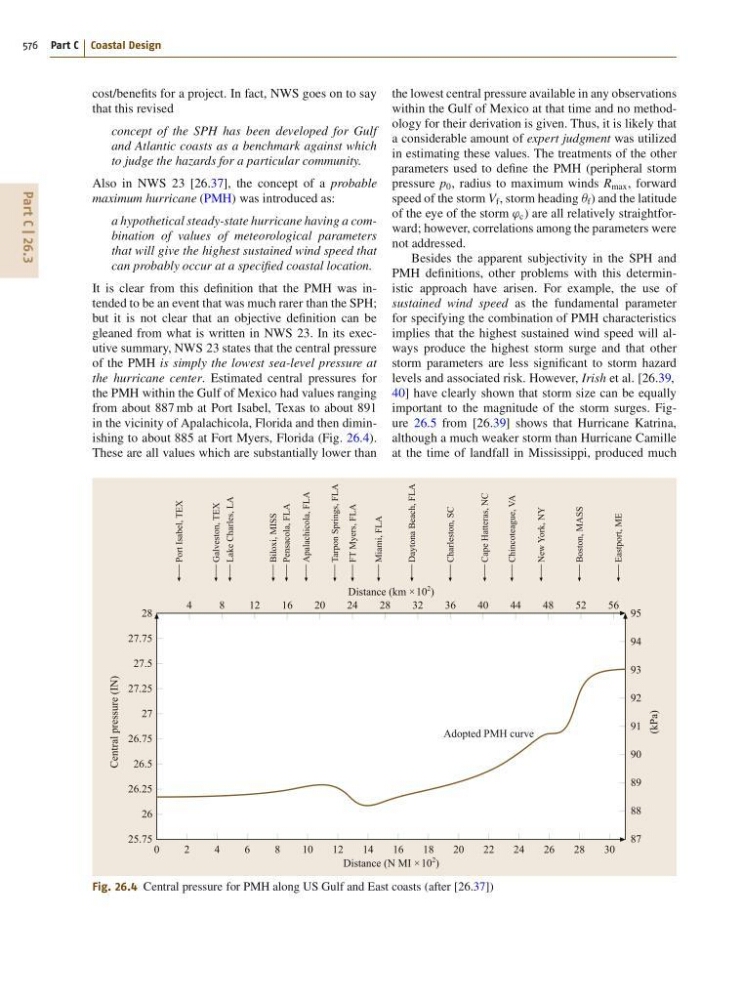
the hurricane center. Estimated central pressures for
the PMH within the Gulf of Mexico had values ranging
from about 887 mb at Port Isabel, Texas to about 891
in the vicinity of Apalachicola, Florida and then diminishing to about 885 at Fort Myers, Florida (Fig. 26.4).
These are all values which are substantially lower than
0
2
4
8
12
16
20
24
28
32
36
40
44
48
56
52
4
6
8
10
12
14
16
18
20
Adopted PMH curve
22
24
26
28
30
Central pressure (IN)
(kPa)
Port Isabel, TEX
Galveston, TEX
Lake Charles, LA
Biloxi, MISS
Pensacola, FLA
Apalachicola, FLA
Tarpon Springs, FLA
FT Myers, FLA
Miami, FLA
Daytona Beach, FLA
Charleston, SC
Cape Hatteras, NC
Chincoteague, VA
New York, NY
Boston, MASS
Eastport, ME
Distance (N MI × 10
2 )
Distance (km × 10
2
)
28
27.75
27.5
27.25
27
26.75
26.5
26.25
26
25.75
95
94
93
92
91
90
89
88
87
Fig. 26.4 Central pressure for PMH along US Gulf and East coasts (after [26.37])
the lowest central pressure available in any observations
within the Gulf of Mexico at that time and no methodology for their derivation is given. Thus, it is likely that
a considerable amount of expert judgment was utilized
in estimating these values. The treatments of the other
parameters used to define the PMH (peripheral storm
pressure p 0 , radius to maximum winds R max , forward
speed of the storm V f , storm heading  f ) and the latitude
of the eye of the storm ' c ) are all relatively straightforward; however, correlations among the parameters were
not addressed.
Besides the apparent subjectivity in the SPH and
PMH definitions, other problems with this deterministic approach have arisen. For example, the use of
sustained wind speed as the fundamental parameter
for specifying the combination of PMH characteristics
implies that the highest sustained wind speed will always produce the highest storm surge and that other
storm parameters are less significant to storm hazard
levels and associated risk. However, Irish et al. [26.39,
40] have clearly shown that storm size can be equally
important to the magnitude of the storm surges. Figure 26.5 from [26.39] shows that Hurricane Katrina,
although a much weaker storm than Hurricane Camille
at the time of landfall in Mississippi, produced much