

546
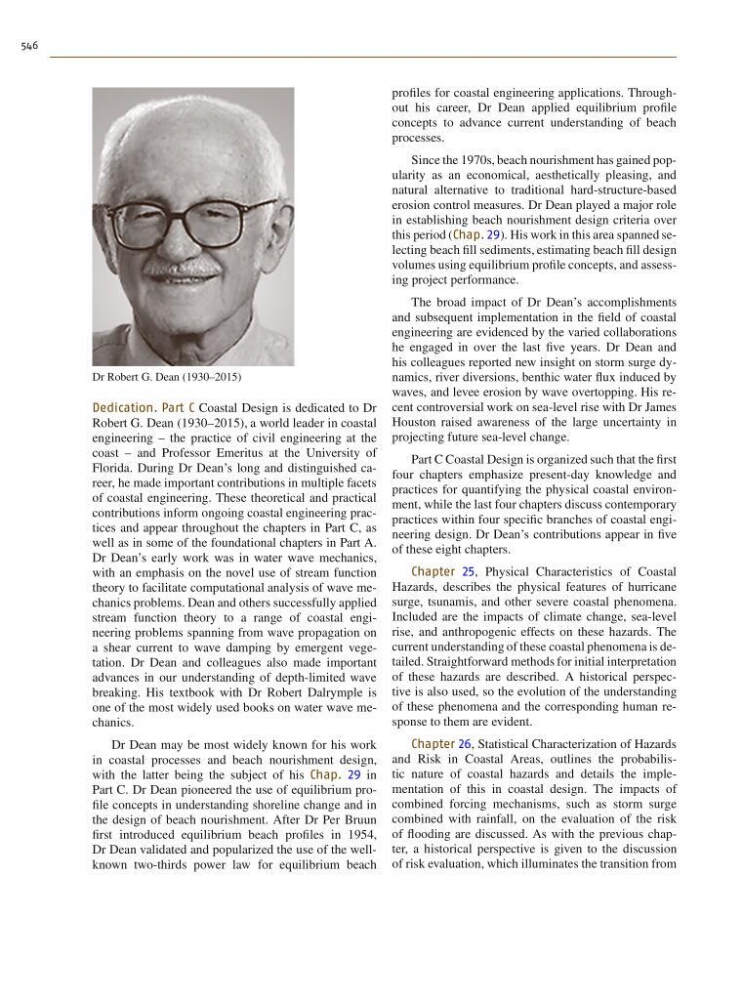
Dr Robert G. Dean (1930–2015)
Dedication. Part C Coastal Design is dedicated to Dr
Robert G. Dean (1930–2015), a world leader in coastal
engineering – the practice of civil engineering at the
coast – and Professor Emeritus at the University of
Florida. During Dr Dean’s long and distinguished career, he made important contributions in multiple facets
of coastal engineering. These theoretical and practical
contributions inform ongoing coastal engineering practices and appear throughout the chapters in Part C, as
well as in some of the foundational chapters in Part A.
Dr Dean’s early work was in water wave mechanics,
with an emphasis on the novel use of stream function
theory to facilitate computational analysis of wave mechanics problems. Dean and others successfully applied
stream function theory to a range of coastal engineering problems spanning from wave propagation on
a shear current to wave damping by emergent vegetation. Dr Dean and colleagues also made important
advances in our understanding of depth-limited wave
breaking. His textbook with Dr Robert Dalrymple is
one of the most widely used books on water wave mechanics.
Dr Dean may be most widely known for his work
in coastal processes and beach nourishment design,
with the latter being the subject of his Chap. 29 in
Part C. Dr Dean pioneered the use of equilibrium profile concepts in understanding shoreline change and in
the design of beach nourishment. After Dr Per Bruun
first introduced equilibrium beach profiles in 1954,
Dr Dean validated and popularized the use of the wellknown two-thirds power law for equilibrium beach
profiles for coastal engineering applications. Throughout his career, Dr Dean applied equilibrium profile
concepts to advance current understanding of beach
processes.
Since the 1970s, beach nourishment has gained popularity as an economical, aesthetically pleasing, and
natural alternative to traditional hard-structure-based
erosion control measures. Dr Dean played a major role
in establishing beach nourishment design criteria over
this period (Chap. 29). His work in this area spanned selecting beach fill sediments, estimating beach fill design
volumes using equilibrium profile concepts, and assessing project performance.
The broad impact of Dr Dean’s accomplishments
and subsequent implementation in the field of coastal
engineering are evidenced by the varied collaborations
he engaged in over the last five years. Dr Dean and
his colleagues reported new insight on storm surge dynamics, river diversions, benthic water flux induced by
waves, and levee erosion by wave overtopping. His recent controversial work on sea-level rise with Dr James
Houston raised awareness of the large uncertainty in
projecting future sea-level change.
Part C Coastal Design is organized such that the first
four chapters emphasize present-day knowledge and
practices for quantifying the physical coastal environment, while the last four chapters discuss contemporary
practices within four specific branches of coastal engineering design. Dr Dean’s contributions appear in five
of these eight chapters.
Chapter 25, Physical Characteristics of Coastal
Hazards, describes the physical features of hurricane
surge, tsunamis, and other severe coastal phenomena.
Included are the impacts of climate change, sea-level
rise, and anthropogenic effects on these hazards. The
current understanding of these coastal phenomena is detailed. Straightforward methods for initial interpretation
of these hazards are described. A historical perspective is also used, so the evolution of the understanding
of these phenomena and the corresponding human response to them are evident.
Chapter 26, Statistical Characterization of Hazards
and Risk in Coastal Areas, outlines the probabilistic nature of coastal hazards and details the implementation of this in coastal design. The impacts of
combined forcing mechanisms, such as storm surge
combined with rainfall, on the evaluation of the risk
of flooding are discussed. As with the previous chapter, a historical perspective is given to the discussion
of risk evaluation, which illuminates the transition from