

Part B | 24.5
540 Part B Autonomous Ocean Vehicles, Subsystems and Control
P M < 0:6, 8 were assessed with P.L j F; E/ > 0:5. This
was the most important set of faults for further investigation and improvement in P M .
24.5.2 Survival Prediction
The risk assessments discussed in the previous section
can be used for directing engineers toward where to put
more effort in fault mitigation. However, the AUV risk
of loss will vary with mission time or length. The decision to deploy an AUV in an extreme environment is
better informed by a risk profile that captures the variation of risk with mission distance or time. The creation
of such risk profile is possible by integrating the expert
judgments of probability of loss with statistical survival
models.
Survival modeling is very popular in medical statistics, where the survival function S.t/ is defined as the
ratio of the number of individuals with survival times
t to the total numbers of individuals in the study.
These methods have been adopted for modeling reliability of systems and components [24.43].
An adequate and representative dataset is central to
the application of statistical survival techniques. Some
entries will consist of recorded time of failures; however there may be missions with no failures. When this
is the case an entry is denoted as right-censored data.
There are several mathematical models for representing censored data; these are divided into parametric and nonparametric models. Parametric models
assume that the failure history follows a particular
Mitigated
Observed
0
50
100
150
200
250
300
350
Probability of survival
Distance (km)
1
0.95
0.9
0.85
0.8
0.75
0.7
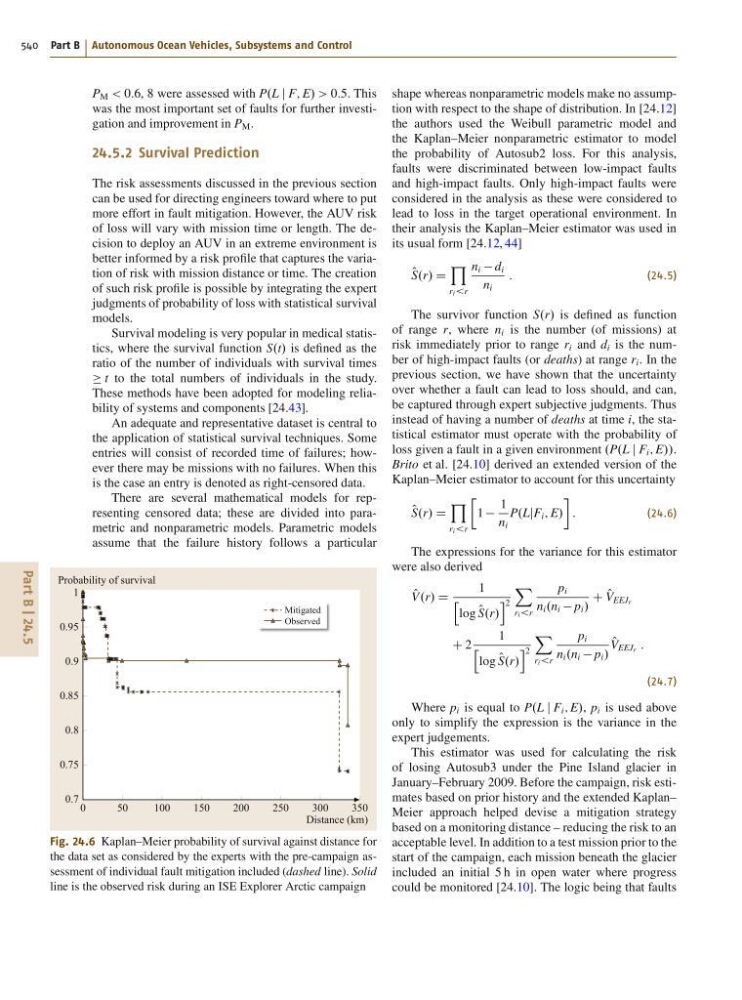
Fig. 24.6 Kaplan–Meier probability of survival against distance for
the data set as considered by the experts with the pre-campaign assessment of individual fault mitigation included (dashed line). Solid
line is the observed risk during an ISE Explorer Arctic campaign
shape whereas nonparametric models make no assumption with respect to the shape of distribution. In [24.12]
the authors used the Weibull parametric model and
the Kaplan–Meier nonparametric estimator to model
the probability of Autosub2 loss. For this analysis,
faults were discriminated between low-impact faults
and high-impact faults. Only high-impact faults were
considered in the analysis as these were considered to
lead to loss in the target operational environment. In
their analysis the Kaplan–Meier estimator was used in
its usual form [24.12, 44]
O
S.r/ D
Y
ri
n i
:
(24.5)
The survivor function S.r/ is defined as function
of range r, where n i is the number (of missions) at
risk immediately prior to range r i and d i is the number of high-impact faults (or deaths) at range r i . In the
previous section, we have shown that the uncertainty
over whether a fault can lead to loss should, and can,
be captured through expert subjective judgments. Thus
instead of having a number of deaths at time i, the statistical estimator must operate with the probability of
loss given a fault in a given environment .P.L j F i ; E//.
Brito et al. [24.10] derived an extended version of the
Kaplan–Meier estimator to account for this uncertainty
O
S.r/ D
Y
ri
1
1
n i
P.LjF i ; E/
:
(24.6)
The expressions for the variance for this estimator
were also derived
O
V.r/ D
1
h
log O
S.r/
i 2
X
ri
n i .n i p i /
C O
V EEJr
C 2
1
h
log O
S.r/
i 2
X
ri
n i .n i p i /
O
V EEJr :
(24.7)
Where p i is equal to P.L j F i ; E/, p i is used above
only to simplify the expression is the variance in the
expert judgements.
This estimator was used for calculating the risk
of losing Autosub3 under the Pine Island glacier in
January–February 2009. Before the campaign, risk estimates based on prior history and the extended Kaplan–
Meier approach helped devise a mitigation strategy
based on a monitoring distance – reducing the risk to an
acceptable level. In addition to a test mission prior to the
start of the campaign, each mission beneath the glacier
included an initial 5 h in open water where progress
could be monitored [24.10]. The logic being that faults