

Cooperative Vehicle Target Tracking References 513
Part B | 22
leading to a hybrid coordination scheme called synchronized covertness.
A methodology to generate coordination schemes
has been developed, stemming from a heuristic bias
toward independence. Coordination schemes generated
with this methodology allow evaluation of the effectiveness of coordination.
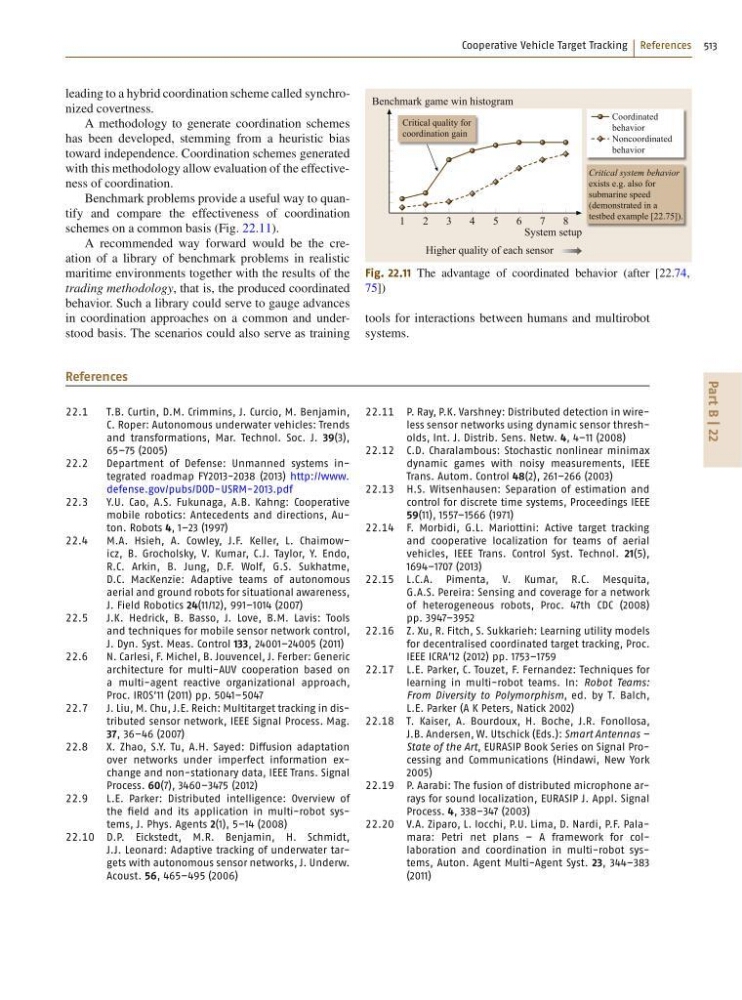
Benchmark problems provide a useful way to quantify and compare the effectiveness of coordination
schemes on a common basis (Fig. 22.11).
A recommended way forward would be the creation of a library of benchmark problems in realistic
maritime environments together with the results of the
trading methodology, that is, the produced coordinated
behavior. Such a library could serve to gauge advances
in coordination approaches on a common and understood basis. The scenarios could also serve as training
Coordinated
behavior
Noncoordinated
behavior
1
2
3
4
5
6
7
8
Benchmark game win histogram
Critical quality for
coordination gain
Critical system behavior
exists e.g. also for
submarine speed
(demonstrated in a
testbed example [22.75]).
Higher quality of each sensor
System setup
Fig. 22.11 The advantage of coordinated behavior (after [22.74,
75])
tools for interactions between humans and multirobot
systems.
References
22.1
T.B. Curtin, D.M. Crimmins, J. Curcio, M. Benjamin,
C. Roper: Autonomous underwater vehicles: Trends
and transformations, Mar. Technol. Soc. J. 39(3),
65–75 (2005)
22.2
Department of Defense: Unmanned systems integrated roadmap FY2013-2038 (2013) http://www.
defense.gov/pubs/DOD-USRM-2013.pdf
22.3
Y.U. Cao, A.S. Fukunaga, A.B. Kahng: Cooperative
mobile robotics: Antecedents and directions, Auton. Robots 4, 1–23 (1997)
22.4
M.A. Hsieh, A. Cowley, J.F. Keller, L. Chaimowicz, B. Grocholsky, V. Kumar, C.J. Taylor, Y. Endo,
R.C. Arkin, B. Jung, D.F. Wolf, G.S. Sukhatme,
D.C. MacKenzie: Adaptive teams of autonomous
aerial and ground robots for situational awareness,
J. Field Robotics 24(11/12), 991–1014 (2007)
22.5
J.K. Hedrick, B. Basso, J. Love, B.M. Lavis: Tools
and techniques for mobile sensor network control,
J. Dyn. Syst. Meas. Control 133, 24001–24005 (2011)
22.6
N. Carlesi, F. Michel, B. Jouvencel, J. Ferber: Generic
architecture for multi-AUV cooperation based on
a multi-agent reactive organizational approach,
Proc. IROS’11 (2011) pp. 5041–5047
22.7
J. Liu, M. Chu, J.E. Reich: Multitarget tracking in distributed sensor network, IEEE Signal Process. Mag.
37, 36–46 (2007)
22.8
X. Zhao, S.Y. Tu, A.H. Sayed: Diffusion adaptation
over networks under imperfect information exchange and non-stationary data, IEEE Trans. Signal
Process. 60(7), 3460–3475 (2012)
22.9
L.E. Parker: Distributed intelligence: Overview of
the field and its application in multi-robot systems, J. Phys. Agents 2(1), 5–14 (2008)
22.10 D.P. Eickstedt, M.R. Benjamin, H. Schmidt,
J.J. Leonard: Adaptive tracking of underwater targets with autonomous sensor networks, J. Underw.
Acoust. 56, 465–495 (2006)
22.11 P. Ray, P.K. Varshney: Distributed detection in wireless sensor networks using dynamic sensor thresholds, Int. J. Distrib. Sens. Netw. 4, 4–11 (2008)
22.12 C.D. Charalambous: Stochastic nonlinear minimax
dynamic games with noisy measurements, IEEE
Trans. Autom. Control 48(2), 261–266 (2003)
22.13 H.S. Witsenhausen: Separation of estimation and
control for discrete time systems, Proceedings IEEE
59(11), 1557–1566 (1971)
22.14 F. Morbidi, G.L. Mariottini: Active target tracking
and cooperative localization for teams of aerial
vehicles, IEEE Trans. Control Syst. Technol. 21(5),
1694–1707 (2013)
22.15 L.C.A. Pimenta, V. Kumar, R.C. Mesquita,
G.A.S. Pereira: Sensing and coverage for a network
of heterogeneous robots, Proc. 47th CDC (2008)
pp. 3947–3952
22.16 Z. Xu, R. Fitch, S. Sukkarieh: Learning utility models
for decentralised coordinated target tracking, Proc.
IEEE ICRA’12 (2012) pp. 1753–1759
22.17 L.E. Parker, C. Touzet, F. Fernandez: Techniques for
learning in multi-robot teams. In: Robot Teams:
From Diversity to Polymorphism, ed. by T. Balch,
L.E. Parker (A K Peters, Natick 2002)
22.18 T. Kaiser, A. Bourdoux, H. Boche, J.R. Fonollosa,
J.B. Andersen, W. Utschick (Eds.): Smart Antennas –
State of the Art, EURASIP Book Series on Signal Processing and Communications (Hindawi, New York
2005)
22.19 P. Aarabi: The fusion of distributed microphone arrays for sound localization, EURASIP J. Appl. Signal
Process. 4, 338–347 (2003)
22.20 V.A. Ziparo, L. Iocchi, P.U. Lima, D. Nardi, P.F. Palamara: Petri net plans – A framework for collaboration and coordination in multi-robot systems, Auton. Agent Multi-Agent Syst. 23, 344–383
(2011)
Part B | 22
leading to a hybrid coordination scheme called synchronized covertness.
A methodology to generate coordination schemes
has been developed, stemming from a heuristic bias
toward independence. Coordination schemes generated
with this methodology allow evaluation of the effectiveness of coordination.
Benchmark problems provide a useful way to quantify and compare the effectiveness of coordination
schemes on a common basis (Fig. 22.11).
A recommended way forward would be the creation of a library of benchmark problems in realistic
maritime environments together with the results of the
trading methodology, that is, the produced coordinated
behavior. Such a library could serve to gauge advances
in coordination approaches on a common and understood basis. The scenarios could also serve as training
Coordinated
behavior
Noncoordinated
behavior
1
2
3
4
5
6
7
8
Benchmark game win histogram
Critical quality for
coordination gain
Critical system behavior
exists e.g. also for
submarine speed
(demonstrated in a
testbed example [22.75]).
Higher quality of each sensor
System setup
Fig. 22.11 The advantage of coordinated behavior (after [22.74,
75])
tools for interactions between humans and multirobot
systems.
References
22.1
T.B. Curtin, D.M. Crimmins, J. Curcio, M. Benjamin,
C. Roper: Autonomous underwater vehicles: Trends
and transformations, Mar. Technol. Soc. J. 39(3),
65–75 (2005)
22.2
Department of Defense: Unmanned systems integrated roadmap FY2013-2038 (2013) http://www.
defense.gov/pubs/DOD-USRM-2013.pdf
22.3
Y.U. Cao, A.S. Fukunaga, A.B. Kahng: Cooperative
mobile robotics: Antecedents and directions, Auton. Robots 4, 1–23 (1997)
22.4
M.A. Hsieh, A. Cowley, J.F. Keller, L. Chaimowicz, B. Grocholsky, V. Kumar, C.J. Taylor, Y. Endo,
R.C. Arkin, B. Jung, D.F. Wolf, G.S. Sukhatme,
D.C. MacKenzie: Adaptive teams of autonomous
aerial and ground robots for situational awareness,
J. Field Robotics 24(11/12), 991–1014 (2007)
22.5
J.K. Hedrick, B. Basso, J. Love, B.M. Lavis: Tools
and techniques for mobile sensor network control,
J. Dyn. Syst. Meas. Control 133, 24001–24005 (2011)
22.6
N. Carlesi, F. Michel, B. Jouvencel, J. Ferber: Generic
architecture for multi-AUV cooperation based on
a multi-agent reactive organizational approach,
Proc. IROS’11 (2011) pp. 5041–5047
22.7
J. Liu, M. Chu, J.E. Reich: Multitarget tracking in distributed sensor network, IEEE Signal Process. Mag.
37, 36–46 (2007)
22.8
X. Zhao, S.Y. Tu, A.H. Sayed: Diffusion adaptation
over networks under imperfect information exchange and non-stationary data, IEEE Trans. Signal
Process. 60(7), 3460–3475 (2012)
22.9
L.E. Parker: Distributed intelligence: Overview of
the field and its application in multi-robot systems, J. Phys. Agents 2(1), 5–14 (2008)
22.10 D.P. Eickstedt, M.R. Benjamin, H. Schmidt,
J.J. Leonard: Adaptive tracking of underwater targets with autonomous sensor networks, J. Underw.
Acoust. 56, 465–495 (2006)
22.11 P. Ray, P.K. Varshney: Distributed detection in wireless sensor networks using dynamic sensor thresholds, Int. J. Distrib. Sens. Netw. 4, 4–11 (2008)
22.12 C.D. Charalambous: Stochastic nonlinear minimax
dynamic games with noisy measurements, IEEE
Trans. Autom. Control 48(2), 261–266 (2003)
22.13 H.S. Witsenhausen: Separation of estimation and
control for discrete time systems, Proceedings IEEE
59(11), 1557–1566 (1971)
22.14 F. Morbidi, G.L. Mariottini: Active target tracking
and cooperative localization for teams of aerial
vehicles, IEEE Trans. Control Syst. Technol. 21(5),
1694–1707 (2013)
22.15 L.C.A. Pimenta, V. Kumar, R.C. Mesquita,
G.A.S. Pereira: Sensing and coverage for a network
of heterogeneous robots, Proc. 47th CDC (2008)
pp. 3947–3952
22.16 Z. Xu, R. Fitch, S. Sukkarieh: Learning utility models
for decentralised coordinated target tracking, Proc.
IEEE ICRA’12 (2012) pp. 1753–1759
22.17 L.E. Parker, C. Touzet, F. Fernandez: Techniques for
learning in multi-robot teams. In: Robot Teams:
From Diversity to Polymorphism, ed. by T. Balch,
L.E. Parker (A K Peters, Natick 2002)
22.18 T. Kaiser, A. Bourdoux, H. Boche, J.R. Fonollosa,
J.B. Andersen, W. Utschick (Eds.): Smart Antennas –
State of the Art, EURASIP Book Series on Signal Processing and Communications (Hindawi, New York
2005)
22.19 P. Aarabi: The fusion of distributed microphone arrays for sound localization, EURASIP J. Appl. Signal
Process. 4, 338–347 (2003)
22.20 V.A. Ziparo, L. Iocchi, P.U. Lima, D. Nardi, P.F. Palamara: Petri net plans – A framework for collaboration and coordination in multi-robot systems, Auton. Agent Multi-Agent Syst. 23, 344–383
(2011)