

Part B | 22.6
512 Part B Autonomous Ocean Vehicles, Subsystems and Control
System MoP
for a given
concept of operations
MoP
network
MoP
sensors
MoP
platforms
Environmental conditions
target behavior
DESIGN
Sensor & platform &
network
System MoE
for a given
concept of operations
EFFECTIVENESS
Military objective &
mission goal
Connection of MoPs and MoEs without execution or sophisticated simulation
EXECUTION
Operational &
environmental
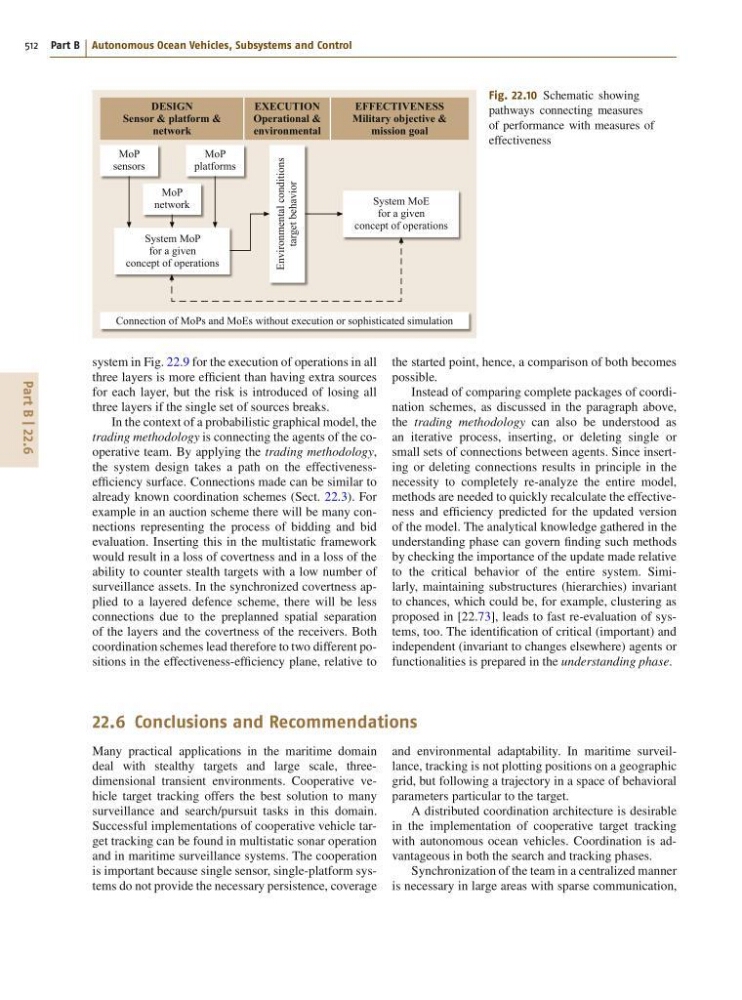
Fig. 22.10 Schematic showing
pathways connecting measures
of performance with measures of
effectiveness
system in Fig. 22.9 for the execution of operations in all
three layers is more efficient than having extra sources
for each layer, but the risk is introduced of losing all
three layers if the single set of sources breaks.
In the context of a probabilistic graphical model, the
trading methodology is connecting the agents of the cooperative team. By applying the trading methodology,
the system design takes a path on the effectivenessefficiency surface. Connections made can be similar to
already known coordination schemes (Sect. 22.3). For
example in an auction scheme there will be many connections representing the process of bidding and bid
evaluation. Inserting this in the multistatic framework
would result in a loss of covertness and in a loss of the
ability to counter stealth targets with a low number of
surveillance assets. In the synchronized covertness applied to a layered defence scheme, there will be less
connections due to the preplanned spatial separation
of the layers and the covertness of the receivers. Both
coordination schemes lead therefore to two different positions in the effectiveness-efficiency plane, relative to
the started point, hence, a comparison of both becomes
possible.
Instead of comparing complete packages of coordination schemes, as discussed in the paragraph above,
the trading methodology can also be understood as
an iterative process, inserting, or deleting single or
small sets of connections between agents. Since inserting or deleting connections results in principle in the
necessity to completely re-analyze the entire model,
methods are needed to quickly recalculate the effectiveness and efficiency predicted for the updated version
of the model. The analytical knowledge gathered in the
understanding phase can govern finding such methods
by checking the importance of the update made relative
to the critical behavior of the entire system. Similarly, maintaining substructures (hierarchies) invariant
to chances, which could be, for example, clustering as
proposed in [22.73], leads to fast re-evaluation of systems, too. The identification of critical (important) and
independent (invariant to changes elsewhere) agents or
functionalities is prepared in the understanding phase.
22.6 Conclusions and Recommendations
Many practical applications in the maritime domain
deal with stealthy targets and large scale, threedimensional transient environments. Cooperative vehicle target tracking offers the best solution to many
surveillance and search/pursuit tasks in this domain.
Successful implementations of cooperative vehicle target tracking can be found in multistatic sonar operation
and in maritime surveillance systems. The cooperation
is important because single sensor, single-platform systems do not provide the necessary persistence, coverage
and environmental adaptability. In maritime surveillance, tracking is not plotting positions on a geographic
grid, but following a trajectory in a space of behavioral
parameters particular to the target.
A distributed coordination architecture is desirable
in the implementation of cooperative target tracking
with autonomous ocean vehicles. Coordination is advantageous in both the search and tracking phases.
Synchronization of the team in a centralized manner
is necessary in large areas with sparse communication,
512 Part B Autonomous Ocean Vehicles, Subsystems and Control
System MoP
for a given
concept of operations
MoP
network
MoP
sensors
MoP
platforms
Environmental conditions
target behavior
DESIGN
Sensor & platform &
network
System MoE
for a given
concept of operations
EFFECTIVENESS
Military objective &
mission goal
Connection of MoPs and MoEs without execution or sophisticated simulation
EXECUTION
Operational &
environmental
Fig. 22.10 Schematic showing
pathways connecting measures
of performance with measures of
effectiveness
system in Fig. 22.9 for the execution of operations in all
three layers is more efficient than having extra sources
for each layer, but the risk is introduced of losing all
three layers if the single set of sources breaks.
In the context of a probabilistic graphical model, the
trading methodology is connecting the agents of the cooperative team. By applying the trading methodology,
the system design takes a path on the effectivenessefficiency surface. Connections made can be similar to
already known coordination schemes (Sect. 22.3). For
example in an auction scheme there will be many connections representing the process of bidding and bid
evaluation. Inserting this in the multistatic framework
would result in a loss of covertness and in a loss of the
ability to counter stealth targets with a low number of
surveillance assets. In the synchronized covertness applied to a layered defence scheme, there will be less
connections due to the preplanned spatial separation
of the layers and the covertness of the receivers. Both
coordination schemes lead therefore to two different positions in the effectiveness-efficiency plane, relative to
the started point, hence, a comparison of both becomes
possible.
Instead of comparing complete packages of coordination schemes, as discussed in the paragraph above,
the trading methodology can also be understood as
an iterative process, inserting, or deleting single or
small sets of connections between agents. Since inserting or deleting connections results in principle in the
necessity to completely re-analyze the entire model,
methods are needed to quickly recalculate the effectiveness and efficiency predicted for the updated version
of the model. The analytical knowledge gathered in the
understanding phase can govern finding such methods
by checking the importance of the update made relative
to the critical behavior of the entire system. Similarly, maintaining substructures (hierarchies) invariant
to chances, which could be, for example, clustering as
proposed in [22.73], leads to fast re-evaluation of systems, too. The identification of critical (important) and
independent (invariant to changes elsewhere) agents or
functionalities is prepared in the understanding phase.
22.6 Conclusions and Recommendations
Many practical applications in the maritime domain
deal with stealthy targets and large scale, threedimensional transient environments. Cooperative vehicle target tracking offers the best solution to many
surveillance and search/pursuit tasks in this domain.
Successful implementations of cooperative vehicle target tracking can be found in multistatic sonar operation
and in maritime surveillance systems. The cooperation
is important because single sensor, single-platform systems do not provide the necessary persistence, coverage
and environmental adaptability. In maritime surveillance, tracking is not plotting positions on a geographic
grid, but following a trajectory in a space of behavioral
parameters particular to the target.
A distributed coordination architecture is desirable
in the implementation of cooperative target tracking
with autonomous ocean vehicles. Coordination is advantageous in both the search and tracking phases.
Synchronization of the team in a centralized manner
is necessary in large areas with sparse communication,