

Cooperative Vehicle Target Tracking 22.3 Multistatic Sonar 505
Part B | 22.3
Bounded
Continuous
Environment
Target
Polygonal
Convex
Finite range
Line-of-sight
False negative errors
Bounded speed
Heterogeneous
Transit costs
False alarms
False positive errors
False contacts
Finite graph
Multiple targets
Adversarial
Non-reactive
Bounded
Unbounded
Bounded
Unbounded
Random walk
Markovian
Single target
Number of targets
Target motion
Stationary
Mobile Type
Agility
Speed
Turning angle
Adversarial placement
Random placement
Known prior distribution
Uniform distribution
Infinite graph
Autonomous search
Unbounded
Homogeneous
Multiple searchers
Single searcher
Number of searchers
Constrained
Unconstrained
Imperfect detection
Sensor model
Discrete
Perfect detection
Searcher motion
Searcher
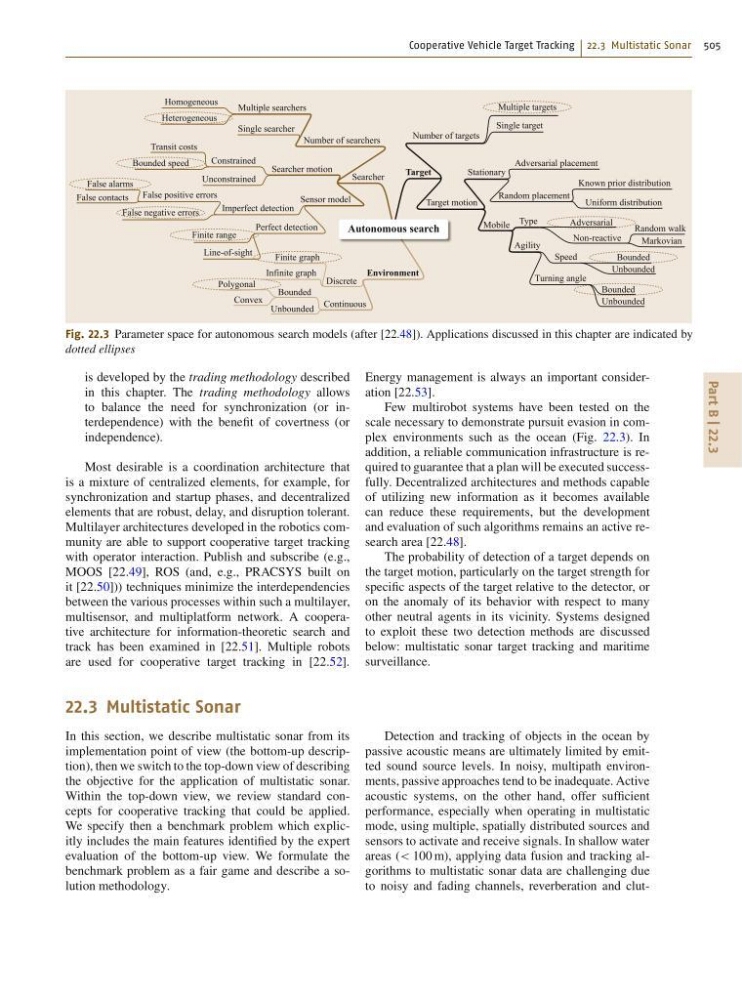
Fig. 22.3 Parameter space for autonomous search models (after [22.48]). Applications discussed in this chapter are indicated by
dotted ellipses
is developed by the trading methodology described
in this chapter. The trading methodology allows
to balance the need for synchronization (or interdependence) with the benefit of covertness (or
independence).
Most desirable is a coordination architecture that
is a mixture of centralized elements, for example, for
synchronization and startup phases, and decentralized
elements that are robust, delay, and disruption tolerant.
Multilayer architectures developed in the robotics community are able to support cooperative target tracking
with operator interaction. Publish and subscribe (e.g.,
MOOS [22.49], ROS (and, e.g., PRACSYS built on
it [22.50])) techniques minimize the interdependencies
between the various processes within such a multilayer,
multisensor, and multiplatform network. A cooperative architecture for information-theoretic search and
track has been examined in [22.51]. Multiple robots
are used for cooperative target tracking in [22.52].
Energy management is always an important consideration [22.53].
Few multirobot systems have been tested on the
scale necessary to demonstrate pursuit evasion in complex environments such as the ocean (Fig. 22.3). In
addition, a reliable communication infrastructure is required to guarantee that a plan will be executed successfully. Decentralized architectures and methods capable
of utilizing new information as it becomes available
can reduce these requirements, but the development
and evaluation of such algorithms remains an active research area [22.48].
The probability of detection of a target depends on
the target motion, particularly on the target strength for
specific aspects of the target relative to the detector, or
on the anomaly of its behavior with respect to many
other neutral agents in its vicinity. Systems designed
to exploit these two detection methods are discussed
below: multistatic sonar target tracking and maritime
surveillance.
22.3 Multistatic Sonar
In this section, we describe multistatic sonar from its
implementation point of view (the bottom-up description), then we switch to the top-down view of describing
the objective for the application of multistatic sonar.
Within the top-down view, we review standard concepts for cooperative tracking that could be applied.
We specify then a benchmark problem which explicitly includes the main features identified by the expert
evaluation of the bottom-up view. We formulate the
benchmark problem as a fair game and describe a solution methodology.
Detection and tracking of objects in the ocean by
passive acoustic means are ultimately limited by emitted sound source levels. In noisy, multipath environments, passive approaches tend to be inadequate. Active
acoustic systems, on the other hand, offer sufficient
performance, especially when operating in multistatic
mode, using multiple, spatially distributed sources and
sensors to activate and receive signals. In shallow water
areas (< 100 m), applying data fusion and tracking algorithms to multistatic sonar data are challenging due
to noisy and fading channels, reverberation and clut-
Part B | 22.3
Bounded
Continuous
Environment
Target
Polygonal
Convex
Finite range
Line-of-sight
False negative errors
Bounded speed
Heterogeneous
Transit costs
False alarms
False positive errors
False contacts
Finite graph
Multiple targets
Adversarial
Non-reactive
Bounded
Unbounded
Bounded
Unbounded
Random walk
Markovian
Single target
Number of targets
Target motion
Stationary
Mobile Type
Agility
Speed
Turning angle
Adversarial placement
Random placement
Known prior distribution
Uniform distribution
Infinite graph
Autonomous search
Unbounded
Homogeneous
Multiple searchers
Single searcher
Number of searchers
Constrained
Unconstrained
Imperfect detection
Sensor model
Discrete
Perfect detection
Searcher motion
Searcher
Fig. 22.3 Parameter space for autonomous search models (after [22.48]). Applications discussed in this chapter are indicated by
dotted ellipses
is developed by the trading methodology described
in this chapter. The trading methodology allows
to balance the need for synchronization (or interdependence) with the benefit of covertness (or
independence).
Most desirable is a coordination architecture that
is a mixture of centralized elements, for example, for
synchronization and startup phases, and decentralized
elements that are robust, delay, and disruption tolerant.
Multilayer architectures developed in the robotics community are able to support cooperative target tracking
with operator interaction. Publish and subscribe (e.g.,
MOOS [22.49], ROS (and, e.g., PRACSYS built on
it [22.50])) techniques minimize the interdependencies
between the various processes within such a multilayer,
multisensor, and multiplatform network. A cooperative architecture for information-theoretic search and
track has been examined in [22.51]. Multiple robots
are used for cooperative target tracking in [22.52].
Energy management is always an important consideration [22.53].
Few multirobot systems have been tested on the
scale necessary to demonstrate pursuit evasion in complex environments such as the ocean (Fig. 22.3). In
addition, a reliable communication infrastructure is required to guarantee that a plan will be executed successfully. Decentralized architectures and methods capable
of utilizing new information as it becomes available
can reduce these requirements, but the development
and evaluation of such algorithms remains an active research area [22.48].
The probability of detection of a target depends on
the target motion, particularly on the target strength for
specific aspects of the target relative to the detector, or
on the anomaly of its behavior with respect to many
other neutral agents in its vicinity. Systems designed
to exploit these two detection methods are discussed
below: multistatic sonar target tracking and maritime
surveillance.
22.3 Multistatic Sonar
In this section, we describe multistatic sonar from its
implementation point of view (the bottom-up description), then we switch to the top-down view of describing
the objective for the application of multistatic sonar.
Within the top-down view, we review standard concepts for cooperative tracking that could be applied.
We specify then a benchmark problem which explicitly includes the main features identified by the expert
evaluation of the bottom-up view. We formulate the
benchmark problem as a fair game and describe a solution methodology.
Detection and tracking of objects in the ocean by
passive acoustic means are ultimately limited by emitted sound source levels. In noisy, multipath environments, passive approaches tend to be inadequate. Active
acoustic systems, on the other hand, offer sufficient
performance, especially when operating in multistatic
mode, using multiple, spatially distributed sources and
sensors to activate and receive signals. In shallow water
areas (< 100 m), applying data fusion and tracking algorithms to multistatic sonar data are challenging due
to noisy and fading channels, reverberation and clut-