

Non-Acoustic Sensors 18.4 Biological Sensor Systems 431
Part B | 18.4
erated are available by remote transmission and autonomous analysis in real time for adaptive sampling.
Assay detection chemistries are available for many
biological targets. These assays enable the sensor
system to be tunable or programmable for different
targeted species. This capability could be integrated
into AUVs outfitted with them to act as a control
function in the vehicle’s control loop. Aquatic microbial detection technologies combined with AUV
marine technology will provide near real-time sensing
and detection capabilities to protect shellfish, beaches,
coastal resources, groundwater, and drinking water
sources. Polymerase chain reaction (PCR) amplification technology is the enabling technology being incorporated into the AUV compatible genetic sensor to
bring down power requirements and scale while extending deployment time and the number of samples
analyzed.
One aspect of these devices is that they can be configured with a variety of genetic probe arrays [18.24,
25] at one time. The probes are on small filters that
have matching genetic markers which capture their genetic match when the assay of material is passed over
them. Using a system of false positives and photosensitive chemistry, the identity and relative concentration
can be captured in situ and in near real time. The probes
can also be fixed and stored for later analysis in the lab.
Mass spectrometry and molecular biology-type systems [18.25] are demonstrating detection that indicates the presence of proteins and toxins. Real-time
proteomic-based sensors that measure expression patterns in biota proteins using automated methods is
a complex technical problem. Proteins are the functional elements in cells that are amenable to significant post-translational modifications not captured by
functional genomic sensors. As such, proteomic-based
sensors are expected to yield information that better relates to functionality at the macro-scale ecosystem. Real-time AUV sampling combined with a postanalysis approach may benefit the elucidation of the
proteomics spatial-temporal dynamics in the immediate
future. Similarly, metabolomic-based sensors that measure metabolic byproducts produced by functional biota
will emerge on AUVs with the growth of mass spectrometry and the advancement of automated sampling
methods. Detection and monitoring of known metabolic
byproducts, or metabolic fingerprints, generated in response to perturbations within the environment will be
highly informative to researchers as well as the general
public.
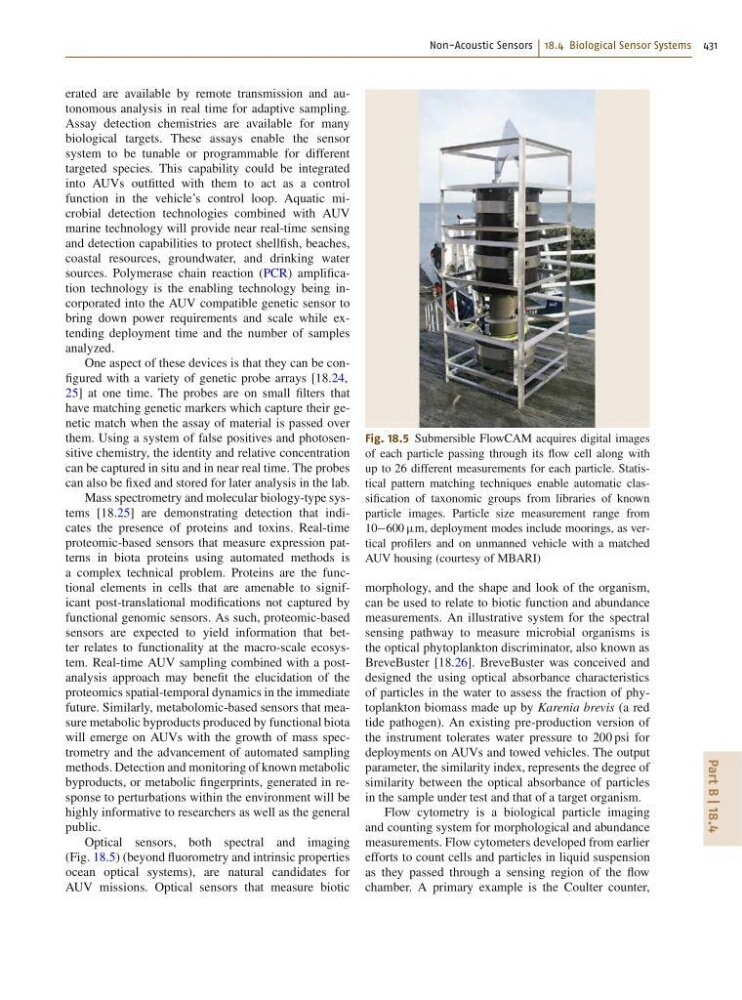
Optical sensors, both spectral and imaging
(Fig. 18.5) (beyond fluorometry and intrinsic properties
ocean optical systems), are natural candidates for
AUV missions. Optical sensors that measure biotic
Fig. 18.5 Submersible FlowCAM acquires digital images
of each particle passing through its flow cell along with
up to 26 different measurements for each particle. Statistical pattern matching techniques enable automatic classification of taxonomic groups from libraries of known
particle images. Particle size measurement range from
10600 m, deployment modes include moorings, as vertical profilers and on unmanned vehicle with a matched
AUV housing (courtesy of MBARI)
morphology, and the shape and look of the organism,
can be used to relate to biotic function and abundance
measurements. An illustrative system for the spectral
sensing pathway to measure microbial organisms is
the optical phytoplankton discriminator, also known as
BreveBuster [18.26]. BreveBuster was conceived and
designed the using optical absorbance characteristics
of particles in the water to assess the fraction of phytoplankton biomass made up by Karenia brevis (a red
tide pathogen). An existing pre-production version of
the instrument tolerates water pressure to 200 psi for
deployments on AUVs and towed vehicles. The output
parameter, the similarity index, represents the degree of
similarity between the optical absorbance of particles
in the sample under test and that of a target organism.
Flow cytometry is a biological particle imaging
and counting system for morphological and abundance
measurements. Flow cytometers developed from earlier
efforts to count cells and particles in liquid suspension
as they passed through a sensing region of the flow
chamber. A primary example is the Coulter counter,
Part B | 18.4
erated are available by remote transmission and autonomous analysis in real time for adaptive sampling.
Assay detection chemistries are available for many
biological targets. These assays enable the sensor
system to be tunable or programmable for different
targeted species. This capability could be integrated
into AUVs outfitted with them to act as a control
function in the vehicle’s control loop. Aquatic microbial detection technologies combined with AUV
marine technology will provide near real-time sensing
and detection capabilities to protect shellfish, beaches,
coastal resources, groundwater, and drinking water
sources. Polymerase chain reaction (PCR) amplification technology is the enabling technology being incorporated into the AUV compatible genetic sensor to
bring down power requirements and scale while extending deployment time and the number of samples
analyzed.
One aspect of these devices is that they can be configured with a variety of genetic probe arrays [18.24,
25] at one time. The probes are on small filters that
have matching genetic markers which capture their genetic match when the assay of material is passed over
them. Using a system of false positives and photosensitive chemistry, the identity and relative concentration
can be captured in situ and in near real time. The probes
can also be fixed and stored for later analysis in the lab.
Mass spectrometry and molecular biology-type systems [18.25] are demonstrating detection that indicates the presence of proteins and toxins. Real-time
proteomic-based sensors that measure expression patterns in biota proteins using automated methods is
a complex technical problem. Proteins are the functional elements in cells that are amenable to significant post-translational modifications not captured by
functional genomic sensors. As such, proteomic-based
sensors are expected to yield information that better relates to functionality at the macro-scale ecosystem. Real-time AUV sampling combined with a postanalysis approach may benefit the elucidation of the
proteomics spatial-temporal dynamics in the immediate
future. Similarly, metabolomic-based sensors that measure metabolic byproducts produced by functional biota
will emerge on AUVs with the growth of mass spectrometry and the advancement of automated sampling
methods. Detection and monitoring of known metabolic
byproducts, or metabolic fingerprints, generated in response to perturbations within the environment will be
highly informative to researchers as well as the general
public.
Optical sensors, both spectral and imaging
(Fig. 18.5) (beyond fluorometry and intrinsic properties
ocean optical systems), are natural candidates for
AUV missions. Optical sensors that measure biotic
Fig. 18.5 Submersible FlowCAM acquires digital images
of each particle passing through its flow cell along with
up to 26 different measurements for each particle. Statistical pattern matching techniques enable automatic classification of taxonomic groups from libraries of known
particle images. Particle size measurement range from
10600 m, deployment modes include moorings, as vertical profilers and on unmanned vehicle with a matched
AUV housing (courtesy of MBARI)
morphology, and the shape and look of the organism,
can be used to relate to biotic function and abundance
measurements. An illustrative system for the spectral
sensing pathway to measure microbial organisms is
the optical phytoplankton discriminator, also known as
BreveBuster [18.26]. BreveBuster was conceived and
designed the using optical absorbance characteristics
of particles in the water to assess the fraction of phytoplankton biomass made up by Karenia brevis (a red
tide pathogen). An existing pre-production version of
the instrument tolerates water pressure to 200 psi for
deployments on AUVs and towed vehicles. The output
parameter, the similarity index, represents the degree of
similarity between the optical absorbance of particles
in the sample under test and that of a target organism.
Flow cytometry is a biological particle imaging
and counting system for morphological and abundance
measurements. Flow cytometers developed from earlier
efforts to count cells and particles in liquid suspension
as they passed through a sensing region of the flow
chamber. A primary example is the Coulter counter,