

Part B | 18.3
428 Part B Autonomous Ocean Vehicles, Subsystems and Control
light frequency is filtered out and the resulting spectra
collected is rich with information other sensors and instrument systems cannot provide. In addition, Raman
spectroscopy looks at a spectrum of chemical compounds simultaneously, as long as they are within the
laser beams’ spot size. Raman systems are also capable
of scanning a prescribed area or watching a reaction occur over time. Therefore, Raman spectroscopy is a very
strong instrument for use in situ.
Natural gas hydrates occur within sediments and
outcrops around the world; hydrates are an excellent target for Raman investigation [18.15]. It is helpful that
hydrates, composed of 85% water and 15% gas, are
ice-like and semi-transparent. The excitation laser can
thus be focused within the specimen without the exact positioning strictures required for a fully opaque
surface. Raman instruments have been evaluated for detection limits on a number of gas species. Samples of
1 atm CO 2 , 0:7 atm N 2 , 0:2 atm O 2 , or 0:01 atm H 2 O
vapor contained in an Erlenmeyer flask were successfully tested using the excitation laser focused through
the wall of a glass vessel. One experiment collected 64
acquisitions of 10 s each and determined the following
detection limits: 0:2 bar CO 2 , 0:1 bar N 2 , 0:1 bar O 2 ,
0:01 bar CH 4 , and 0:01 bar H 2 O vapor [18.16]. The results observed are consistent with the well-documented
Raman scattering cross-sections for CO 2 , N 2 , and O 2 ,
where the scattering cross-section for CH 4 is almost
an order of magnitude greater [18.17]. The detection
limit for CH 4 is, therefore, about 10 greater than
that for CO 2 , N 2 , and O 2 . In addition, although seawater itself is of little interest for direct spectroscopy,
one species peak is usually dominant, that this that
of SO
2
4
at a near constant 28 mM concentration. In
the normal oxygenated ocean, SO
2
4 varies with salinity; therefore, it is possible to use this prominent peak
to provide a quantitative marker. Acquiring a seawater
spectrum at depth serves as a valuable quantitative system check [18.18].
Current trends indicate a high likelihood that autonomous vehicles may in the near term be capable
of successfully hosting instruments such as a Raman
spectrometer. When suitable, autonomous target locating and sensing strategies can be devised; the detection
of a chemical signature from gas plumes emitting from
the seafloor are one potential example. Although autonomous operation is commonplace in industry, there
are current technical barriers that inhibit long-term
at sea operations for Raman spectroscopy in an autonomous mode, namely a suitable cost effective power
source. In remotely operated vehicle (ROV) operations Raman spectroscopy has no limitations with the
abundance of power, nominally 10 W continuous with
today’s technology.
In-situ fluorometers are another class of AUV compatible sensors that see almost routine use on AUVs
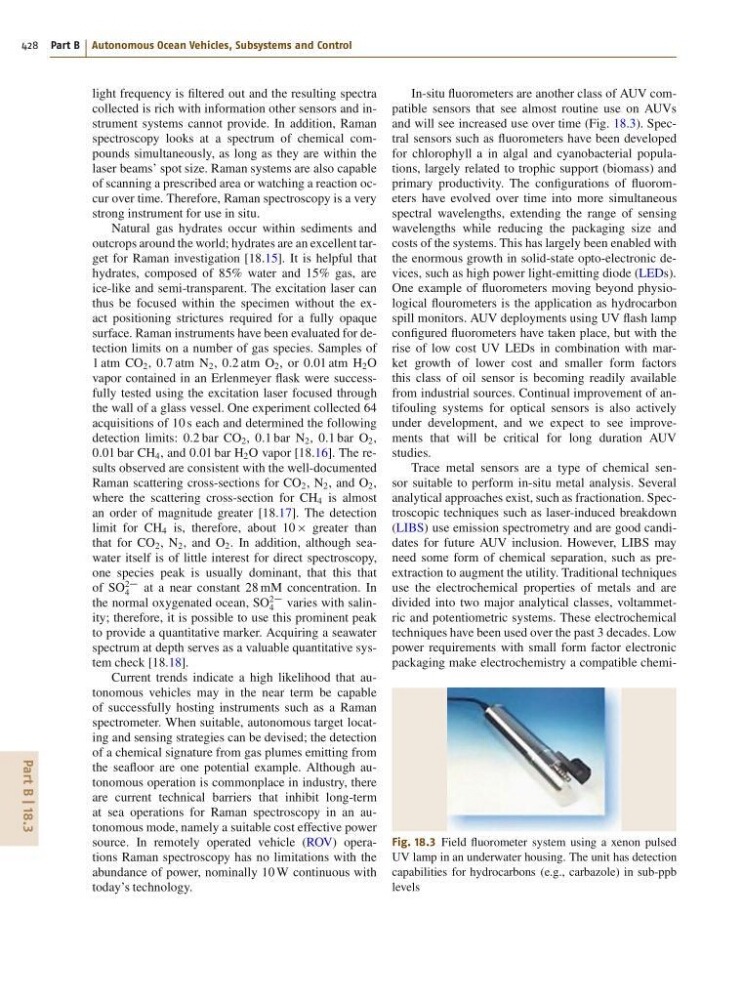
and will see increased use over time (Fig. 18.3). Spectral sensors such as fluorometers have been developed
for chlorophyll a in algal and cyanobacterial populations, largely related to trophic support (biomass) and
primary productivity. The configurations of fluorometers have evolved over time into more simultaneous
spectral wavelengths, extending the range of sensing
wavelengths while reducing the packaging size and
costs of the systems. This has largely been enabled with
the enormous growth in solid-state opto-electronic devices, such as high power light-emitting diode (LEDs).
One example of fluorometers moving beyond physiological flourometers is the application as hydrocarbon
spill monitors. AUV deployments using UV flash lamp
configured fluorometers have taken place, but with the
rise of low cost UV LEDs in combination with market growth of lower cost and smaller form factors
this class of oil sensor is becoming readily available
from industrial sources. Continual improvement of antifouling systems for optical sensors is also actively
under development, and we expect to see improvements that will be critical for long duration AUV
studies.
Trace metal sensors are a type of chemical sensor suitable to perform in-situ metal analysis. Several
analytical approaches exist, such as fractionation. Spectroscopic techniques such as laser-induced breakdown
(LIBS) use emission spectrometry and are good candidates for future AUV inclusion. However, LIBS may
need some form of chemical separation, such as preextraction to augment the utility. Traditional techniques
use the electrochemical properties of metals and are
divided into two major analytical classes, voltammetric and potentiometric systems. These electrochemical
techniques have been used over the past 3 decades. Low
power requirements with small form factor electronic
packaging make electrochemistry a compatible chemiFig. 18.3 Field fluorometer system using a xenon pulsed
UV lamp in an underwater housing. The unit has detection
capabilities for hydrocarbons (e.g., carbazole) in sub-ppb
levels
428 Part B Autonomous Ocean Vehicles, Subsystems and Control
light frequency is filtered out and the resulting spectra
collected is rich with information other sensors and instrument systems cannot provide. In addition, Raman
spectroscopy looks at a spectrum of chemical compounds simultaneously, as long as they are within the
laser beams’ spot size. Raman systems are also capable
of scanning a prescribed area or watching a reaction occur over time. Therefore, Raman spectroscopy is a very
strong instrument for use in situ.
Natural gas hydrates occur within sediments and
outcrops around the world; hydrates are an excellent target for Raman investigation [18.15]. It is helpful that
hydrates, composed of 85% water and 15% gas, are
ice-like and semi-transparent. The excitation laser can
thus be focused within the specimen without the exact positioning strictures required for a fully opaque
surface. Raman instruments have been evaluated for detection limits on a number of gas species. Samples of
1 atm CO 2 , 0:7 atm N 2 , 0:2 atm O 2 , or 0:01 atm H 2 O
vapor contained in an Erlenmeyer flask were successfully tested using the excitation laser focused through
the wall of a glass vessel. One experiment collected 64
acquisitions of 10 s each and determined the following
detection limits: 0:2 bar CO 2 , 0:1 bar N 2 , 0:1 bar O 2 ,
0:01 bar CH 4 , and 0:01 bar H 2 O vapor [18.16]. The results observed are consistent with the well-documented
Raman scattering cross-sections for CO 2 , N 2 , and O 2 ,
where the scattering cross-section for CH 4 is almost
an order of magnitude greater [18.17]. The detection
limit for CH 4 is, therefore, about 10 greater than
that for CO 2 , N 2 , and O 2 . In addition, although seawater itself is of little interest for direct spectroscopy,
one species peak is usually dominant, that this that
of SO
2
4
at a near constant 28 mM concentration. In
the normal oxygenated ocean, SO
2
4 varies with salinity; therefore, it is possible to use this prominent peak
to provide a quantitative marker. Acquiring a seawater
spectrum at depth serves as a valuable quantitative system check [18.18].
Current trends indicate a high likelihood that autonomous vehicles may in the near term be capable
of successfully hosting instruments such as a Raman
spectrometer. When suitable, autonomous target locating and sensing strategies can be devised; the detection
of a chemical signature from gas plumes emitting from
the seafloor are one potential example. Although autonomous operation is commonplace in industry, there
are current technical barriers that inhibit long-term
at sea operations for Raman spectroscopy in an autonomous mode, namely a suitable cost effective power
source. In remotely operated vehicle (ROV) operations Raman spectroscopy has no limitations with the
abundance of power, nominally 10 W continuous with
today’s technology.
In-situ fluorometers are another class of AUV compatible sensors that see almost routine use on AUVs
and will see increased use over time (Fig. 18.3). Spectral sensors such as fluorometers have been developed
for chlorophyll a in algal and cyanobacterial populations, largely related to trophic support (biomass) and
primary productivity. The configurations of fluorometers have evolved over time into more simultaneous
spectral wavelengths, extending the range of sensing
wavelengths while reducing the packaging size and
costs of the systems. This has largely been enabled with
the enormous growth in solid-state opto-electronic devices, such as high power light-emitting diode (LEDs).
One example of fluorometers moving beyond physiological flourometers is the application as hydrocarbon
spill monitors. AUV deployments using UV flash lamp
configured fluorometers have taken place, but with the
rise of low cost UV LEDs in combination with market growth of lower cost and smaller form factors
this class of oil sensor is becoming readily available
from industrial sources. Continual improvement of antifouling systems for optical sensors is also actively
under development, and we expect to see improvements that will be critical for long duration AUV
studies.
Trace metal sensors are a type of chemical sensor suitable to perform in-situ metal analysis. Several
analytical approaches exist, such as fractionation. Spectroscopic techniques such as laser-induced breakdown
(LIBS) use emission spectrometry and are good candidates for future AUV inclusion. However, LIBS may
need some form of chemical separation, such as preextraction to augment the utility. Traditional techniques
use the electrochemical properties of metals and are
divided into two major analytical classes, voltammetric and potentiometric systems. These electrochemical
techniques have been used over the past 3 decades. Low
power requirements with small form factor electronic
packaging make electrochemistry a compatible chemiFig. 18.3 Field fluorometer system using a xenon pulsed
UV lamp in an underwater housing. The unit has detection
capabilities for hydrocarbons (e.g., carbazole) in sub-ppb
levels