

Non-Acoustic Sensors 18.3 Chemical Sensor Systems 427
Part B | 18.3
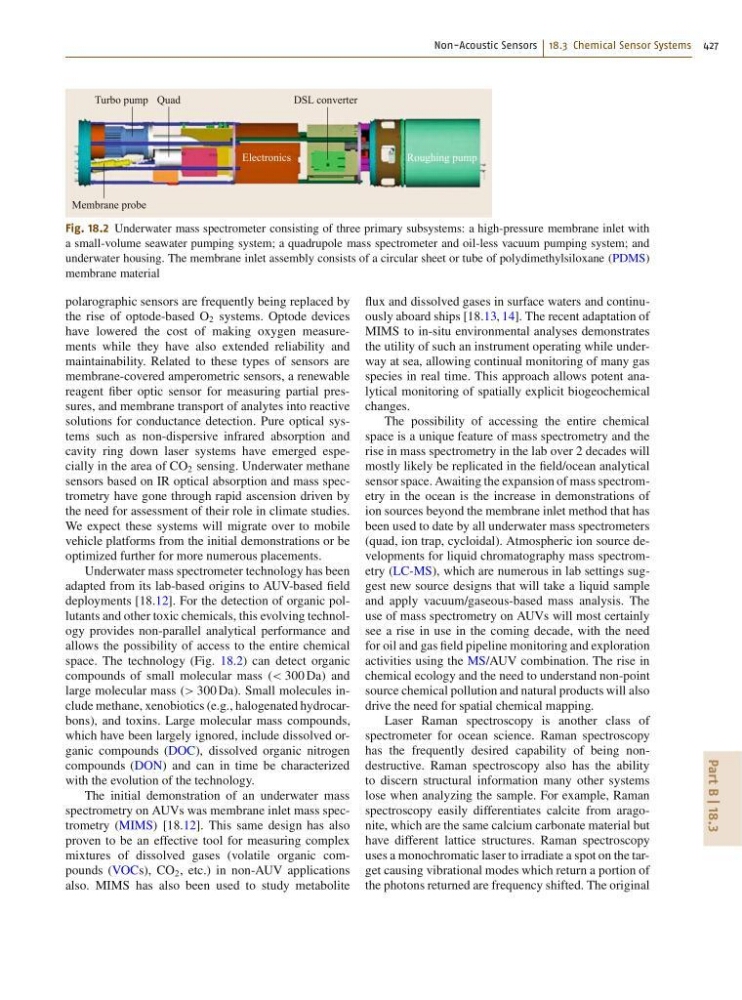
Membrane probe
Turbo pump Quad
DSL converter
Electronics
Roughing pump
Fig. 18.2 Underwater mass spectrometer consisting of three primary subsystems: a high-pressure membrane inlet with
a small-volume seawater pumping system; a quadrupole mass spectrometer and oil-less vacuum pumping system; and
underwater housing. The membrane inlet assembly consists of a circular sheet or tube of polydimethylsiloxane (PDMS)
membrane material
polarographic sensors are frequently being replaced by
the rise of optode-based O 2 systems. Optode devices
have lowered the cost of making oxygen measurements while they have also extended reliability and
maintainability. Related to these types of sensors are
membrane-covered amperometric sensors, a renewable
reagent fiber optic sensor for measuring partial pressures, and membrane transport of analytes into reactive
solutions for conductance detection. Pure optical systems such as non-dispersive infrared absorption and
cavity ring down laser systems have emerged especially in the area of CO 2 sensing. Underwater methane
sensors based on IR optical absorption and mass spectrometry have gone through rapid ascension driven by
the need for assessment of their role in climate studies.
We expect these systems will migrate over to mobile
vehicle platforms from the initial demonstrations or be
optimized further for more numerous placements.
Underwater mass spectrometer technology has been
adapted from its lab-based origins to AUV-based field
deployments [18.12]. For the detection of organic pollutants and other toxic chemicals, this evolving technology provides non-parallel analytical performance and
allows the possibility of access to the entire chemical
space. The technology (Fig. 18.2) can detect organic
compounds of small molecular mass (< 300 Da) and
large molecular mass (> 300 Da). Small molecules include methane, xenobiotics (e.g., halogenated hydrocarbons), and toxins. Large molecular mass compounds,
which have been largely ignored, include dissolved organic compounds (DOC), dissolved organic nitrogen
compounds (DON) and can in time be characterized
with the evolution of the technology.
The initial demonstration of an underwater mass
spectrometry on AUVs was membrane inlet mass spectrometry (MIMS) [18.12]. This same design has also
proven to be an effective tool for measuring complex
mixtures of dissolved gases (volatile organic compounds (VOCs), CO 2 , etc.) in non-AUV applications
also. MIMS has also been used to study metabolite
flux and dissolved gases in surface waters and continuously aboard ships [18.13, 14]. The recent adaptation of
MIMS to in-situ environmental analyses demonstrates
the utility of such an instrument operating while underway at sea, allowing continual monitoring of many gas
species in real time. This approach allows potent analytical monitoring of spatially explicit biogeochemical
changes.
The possibility of accessing the entire chemical
space is a unique feature of mass spectrometry and the
rise in mass spectrometry in the lab over 2 decades will
mostly likely be replicated in the field/ocean analytical
sensor space. Awaiting the expansion of mass spectrometry in the ocean is the increase in demonstrations of
ion sources beyond the membrane inlet method that has
been used to date by all underwater mass spectrometers
(quad, ion trap, cycloidal). Atmospheric ion source developments for liquid chromatography mass spectrometry (LC-MS), which are numerous in lab settings suggest new source designs that will take a liquid sample
and apply vacuum/gaseous-based mass analysis. The
use of mass spectrometry on AUVs will most certainly
see a rise in use in the coming decade, with the need
for oil and gas field pipeline monitoring and exploration
activities using the MS/AUV combination. The rise in
chemical ecology and the need to understand non-point
source chemical pollution and natural products will also
drive the need for spatial chemical mapping.
Laser Raman spectroscopy is another class of
spectrometer for ocean science. Raman spectroscopy
has the frequently desired capability of being nondestructive. Raman spectroscopy also has the ability
to discern structural information many other systems
lose when analyzing the sample. For example, Raman
spectroscopy easily differentiates calcite from aragonite, which are the same calcium carbonate material but
have different lattice structures. Raman spectroscopy
uses a monochromatic laser to irradiate a spot on the target causing vibrational modes which return a portion of
the photons returned are frequency shifted. The original
Part B | 18.3
Membrane probe
Turbo pump Quad
DSL converter
Electronics
Roughing pump
Fig. 18.2 Underwater mass spectrometer consisting of three primary subsystems: a high-pressure membrane inlet with
a small-volume seawater pumping system; a quadrupole mass spectrometer and oil-less vacuum pumping system; and
underwater housing. The membrane inlet assembly consists of a circular sheet or tube of polydimethylsiloxane (PDMS)
membrane material
polarographic sensors are frequently being replaced by
the rise of optode-based O 2 systems. Optode devices
have lowered the cost of making oxygen measurements while they have also extended reliability and
maintainability. Related to these types of sensors are
membrane-covered amperometric sensors, a renewable
reagent fiber optic sensor for measuring partial pressures, and membrane transport of analytes into reactive
solutions for conductance detection. Pure optical systems such as non-dispersive infrared absorption and
cavity ring down laser systems have emerged especially in the area of CO 2 sensing. Underwater methane
sensors based on IR optical absorption and mass spectrometry have gone through rapid ascension driven by
the need for assessment of their role in climate studies.
We expect these systems will migrate over to mobile
vehicle platforms from the initial demonstrations or be
optimized further for more numerous placements.
Underwater mass spectrometer technology has been
adapted from its lab-based origins to AUV-based field
deployments [18.12]. For the detection of organic pollutants and other toxic chemicals, this evolving technology provides non-parallel analytical performance and
allows the possibility of access to the entire chemical
space. The technology (Fig. 18.2) can detect organic
compounds of small molecular mass (< 300 Da) and
large molecular mass (> 300 Da). Small molecules include methane, xenobiotics (e.g., halogenated hydrocarbons), and toxins. Large molecular mass compounds,
which have been largely ignored, include dissolved organic compounds (DOC), dissolved organic nitrogen
compounds (DON) and can in time be characterized
with the evolution of the technology.
The initial demonstration of an underwater mass
spectrometry on AUVs was membrane inlet mass spectrometry (MIMS) [18.12]. This same design has also
proven to be an effective tool for measuring complex
mixtures of dissolved gases (volatile organic compounds (VOCs), CO 2 , etc.) in non-AUV applications
also. MIMS has also been used to study metabolite
flux and dissolved gases in surface waters and continuously aboard ships [18.13, 14]. The recent adaptation of
MIMS to in-situ environmental analyses demonstrates
the utility of such an instrument operating while underway at sea, allowing continual monitoring of many gas
species in real time. This approach allows potent analytical monitoring of spatially explicit biogeochemical
changes.
The possibility of accessing the entire chemical
space is a unique feature of mass spectrometry and the
rise in mass spectrometry in the lab over 2 decades will
mostly likely be replicated in the field/ocean analytical
sensor space. Awaiting the expansion of mass spectrometry in the ocean is the increase in demonstrations of
ion sources beyond the membrane inlet method that has
been used to date by all underwater mass spectrometers
(quad, ion trap, cycloidal). Atmospheric ion source developments for liquid chromatography mass spectrometry (LC-MS), which are numerous in lab settings suggest new source designs that will take a liquid sample
and apply vacuum/gaseous-based mass analysis. The
use of mass spectrometry on AUVs will most certainly
see a rise in use in the coming decade, with the need
for oil and gas field pipeline monitoring and exploration
activities using the MS/AUV combination. The rise in
chemical ecology and the need to understand non-point
source chemical pollution and natural products will also
drive the need for spatial chemical mapping.
Laser Raman spectroscopy is another class of
spectrometer for ocean science. Raman spectroscopy
has the frequently desired capability of being nondestructive. Raman spectroscopy also has the ability
to discern structural information many other systems
lose when analyzing the sample. For example, Raman
spectroscopy easily differentiates calcite from aragonite, which are the same calcium carbonate material but
have different lattice structures. Raman spectroscopy
uses a monochromatic laser to irradiate a spot on the target causing vibrational modes which return a portion of
the photons returned are frequency shifted. The original