

Autonomous Underwater Vehicle Docking 16.4 Capture and Connection Mechanisms 397
Part B | 16.4
deployment. In the second case, the dock orientation
is determined by the platform hosting the dock. Since
almost all dock homing methodologies assume a constant or near constant depth approach, assuring the dock
is level is an important consideration in design and
deployment. For example, a bottom-mounted system
might be placed on an uneven surface, causing the dock
to be tilted. The Dorado dock [16.2] gimballed the dock
on the support structure, using a large counterweight to
hold the dock upright and level. Various funnel docks
are depicted in Fig. 16.4.
16.4.2 Omnidirectional Docks: Poles
Pole docks are vertical structures, usually rigid poles or
cables under tension, to which the vehicle attaches with
a)
b)
d)
e)
c)
Homing beacon
Motorized
carriage
Passive
latch
Inductive
cores
AUV approaching
dock
AUV latched
Cores
aligned
Electronics and
battery housings
Pole
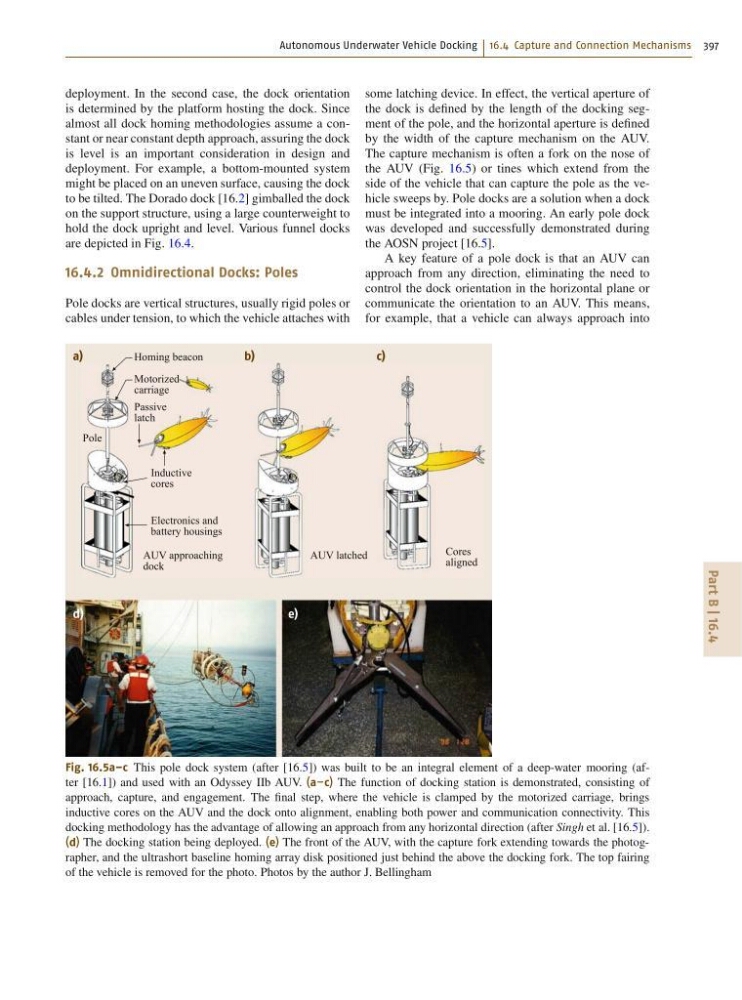
Fig. 16.5a–c This pole dock system (after [16.5]) was built to be an integral element of a deep-water mooring (after [16.1]) and used with an Odyssey IIb AUV. (a–c) The function of docking station is demonstrated, consisting of
approach, capture, and engagement. The final step, where the vehicle is clamped by the motorized carriage, brings
inductive cores on the AUV and the dock onto alignment, enabling both power and communication connectivity. This
docking methodology has the advantage of allowing an approach from any horizontal direction (after Singh et al. [16.5]).
(d) The docking station being deployed. (e) The front of the AUV, with the capture fork extending towards the photographer, and the ultrashort baseline homing array disk positioned just behind the above the docking fork. The top fairing
of the vehicle is removed for the photo. Photos by the author J. Bellingham
some latching device. In effect, the vertical aperture of
the dock is defined by the length of the docking segment of the pole, and the horizontal aperture is defined
by the width of the capture mechanism on the AUV.
The capture mechanism is often a fork on the nose of
the AUV (Fig. 16.5) or tines which extend from the
side of the vehicle that can capture the pole as the vehicle sweeps by. Pole docks are a solution when a dock
must be integrated into a mooring. An early pole dock
was developed and successfully demonstrated during
the AOSN project [16.5].
A key feature of a pole dock is that an AUV can
approach from any direction, eliminating the need to
control the dock orientation in the horizontal plane or
communicate the orientation to an AUV. This means,
for example, that a vehicle can always approach into
Part B | 16.4
deployment. In the second case, the dock orientation
is determined by the platform hosting the dock. Since
almost all dock homing methodologies assume a constant or near constant depth approach, assuring the dock
is level is an important consideration in design and
deployment. For example, a bottom-mounted system
might be placed on an uneven surface, causing the dock
to be tilted. The Dorado dock [16.2] gimballed the dock
on the support structure, using a large counterweight to
hold the dock upright and level. Various funnel docks
are depicted in Fig. 16.4.
16.4.2 Omnidirectional Docks: Poles
Pole docks are vertical structures, usually rigid poles or
cables under tension, to which the vehicle attaches with
a)
b)
d)
e)
c)
Homing beacon
Motorized
carriage
Passive
latch
Inductive
cores
AUV approaching
dock
AUV latched
Cores
aligned
Electronics and
battery housings
Pole
Fig. 16.5a–c This pole dock system (after [16.5]) was built to be an integral element of a deep-water mooring (after [16.1]) and used with an Odyssey IIb AUV. (a–c) The function of docking station is demonstrated, consisting of
approach, capture, and engagement. The final step, where the vehicle is clamped by the motorized carriage, brings
inductive cores on the AUV and the dock onto alignment, enabling both power and communication connectivity. This
docking methodology has the advantage of allowing an approach from any horizontal direction (after Singh et al. [16.5]).
(d) The docking station being deployed. (e) The front of the AUV, with the capture fork extending towards the photographer, and the ultrashort baseline homing array disk positioned just behind the above the docking fork. The top fairing
of the vehicle is removed for the photo. Photos by the author J. Bellingham
some latching device. In effect, the vertical aperture of
the dock is defined by the length of the docking segment of the pole, and the horizontal aperture is defined
by the width of the capture mechanism on the AUV.
The capture mechanism is often a fork on the nose of
the AUV (Fig. 16.5) or tines which extend from the
side of the vehicle that can capture the pole as the vehicle sweeps by. Pole docks are a solution when a dock
must be integrated into a mooring. An early pole dock
was developed and successfully demonstrated during
the AOSN project [16.5].
A key feature of a pole dock is that an AUV can
approach from any direction, eliminating the need to
control the dock orientation in the horizontal plane or
communicate the orientation to an AUV. This means,
for example, that a vehicle can always approach into