

Part B | 16.4
396 Part B Autonomous Ocean Vehicles, Subsystems and Control
The concept of a capture aperture is a useful abstraction for comparing docking methodologies. This
is best understood in the context of a simple model of
a dock as an area in space which defines the region the
vehicle must encounter during final approach for a successful capture. Typically, there are constraints on the
alignment of the vehicle with the dock as well.
16.4.1 Directional Docks: Funnels
Funnel docks are designed to provide a large crosssection with which to capture the vehicle and guide
it to a capture mechanism. In some cases, the funnel guides the vehicle to a cylindrical structure which
encloses all or part of the AUV. In most cases, the
vehicle drives into the dock under propulsion power.
Examples of funnel docks include the early Odyssey
docking systems [16.6, 7], the REMUS docking system [16.34], the Dorado docking system [16.2], and
the UUV (unmanned underwater vehicle) Docking and
Recharge System designed to accommodate multiple
vehicles [16.18]. Cone docking systems are most often
used with torpedo-like AUVs.
Attractive features of funnel-type docks include the
potential for a large capture aperture. Further, funnels
can be constructed to fully constrain the AUV after
a)
c)
b)
d)
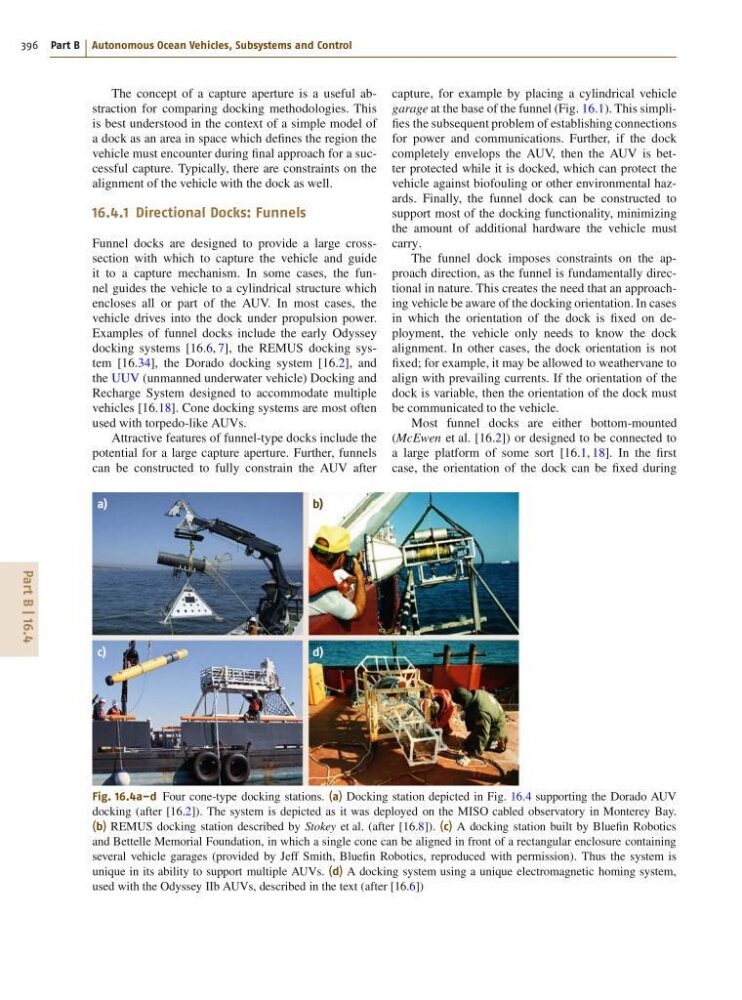
Fig. 16.4a–d Four cone-type docking stations. (a) Docking station depicted in Fig. 16.4 supporting the Dorado AUV
docking (after [16.2]). The system is depicted as it was deployed on the MISO cabled observatory in Monterey Bay.
(b) REMUS docking station described by Stokey et al. (after [16.8]). (c) A docking station built by Bluefin Robotics
and Bettelle Memorial Foundation, in which a single cone can be aligned in front of a rectangular enclosure containing
several vehicle garages (provided by Jeff Smith, Bluefin Robotics, reproduced with permission). Thus the system is
unique in its ability to support multiple AUVs. (d) A docking system using a unique electromagnetic homing system,
used with the Odyssey IIb AUVs, described in the text (after [16.6])
capture, for example by placing a cylindrical vehicle
garage at the base of the funnel (Fig. 16.1). This simplifies the subsequent problem of establishing connections
for power and communications. Further, if the dock
completely envelops the AUV, then the AUV is better protected while it is docked, which can protect the
vehicle against biofouling or other environmental hazards. Finally, the funnel dock can be constructed to
support most of the docking functionality, minimizing
the amount of additional hardware the vehicle must
carry.
The funnel dock imposes constraints on the approach direction, as the funnel is fundamentally directional in nature. This creates the need that an approaching vehicle be aware of the docking orientation. In cases
in which the orientation of the dock is fixed on deployment, the vehicle only needs to know the dock
alignment. In other cases, the dock orientation is not
fixed; for example, it may be allowed to weathervane to
align with prevailing currents. If the orientation of the
dock is variable, then the orientation of the dock must
be communicated to the vehicle.
Most funnel docks are either bottom-mounted
(McEwen et al. [16.2]) or designed to be connected to
a large platform of some sort [16.1, 18]. In the first
case, the orientation of the dock can be fixed during
396 Part B Autonomous Ocean Vehicles, Subsystems and Control
The concept of a capture aperture is a useful abstraction for comparing docking methodologies. This
is best understood in the context of a simple model of
a dock as an area in space which defines the region the
vehicle must encounter during final approach for a successful capture. Typically, there are constraints on the
alignment of the vehicle with the dock as well.
16.4.1 Directional Docks: Funnels
Funnel docks are designed to provide a large crosssection with which to capture the vehicle and guide
it to a capture mechanism. In some cases, the funnel guides the vehicle to a cylindrical structure which
encloses all or part of the AUV. In most cases, the
vehicle drives into the dock under propulsion power.
Examples of funnel docks include the early Odyssey
docking systems [16.6, 7], the REMUS docking system [16.34], the Dorado docking system [16.2], and
the UUV (unmanned underwater vehicle) Docking and
Recharge System designed to accommodate multiple
vehicles [16.18]. Cone docking systems are most often
used with torpedo-like AUVs.
Attractive features of funnel-type docks include the
potential for a large capture aperture. Further, funnels
can be constructed to fully constrain the AUV after
a)
c)
b)
d)
Fig. 16.4a–d Four cone-type docking stations. (a) Docking station depicted in Fig. 16.4 supporting the Dorado AUV
docking (after [16.2]). The system is depicted as it was deployed on the MISO cabled observatory in Monterey Bay.
(b) REMUS docking station described by Stokey et al. (after [16.8]). (c) A docking station built by Bluefin Robotics
and Bettelle Memorial Foundation, in which a single cone can be aligned in front of a rectangular enclosure containing
several vehicle garages (provided by Jeff Smith, Bluefin Robotics, reproduced with permission). Thus the system is
unique in its ability to support multiple AUVs. (d) A docking system using a unique electromagnetic homing system,
used with the Odyssey IIb AUVs, described in the text (after [16.6])
capture, for example by placing a cylindrical vehicle
garage at the base of the funnel (Fig. 16.1). This simplifies the subsequent problem of establishing connections
for power and communications. Further, if the dock
completely envelops the AUV, then the AUV is better protected while it is docked, which can protect the
vehicle against biofouling or other environmental hazards. Finally, the funnel dock can be constructed to
support most of the docking functionality, minimizing
the amount of additional hardware the vehicle must
carry.
The funnel dock imposes constraints on the approach direction, as the funnel is fundamentally directional in nature. This creates the need that an approaching vehicle be aware of the docking orientation. In cases
in which the orientation of the dock is fixed on deployment, the vehicle only needs to know the dock
alignment. In other cases, the dock orientation is not
fixed; for example, it may be allowed to weathervane to
align with prevailing currents. If the orientation of the
dock is variable, then the orientation of the dock must
be communicated to the vehicle.
Most funnel docks are either bottom-mounted
(McEwen et al. [16.2]) or designed to be connected to
a large platform of some sort [16.1, 18]. In the first
case, the orientation of the dock can be fixed during