

Part B | 16.2
390 Part B Autonomous Ocean Vehicles, Subsystems and Control
16.2 AUV Characteristics
The design and operational characteristics of a docking
system are intimately connected to the characteristics
of the AUV. Important parameters include the controllability of the platform, its external characteristics, its
size, and its ability to withstand impacts. For example,
some docking methodologies involve a slow and careful approach to the dock, while others achieve docking
by running the vehicle into the dock at or close to
its maximum speed. The reasons behind these different strategies largely revolve around the nature of the
AUV.
16.2.1 Vehicle Configuration
and Controllability
Perhaps the most common type of propeller-driven
AUVs are designed like torpedoes; they are propelled
by a single propeller, and their attitude controlled by
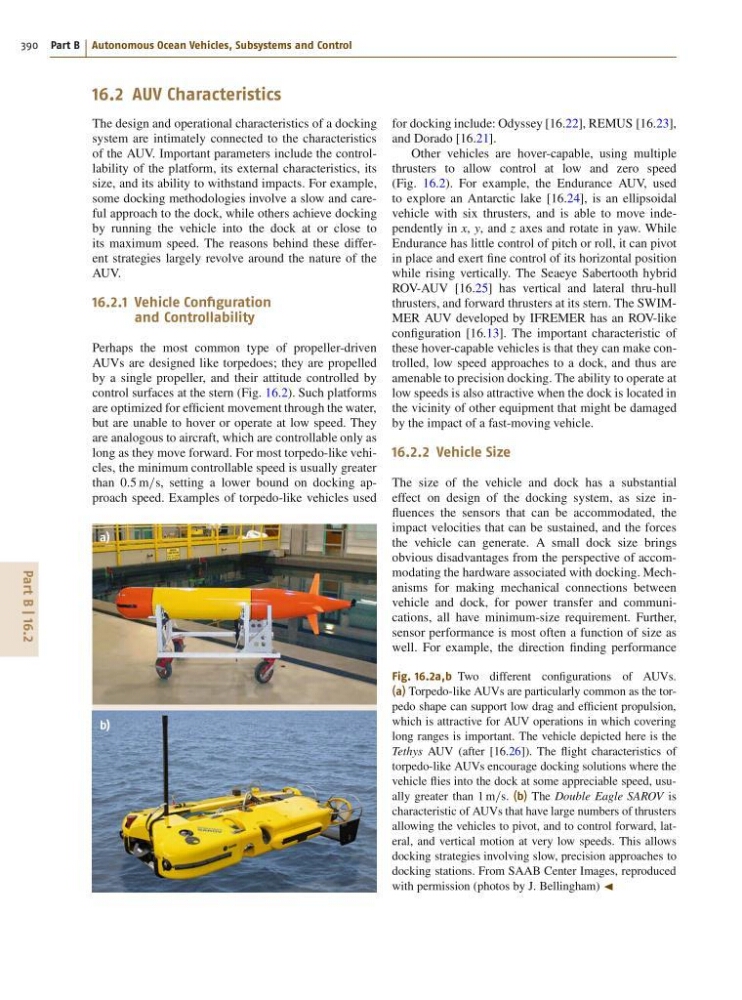
control surfaces at the stern (Fig. 16.2). Such platforms
are optimized for efficient movement through the water,
but are unable to hover or operate at low speed. They
are analogous to aircraft, which are controllable only as
long as they move forward. For most torpedo-like vehicles, the minimum controllable speed is usually greater
than 0:5 m=s, setting a lower bound on docking approach speed. Examples of torpedo-like vehicles used
a)
b)
for docking include: Odyssey [16.22], REMUS [16.23],
and Dorado [16.21].
Other vehicles are hover-capable, using multiple
thrusters to allow control at low and zero speed
(Fig. 16.2). For example, the Endurance AUV, used
to explore an Antarctic lake [16.24], is an ellipsoidal
vehicle with six thrusters, and is able to move independently in x, y, and z axes and rotate in yaw. While
Endurance has little control of pitch or roll, it can pivot
in place and exert fine control of its horizontal position
while rising vertically. The Seaeye Sabertooth hybrid
ROV-AUV [16.25] has vertical and lateral thru-hull
thrusters, and forward thrusters at its stern. The SWIMMER AUV developed by IFREMER has an ROV-like
configuration [16.13]. The important characteristic of
these hover-capable vehicles is that they can make controlled, low speed approaches to a dock, and thus are
amenable to precision docking. The ability to operate at
low speeds is also attractive when the dock is located in
the vicinity of other equipment that might be damaged
by the impact of a fast-moving vehicle.
16.2.2 Vehicle Size
The size of the vehicle and dock has a substantial
effect on design of the docking system, as size influences the sensors that can be accommodated, the
impact velocities that can be sustained, and the forces
the vehicle can generate. A small dock size brings
obvious disadvantages from the perspective of accommodating the hardware associated with docking. Mechanisms for making mechanical connections between
vehicle and dock, for power transfer and communications, all have minimum-size requirement. Further,
sensor performance is most often a function of size as
well. For example, the direction finding performance
Fig. 16.2a,b Two different configurations of AUVs.
(a) Torpedo-like AUVs are particularly common as the torpedo shape can support low drag and efficient propulsion,
which is attractive for AUV operations in which covering
long ranges is important. The vehicle depicted here is the
Tethys AUV (after [16.26]). The flight characteristics of
torpedo-like AUVs encourage docking solutions where the
vehicle flies into the dock at some appreciable speed, usually greater than 1 m=s. (b) The Double Eagle SAROV is
characteristic of AUVs that have large numbers of thrusters
allowing the vehicles to pivot, and to control forward, lateral, and vertical motion at very low speeds. This allows
docking strategies involving slow, precision approaches to
docking stations. From SAAB Center Images, reproduced
with permission (photos by J. Bellingham) J
390 Part B Autonomous Ocean Vehicles, Subsystems and Control
16.2 AUV Characteristics
The design and operational characteristics of a docking
system are intimately connected to the characteristics
of the AUV. Important parameters include the controllability of the platform, its external characteristics, its
size, and its ability to withstand impacts. For example,
some docking methodologies involve a slow and careful approach to the dock, while others achieve docking
by running the vehicle into the dock at or close to
its maximum speed. The reasons behind these different strategies largely revolve around the nature of the
AUV.
16.2.1 Vehicle Configuration
and Controllability
Perhaps the most common type of propeller-driven
AUVs are designed like torpedoes; they are propelled
by a single propeller, and their attitude controlled by
control surfaces at the stern (Fig. 16.2). Such platforms
are optimized for efficient movement through the water,
but are unable to hover or operate at low speed. They
are analogous to aircraft, which are controllable only as
long as they move forward. For most torpedo-like vehicles, the minimum controllable speed is usually greater
than 0:5 m=s, setting a lower bound on docking approach speed. Examples of torpedo-like vehicles used
a)
b)
for docking include: Odyssey [16.22], REMUS [16.23],
and Dorado [16.21].
Other vehicles are hover-capable, using multiple
thrusters to allow control at low and zero speed
(Fig. 16.2). For example, the Endurance AUV, used
to explore an Antarctic lake [16.24], is an ellipsoidal
vehicle with six thrusters, and is able to move independently in x, y, and z axes and rotate in yaw. While
Endurance has little control of pitch or roll, it can pivot
in place and exert fine control of its horizontal position
while rising vertically. The Seaeye Sabertooth hybrid
ROV-AUV [16.25] has vertical and lateral thru-hull
thrusters, and forward thrusters at its stern. The SWIMMER AUV developed by IFREMER has an ROV-like
configuration [16.13]. The important characteristic of
these hover-capable vehicles is that they can make controlled, low speed approaches to a dock, and thus are
amenable to precision docking. The ability to operate at
low speeds is also attractive when the dock is located in
the vicinity of other equipment that might be damaged
by the impact of a fast-moving vehicle.
16.2.2 Vehicle Size
The size of the vehicle and dock has a substantial
effect on design of the docking system, as size influences the sensors that can be accommodated, the
impact velocities that can be sustained, and the forces
the vehicle can generate. A small dock size brings
obvious disadvantages from the perspective of accommodating the hardware associated with docking. Mechanisms for making mechanical connections between
vehicle and dock, for power transfer and communications, all have minimum-size requirement. Further,
sensor performance is most often a function of size as
well. For example, the direction finding performance
Fig. 16.2a,b Two different configurations of AUVs.
(a) Torpedo-like AUVs are particularly common as the torpedo shape can support low drag and efficient propulsion,
which is attractive for AUV operations in which covering
long ranges is important. The vehicle depicted here is the
Tethys AUV (after [16.26]). The flight characteristics of
torpedo-like AUVs encourage docking solutions where the
vehicle flies into the dock at some appreciable speed, usually greater than 1 m=s. (b) The Double Eagle SAROV is
characteristic of AUVs that have large numbers of thrusters
allowing the vehicles to pivot, and to control forward, lateral, and vertical motion at very low speeds. This allows
docking strategies involving slow, precision approaches to
docking stations. From SAAB Center Images, reproduced
with permission (photos by J. Bellingham) J