

Part B | 15.5
374 Part B Autonomous Ocean Vehicles, Subsystems and Control
low-rate signals (the difference is about 2 dB). Another
way to save the energy is by minimizing the number
of retransmissions (we discuss the relevant protocols in
Sect. 15.5.6). Finally, energy spent in idle listening over
a longer period of time is not to be neglected. Having
modems that are capable of hibernation, or instituting
intentional sleeping schedules for those that are not, can
help to control this type of power expenditure [15.56].
15.5 Point-to-Point Links: Signal Processing
15.5.1 Noncoherent Modulation/Detection
Noncoherent signaling is commonly used to relay data
and to transmit command-and-control information at
low bit rates. Frequency-hopped m-ary frequency-shiftkey (FH-MFSK) modulation is widely accepted as a reliable albeit inefficient choice for such modems. FSK
modulation uses distinct tonal or frequency-modulated
pulses to map digital information. Frequency-hopping
is a spread-spectrum technique, which alternates portions of the frequency band over fixed periods of time,
so that successive FSK-modulated symbols use a different portion of the frequency spectrum, thus minimizing
inter-symbol-interference (ISI) caused by reverbera0
500 1000 1500 2000 2500 3000 3500 4000
a) ×10
4
Time sample number
1
0.8
0.6
0.4
0.2
0
–0.2
–0.4
–0.6
–0.8
–1
0
10 20 30 40 50 60 70 80
b) Frequency band number
50
55
60
65
70
75
80
85
90
95
100
60
50
40
30
20
10
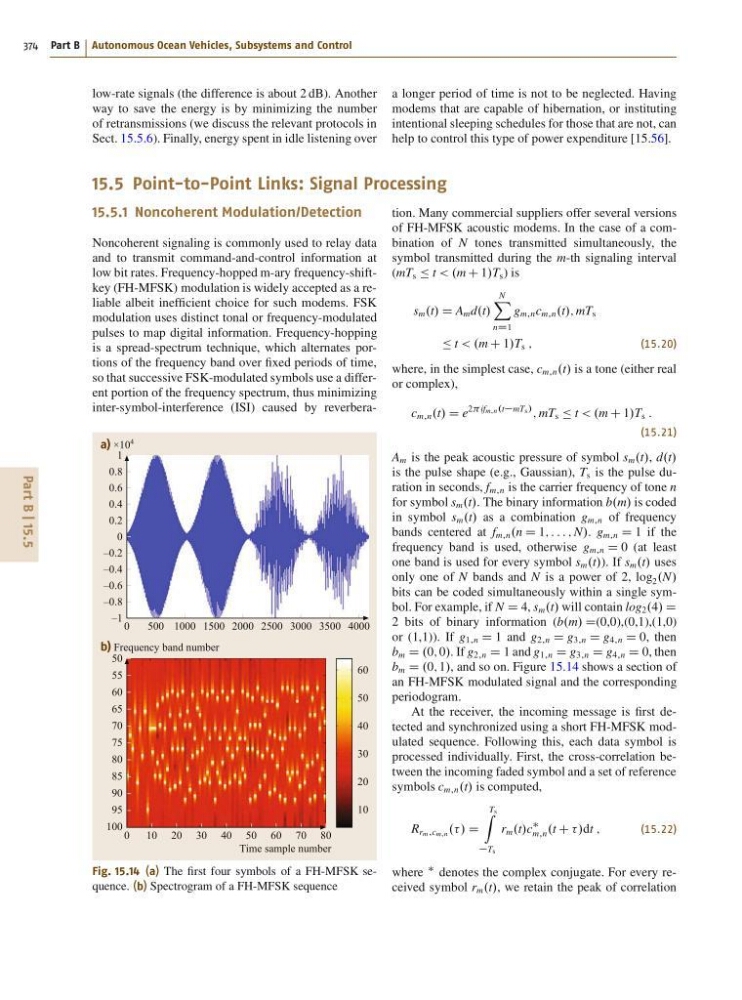
Fig. 15.14 (a) The first four symbols of a FH-MFSK sequence. (b) Spectrogram of a FH-MFSK sequence
tion. Many commercial suppliers offer several versions
of FH-MFSK acoustic modems. In the case of a combination of N tones transmitted simultaneously, the
symbol transmitted during the m-th signaling interval
(mT s Ä t < .m C 1/T s ) is
s m .t/ D A m d.t/
N
X
nD1
g m;n c m;n .t/; mT s
Ä t < .m C 1/T s ;
(15.20)
where, in the simplest case, c m;n .t/ is a tone (either real
or complex),
c m;n .t/ D e
2ifm;n.tmTs/
; mT s Ä t < .m C 1/T s :
(15.21)
A m is the peak acoustic pressure of symbol s m .t/, d.t/
is the pulse shape (e.g., Gaussian), T s is the pulse duration in seconds, f m;n is the carrier frequency of tone n
for symbol s m .t/. The binary information b.m/ is coded
in symbol s m .t/ as a combination g m;n of frequency
bands centered at f m;n .n D 1; : : : ; N/. g m;n D 1 if the
frequency band is used, otherwise g m;n D 0 (at least
one band is used for every symbol s m .t/). If s m .t/ uses
only one of N bands and N is a power of 2, log 2 .N/
bits can be coded simultaneously within a single symbol. For example, if N D 4, s m .t/ will contain log 2 .4/ D
2 bits of binary information (b.m/ D(0,0),(0,1),(1,0)
or (1,1)). If g 1;n D 1 and g 2;n D g 3;n D g 4;n D 0, then
b m D .0; 0/. If g 2;n D 1 and g 1;n D g 3;n D g 4;n D 0, then
b m D .0; 1/, and so on. Figure 15.14 shows a section of
an FH-MFSK modulated signal and the corresponding
periodogram.
At the receiver, the incoming message is first detected and synchronized using a short FH-MFSK modulated sequence. Following this, each data symbol is
processed individually. First, the cross-correlation between the incoming faded symbol and a set of reference
symbols c m;n .t/ is computed,
R rm;cm;n ../ D
Ts
Z
Ts
r m .t/c
m;n .t C /dt ;
(15.22)
where
denotes the complex conjugate. For every received symbol r m .t/, we retain the peak of correlation
374 Part B Autonomous Ocean Vehicles, Subsystems and Control
low-rate signals (the difference is about 2 dB). Another
way to save the energy is by minimizing the number
of retransmissions (we discuss the relevant protocols in
Sect. 15.5.6). Finally, energy spent in idle listening over
a longer period of time is not to be neglected. Having
modems that are capable of hibernation, or instituting
intentional sleeping schedules for those that are not, can
help to control this type of power expenditure [15.56].
15.5 Point-to-Point Links: Signal Processing
15.5.1 Noncoherent Modulation/Detection
Noncoherent signaling is commonly used to relay data
and to transmit command-and-control information at
low bit rates. Frequency-hopped m-ary frequency-shiftkey (FH-MFSK) modulation is widely accepted as a reliable albeit inefficient choice for such modems. FSK
modulation uses distinct tonal or frequency-modulated
pulses to map digital information. Frequency-hopping
is a spread-spectrum technique, which alternates portions of the frequency band over fixed periods of time,
so that successive FSK-modulated symbols use a different portion of the frequency spectrum, thus minimizing
inter-symbol-interference (ISI) caused by reverbera0
500 1000 1500 2000 2500 3000 3500 4000
a) ×10
4
Time sample number
1
0.8
0.6
0.4
0.2
0
–0.2
–0.4
–0.6
–0.8
–1
0
10 20 30 40 50 60 70 80
b) Frequency band number
50
55
60
65
70
75
80
85
90
95
100
60
50
40
30
20
10
Fig. 15.14 (a) The first four symbols of a FH-MFSK sequence. (b) Spectrogram of a FH-MFSK sequence
tion. Many commercial suppliers offer several versions
of FH-MFSK acoustic modems. In the case of a combination of N tones transmitted simultaneously, the
symbol transmitted during the m-th signaling interval
(mT s Ä t < .m C 1/T s ) is
s m .t/ D A m d.t/
N
X
nD1
g m;n c m;n .t/; mT s
Ä t < .m C 1/T s ;
(15.20)
where, in the simplest case, c m;n .t/ is a tone (either real
or complex),
c m;n .t/ D e
2ifm;n.tmTs/
; mT s Ä t < .m C 1/T s :
(15.21)
A m is the peak acoustic pressure of symbol s m .t/, d.t/
is the pulse shape (e.g., Gaussian), T s is the pulse duration in seconds, f m;n is the carrier frequency of tone n
for symbol s m .t/. The binary information b.m/ is coded
in symbol s m .t/ as a combination g m;n of frequency
bands centered at f m;n .n D 1; : : : ; N/. g m;n D 1 if the
frequency band is used, otherwise g m;n D 0 (at least
one band is used for every symbol s m .t/). If s m .t/ uses
only one of N bands and N is a power of 2, log 2 .N/
bits can be coded simultaneously within a single symbol. For example, if N D 4, s m .t/ will contain log 2 .4/ D
2 bits of binary information (b.m/ D(0,0),(0,1),(1,0)
or (1,1)). If g 1;n D 1 and g 2;n D g 3;n D g 4;n D 0, then
b m D .0; 0/. If g 2;n D 1 and g 1;n D g 3;n D g 4;n D 0, then
b m D .0; 1/, and so on. Figure 15.14 shows a section of
an FH-MFSK modulated signal and the corresponding
periodogram.
At the receiver, the incoming message is first detected and synchronized using a short FH-MFSK modulated sequence. Following this, each data symbol is
processed individually. First, the cross-correlation between the incoming faded symbol and a set of reference
symbols c m;n .t/ is computed,
R rm;cm;n ../ D
Ts
Z
Ts
r m .t/c
m;n .t C /dt ;
(15.22)
where
denotes the complex conjugate. For every received symbol r m .t/, we retain the peak of correlation