

Part B | 15.4
372 Part B Autonomous Ocean Vehicles, Subsystems and Control
g
g 0 – k 0 10 log d
100 200 300 400 500 600 700 800 900 1000
a) Gain (dB)
Distance (m)
30
25
20
15
10
5
–15
–10
–5
0
5
10
15
b) pdf
x (dB)
0.16
0.14
0.12
0.1
0.08
0.06
0.04
0.02
0
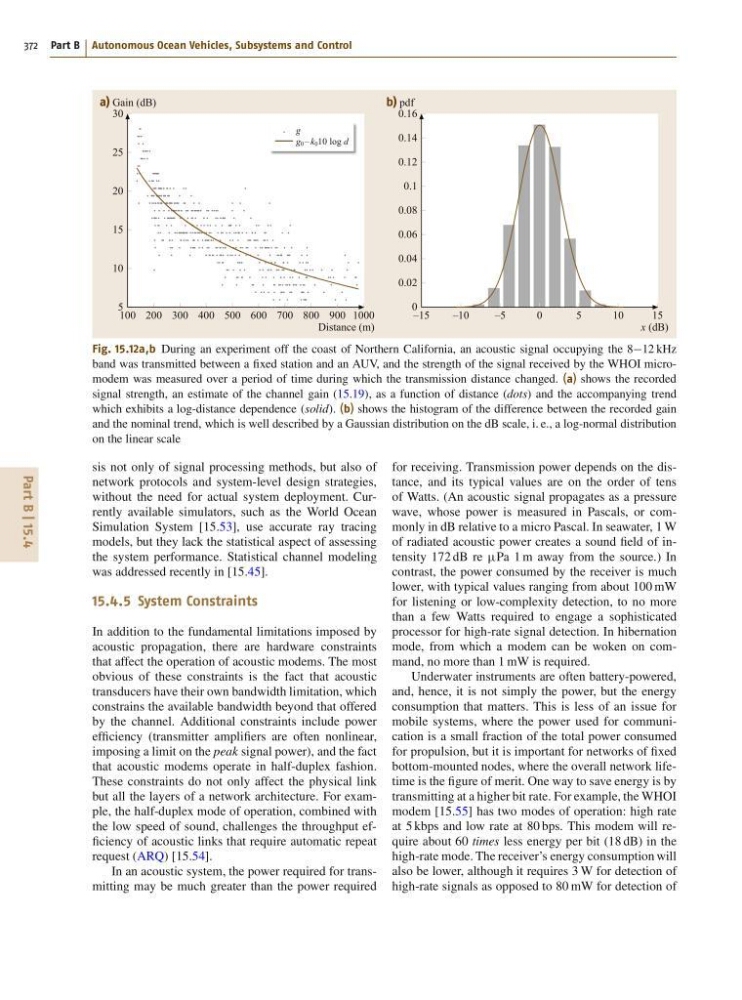
Fig. 15.12a,b During an experiment off the coast of Northern California, an acoustic signal occupying the 812 kHz
band was transmitted between a fixed station and an AUV, and the strength of the signal received by the WHOI micromodem was measured over a period of time during which the transmission distance changed. (a) shows the recorded
signal strength, an estimate of the channel gain (15.19), as a function of distance (dots) and the accompanying trend
which exhibits a log-distance dependence (solid). (b) shows the histogram of the difference between the recorded gain
and the nominal trend, which is well described by a Gaussian distribution on the dB scale, i. e., a log-normal distribution
on the linear scale
sis not only of signal processing methods, but also of
network protocols and system-level design strategies,
without the need for actual system deployment. Currently available simulators, such as the World Ocean
Simulation System [15.53], use accurate ray tracing
models, but they lack the statistical aspect of assessing
the system performance. Statistical channel modeling
was addressed recently in [15.45].
15.4.5 System Constraints
In addition to the fundamental limitations imposed by
acoustic propagation, there are hardware constraints
that affect the operation of acoustic modems. The most
obvious of these constraints is the fact that acoustic
transducers have their own bandwidth limitation, which
constrains the available bandwidth beyond that offered
by the channel. Additional constraints include power
efficiency (transmitter amplifiers are often nonlinear,
imposing a limit on the peak signal power), and the fact
that acoustic modems operate in half-duplex fashion.
These constraints do not only affect the physical link
but all the layers of a network architecture. For example, the half-duplex mode of operation, combined with
the low speed of sound, challenges the throughput efficiency of acoustic links that require automatic repeat
request (ARQ) [15.54].
In an acoustic system, the power required for transmitting may be much greater than the power required
for receiving. Transmission power depends on the distance, and its typical values are on the order of tens
of Watts. (An acoustic signal propagates as a pressure
wave, whose power is measured in Pascals, or commonly in dB relative to a micro Pascal. In seawater, 1 W
of radiated acoustic power creates a sound field of intensity 172 dB re Pa 1 m away from the source.) In
contrast, the power consumed by the receiver is much
lower, with typical values ranging from about 100 mW
for listening or low-complexity detection, to no more
than a few Watts required to engage a sophisticated
processor for high-rate signal detection. In hibernation
mode, from which a modem can be woken on command, no more than 1 mW is required.
Underwater instruments are often battery-powered,
and, hence, it is not simply the power, but the energy
consumption that matters. This is less of an issue for
mobile systems, where the power used for communication is a small fraction of the total power consumed
for propulsion, but it is important for networks of fixed
bottom-mounted nodes, where the overall network lifetime is the figure of merit. One way to save energy is by
transmitting at a higher bit rate. For example, the WHOI
modem [15.55] has two modes of operation: high rate
at 5 kbps and low rate at 80 bps. This modem will require about 60 times less energy per bit (18 dB) in the
high-rate mode. The receiver’s energy consumption will
also be lower, although it requires 3 W for detection of
high-rate signals as opposed to 80 mW for detection of
372 Part B Autonomous Ocean Vehicles, Subsystems and Control
g
g 0 – k 0 10 log d
100 200 300 400 500 600 700 800 900 1000
a) Gain (dB)
Distance (m)
30
25
20
15
10
5
–15
–10
–5
0
5
10
15
b) pdf
x (dB)
0.16
0.14
0.12
0.1
0.08
0.06
0.04
0.02
0
Fig. 15.12a,b During an experiment off the coast of Northern California, an acoustic signal occupying the 812 kHz
band was transmitted between a fixed station and an AUV, and the strength of the signal received by the WHOI micromodem was measured over a period of time during which the transmission distance changed. (a) shows the recorded
signal strength, an estimate of the channel gain (15.19), as a function of distance (dots) and the accompanying trend
which exhibits a log-distance dependence (solid). (b) shows the histogram of the difference between the recorded gain
and the nominal trend, which is well described by a Gaussian distribution on the dB scale, i. e., a log-normal distribution
on the linear scale
sis not only of signal processing methods, but also of
network protocols and system-level design strategies,
without the need for actual system deployment. Currently available simulators, such as the World Ocean
Simulation System [15.53], use accurate ray tracing
models, but they lack the statistical aspect of assessing
the system performance. Statistical channel modeling
was addressed recently in [15.45].
15.4.5 System Constraints
In addition to the fundamental limitations imposed by
acoustic propagation, there are hardware constraints
that affect the operation of acoustic modems. The most
obvious of these constraints is the fact that acoustic
transducers have their own bandwidth limitation, which
constrains the available bandwidth beyond that offered
by the channel. Additional constraints include power
efficiency (transmitter amplifiers are often nonlinear,
imposing a limit on the peak signal power), and the fact
that acoustic modems operate in half-duplex fashion.
These constraints do not only affect the physical link
but all the layers of a network architecture. For example, the half-duplex mode of operation, combined with
the low speed of sound, challenges the throughput efficiency of acoustic links that require automatic repeat
request (ARQ) [15.54].
In an acoustic system, the power required for transmitting may be much greater than the power required
for receiving. Transmission power depends on the distance, and its typical values are on the order of tens
of Watts. (An acoustic signal propagates as a pressure
wave, whose power is measured in Pascals, or commonly in dB relative to a micro Pascal. In seawater, 1 W
of radiated acoustic power creates a sound field of intensity 172 dB re Pa 1 m away from the source.) In
contrast, the power consumed by the receiver is much
lower, with typical values ranging from about 100 mW
for listening or low-complexity detection, to no more
than a few Watts required to engage a sophisticated
processor for high-rate signal detection. In hibernation
mode, from which a modem can be woken on command, no more than 1 mW is required.
Underwater instruments are often battery-powered,
and, hence, it is not simply the power, but the energy
consumption that matters. This is less of an issue for
mobile systems, where the power used for communication is a small fraction of the total power consumed
for propulsion, but it is important for networks of fixed
bottom-mounted nodes, where the overall network lifetime is the figure of merit. One way to save energy is by
transmitting at a higher bit rate. For example, the WHOI
modem [15.55] has two modes of operation: high rate
at 5 kbps and low rate at 80 bps. This modem will require about 60 times less energy per bit (18 dB) in the
high-rate mode. The receiver’s energy consumption will
also be lower, although it requires 3 W for detection of
high-rate signals as opposed to 80 mW for detection of