

Part B | 13.1
324 Part B Autonomous Ocean Vehicles, Subsystems and Control
USVs have greatly advanced in capability over the
past 10 years and can be of substantial use in missions
today. As these developments continue, USVs are expected to soon have capabilities formerly seen only in
much larger, manned vessels and aircraft. USVs are
now being sold commercially, under development, used
operationally, and are considered for operational use
by a number of nations. The utility of USVs can be
thought of as dependent on the complexity of mission
they are called on to do, the complexity of environment,
and the degree of involvement of human operators. Today, USVs are on the lower end of the mission and
environmental complexity scales; therefore, a substantial degree of human operator involvement is required.
In the future, as technology matures, operations with
greater mission and environmental complexity will become possible and less human involvement will be
required. For example, currently USVs generally operate in fair weather and low sea states, and in areas
of little or no other maritime traffic. Capability is
degraded in higher sea states, in part due to limitations of sensors and algorithms. In the future, USVs
will be called on to operate in degraded weather conditions and higher sea states. Missions that require
patrol and running tracks are fairly straightforward
and can be undertaken today. Missions that require
the USV to adjust on-the-fly to changing situations
are still in the future. Today, the human operator is
commonly responsible for hazard avoidance, controlling the USV remotely based on video streamed from
the USV. As the autonomy matures, more functionality will be assumed by the autonomous control system,
freeing the USV from the tether of a communications system and reducing the workload of the human
operator.
USVs are a system composed of the platform, the
navigation/maneuvering control system, and a payload.
Additional system components may include, for example, subsystems for launch, recovery, and refueling.
The following sections will address USV platforms and
control systems; payloads are outside the scope of this
chapter.
13.1 Platforms
The US Navy USV Master Plan has classified USVs
into four size ranges: Fleet Class (approximately
11 m in length), Harbor Class (approximately 7 m in
length), X-Class (small USVs deployable from an 11 m
RHIB (rigid hull inflatable boat)) and Snorkler (semisubmersible platforms) [13.5]. All of these size classes
are designed to operate from, and in close proximity to,
conventional ships, or close to shore-based pier facilities. The USV mission is typically in support of conventional ships, and their size is limited by host ship launch
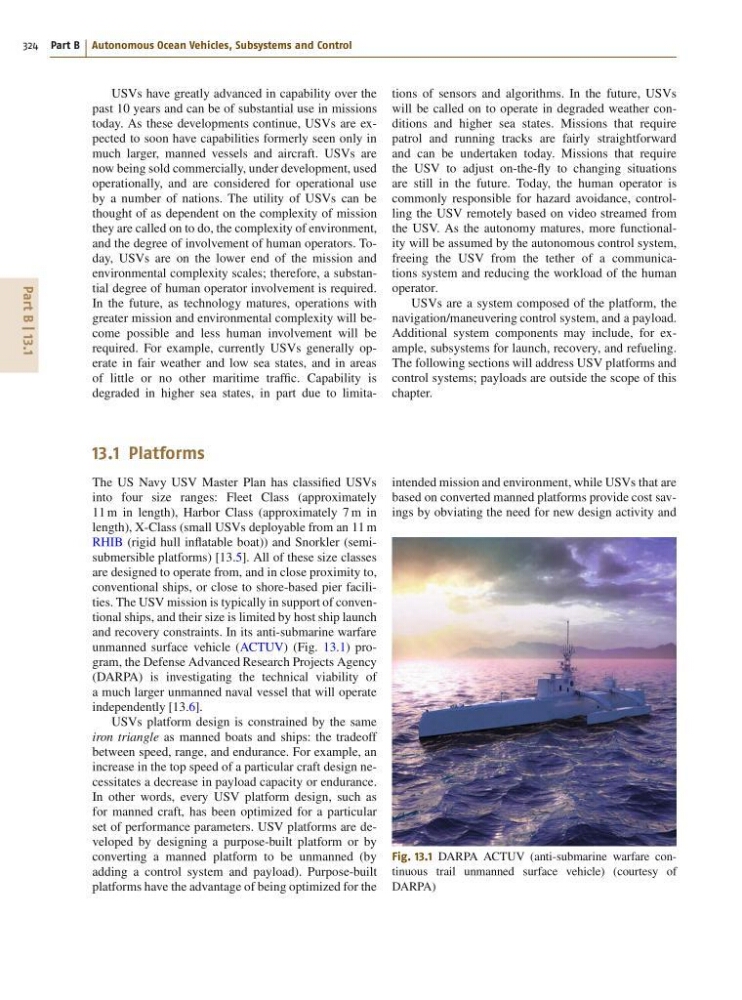
and recovery constraints. In its anti-submarine warfare
unmanned surface vehicle (ACTUV) (Fig. 13.1) program, the Defense Advanced Research Projects Agency
(DARPA) is investigating the technical viability of
a much larger unmanned naval vessel that will operate
independently [13.6].
USVs platform design is constrained by the same
iron triangle as manned boats and ships: the tradeoff
between speed, range, and endurance. For example, an
increase in the top speed of a particular craft design necessitates a decrease in payload capacity or endurance.
In other words, every USV platform design, such as
for manned craft, has been optimized for a particular
set of performance parameters. USV platforms are developed by designing a purpose-built platform or by
converting a manned platform to be unmanned (by
adding a control system and payload). Purpose-built
platforms have the advantage of being optimized for the
intended mission and environment, while USVs that are
based on converted manned platforms provide cost savings by obviating the need for new design activity and
Fig. 13.1 DARPA ACTUV (anti-submarine warfare continuous trail unmanned surface vehicle) (courtesy of
DARPA)
324 Part B Autonomous Ocean Vehicles, Subsystems and Control
USVs have greatly advanced in capability over the
past 10 years and can be of substantial use in missions
today. As these developments continue, USVs are expected to soon have capabilities formerly seen only in
much larger, manned vessels and aircraft. USVs are
now being sold commercially, under development, used
operationally, and are considered for operational use
by a number of nations. The utility of USVs can be
thought of as dependent on the complexity of mission
they are called on to do, the complexity of environment,
and the degree of involvement of human operators. Today, USVs are on the lower end of the mission and
environmental complexity scales; therefore, a substantial degree of human operator involvement is required.
In the future, as technology matures, operations with
greater mission and environmental complexity will become possible and less human involvement will be
required. For example, currently USVs generally operate in fair weather and low sea states, and in areas
of little or no other maritime traffic. Capability is
degraded in higher sea states, in part due to limitations of sensors and algorithms. In the future, USVs
will be called on to operate in degraded weather conditions and higher sea states. Missions that require
patrol and running tracks are fairly straightforward
and can be undertaken today. Missions that require
the USV to adjust on-the-fly to changing situations
are still in the future. Today, the human operator is
commonly responsible for hazard avoidance, controlling the USV remotely based on video streamed from
the USV. As the autonomy matures, more functionality will be assumed by the autonomous control system,
freeing the USV from the tether of a communications system and reducing the workload of the human
operator.
USVs are a system composed of the platform, the
navigation/maneuvering control system, and a payload.
Additional system components may include, for example, subsystems for launch, recovery, and refueling.
The following sections will address USV platforms and
control systems; payloads are outside the scope of this
chapter.
13.1 Platforms
The US Navy USV Master Plan has classified USVs
into four size ranges: Fleet Class (approximately
11 m in length), Harbor Class (approximately 7 m in
length), X-Class (small USVs deployable from an 11 m
RHIB (rigid hull inflatable boat)) and Snorkler (semisubmersible platforms) [13.5]. All of these size classes
are designed to operate from, and in close proximity to,
conventional ships, or close to shore-based pier facilities. The USV mission is typically in support of conventional ships, and their size is limited by host ship launch
and recovery constraints. In its anti-submarine warfare
unmanned surface vehicle (ACTUV) (Fig. 13.1) program, the Defense Advanced Research Projects Agency
(DARPA) is investigating the technical viability of
a much larger unmanned naval vessel that will operate
independently [13.6].
USVs platform design is constrained by the same
iron triangle as manned boats and ships: the tradeoff
between speed, range, and endurance. For example, an
increase in the top speed of a particular craft design necessitates a decrease in payload capacity or endurance.
In other words, every USV platform design, such as
for manned craft, has been optimized for a particular
set of performance parameters. USV platforms are developed by designing a purpose-built platform or by
converting a manned platform to be unmanned (by
adding a control system and payload). Purpose-built
platforms have the advantage of being optimized for the
intended mission and environment, while USVs that are
based on converted manned platforms provide cost savings by obviating the need for new design activity and
Fig. 13.1 DARPA ACTUV (anti-submarine warfare continuous trail unmanned surface vehicle) (courtesy of
DARPA)