

Autonomous Underwater Gliders 12.4 Optimal Size and Shape for Horizontal Transport Efficiency 317
Part B | 12.4
a)
b)
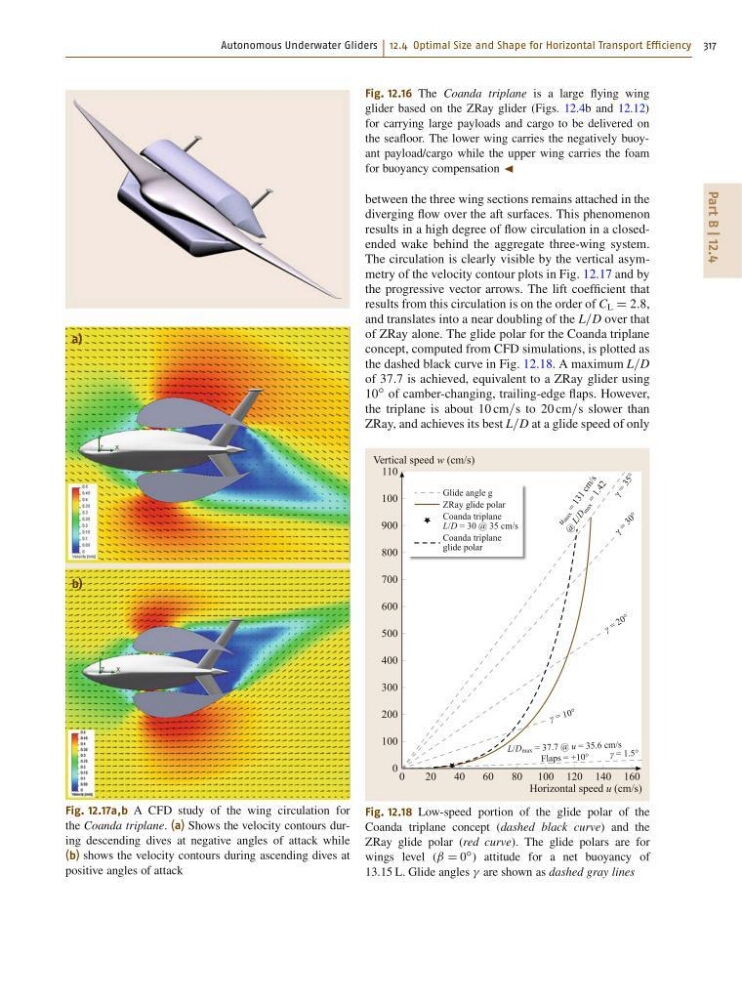
Fig. 12.17a,b A CFD study of the wing circulation for
the Coanda triplane. (a) Shows the velocity contours during descending dives at negative angles of attack while
(b) shows the velocity contours during ascending dives at
positive angles of attack
Fig. 12.16 The Coanda triplane is a large flying wing
glider based on the ZRay glider (Figs. 12.4b and 12.12)
for carrying large payloads and cargo to be delivered on
the seafloor. The lower wing carries the negatively buoyant payload/cargo while the upper wing carries the foam
for buoyancy compensation J
between the three wing sections remains attached in the
diverging flow over the aft surfaces. This phenomenon
results in a high degree of flow circulation in a closedended wake behind the aggregate three-wing system.
The circulation is clearly visible by the vertical asymmetry of the velocity contour plots in Fig. 12.17 and by
the progressive vector arrows. The lift coefficient that
results from this circulation is on the order of C L D 2:8,
and translates into a near doubling of the L=D over that
of ZRay alone. The glide polar for the Coanda triplane
concept, computed from CFD simulations, is plotted as
the dashed black curve in Fig. 12.18. A maximum L=D
of 37:7 is achieved, equivalent to a ZRay glider using
10
ı of camber-changing, trailing-edge flaps. However,
the triplane is about 10 cm=s to 20 cm=s slower than
ZRay, and achieves its best L=D at a glide speed of only
Glide angle g
ZRay glide polar
Coanda triplane
L/D = 30 @ 35 cm/s
Coanda triplane
glide polar
0
20
40
60
80 100 120
160
γ = 1.5°
γ = 2 0 °
γ = 10 °
γ =
3 0 °
γ = 3 5 °
L/Dmax = 37.7 @ u = 35.6 cm/s
Flaps = +10°
u m a x
= 1 3 1 c m / s
@
L / D
m a x
= 1 . 4 2
140
Vertical speed w (cm/s)
Horizontal speed u (cm/s)
110
100
900
800
700
600
500
400
300
200
100
0
Fig. 12.18 Low-speed portion of the glide polar of the
Coanda triplane concept (dashed black curve) and the
ZRay glide polar (red curve). The glide polars are for
wings level (ˇ D 0
ı ) attitude for a net buoyancy of
13:15 L. Glide angles are shown as dashed gray lines
Part B | 12.4
a)
b)
Fig. 12.17a,b A CFD study of the wing circulation for
the Coanda triplane. (a) Shows the velocity contours during descending dives at negative angles of attack while
(b) shows the velocity contours during ascending dives at
positive angles of attack
Fig. 12.16 The Coanda triplane is a large flying wing
glider based on the ZRay glider (Figs. 12.4b and 12.12)
for carrying large payloads and cargo to be delivered on
the seafloor. The lower wing carries the negatively buoyant payload/cargo while the upper wing carries the foam
for buoyancy compensation J
between the three wing sections remains attached in the
diverging flow over the aft surfaces. This phenomenon
results in a high degree of flow circulation in a closedended wake behind the aggregate three-wing system.
The circulation is clearly visible by the vertical asymmetry of the velocity contour plots in Fig. 12.17 and by
the progressive vector arrows. The lift coefficient that
results from this circulation is on the order of C L D 2:8,
and translates into a near doubling of the L=D over that
of ZRay alone. The glide polar for the Coanda triplane
concept, computed from CFD simulations, is plotted as
the dashed black curve in Fig. 12.18. A maximum L=D
of 37:7 is achieved, equivalent to a ZRay glider using
10
ı of camber-changing, trailing-edge flaps. However,
the triplane is about 10 cm=s to 20 cm=s slower than
ZRay, and achieves its best L=D at a glide speed of only
Glide angle g
ZRay glide polar
Coanda triplane
L/D = 30 @ 35 cm/s
Coanda triplane
glide polar
0
20
40
60
80 100 120
160
γ = 1.5°
γ = 2 0 °
γ = 10 °
γ =
3 0 °
γ = 3 5 °
L/Dmax = 37.7 @ u = 35.6 cm/s
Flaps = +10°
u m a x
= 1 3 1 c m / s
@
L / D
m a x
= 1 . 4 2
140
Vertical speed w (cm/s)
Horizontal speed u (cm/s)
110
100
900
800
700
600
500
400
300
200
100
0
Fig. 12.18 Low-speed portion of the glide polar of the
Coanda triplane concept (dashed black curve) and the
ZRay glide polar (red curve). The glide polars are for
wings level (ˇ D 0
ı ) attitude for a net buoyancy of
13:15 L. Glide angles are shown as dashed gray lines