

Autonomous Underwater Gliders 12.1 Concept 303
Part B | 12.1
and for several decades, nothing of its concepts and
testing was known to the outside world. In the 1970s,
analysis of the energetics of UW gliders and an evaluation of various applications was performed at the
Naval Electronics Laboratory. At the end of the 1980s,
Stommel independently proposed a fleet of autonomous
gliders referred to as Slocums to profile the ocean’s
water properties [12.6]. Shortly thereafter, underwater
gliders started being developed into useful sensor platforms as a result of sustained funding from the Office
of Naval Research. These underwater gliders were developed and tested primarily for the purpose of profiling
ocean water properties, commensurate with the role first
envisioned by Stommel [12.6], and so are referred to
herein as profiling gliders (Fig. 12.3).
The profiling gliders include Spray, Seaglider, and
Slocum [12.2–4]. All three designs are based on a conventional winged body of revolution. Emphasis was
placed on optimizing the performance of the profiling
gliders to travel up and down through the water column
at steep glide angles to obtain vertical profiles of water
mass properties, rather than optimizing for cross country performance as with conventional gliders in air. The
profiling gliders also were designed to accommodate
the limited deck space available on small oceanographic
vessels, and be two-person portable. As a result, all are
similar in size and weight; order 2 m in length, 1 m in
wingspan, 50 L in total vehicle volume, and operating
at a net buoyancy of about 13 N. These three types of
UW gliders have logged hundreds of at-sea days during
a given mission, collecting ocean profiles. When running down-wind with western boundary currents such
Spray
Length = 216.28 cm
Diameter = 20.32 cm
Span = 119.38 cm
Wing area = 502.58 cm
2
Seaglider
Length = 180.01 cm
Diameter = 30.48 cm
Span = 101.27 cm
Wing area = 668.84 cm
2
Slocum
Length = 178.92 cm
Diameter = 21.27 cm
Span = 101.19 cm
Wing area = 487.35 cm
2
Fig. 12.3 Profiling underwater gliders, post Concept Whisper. Developed for vertical profiling of ocean water mass
properties (after [12.2–4])
as the Kuroshio or Gulf Stream Currents, they have covered distances of 1000 km and more.
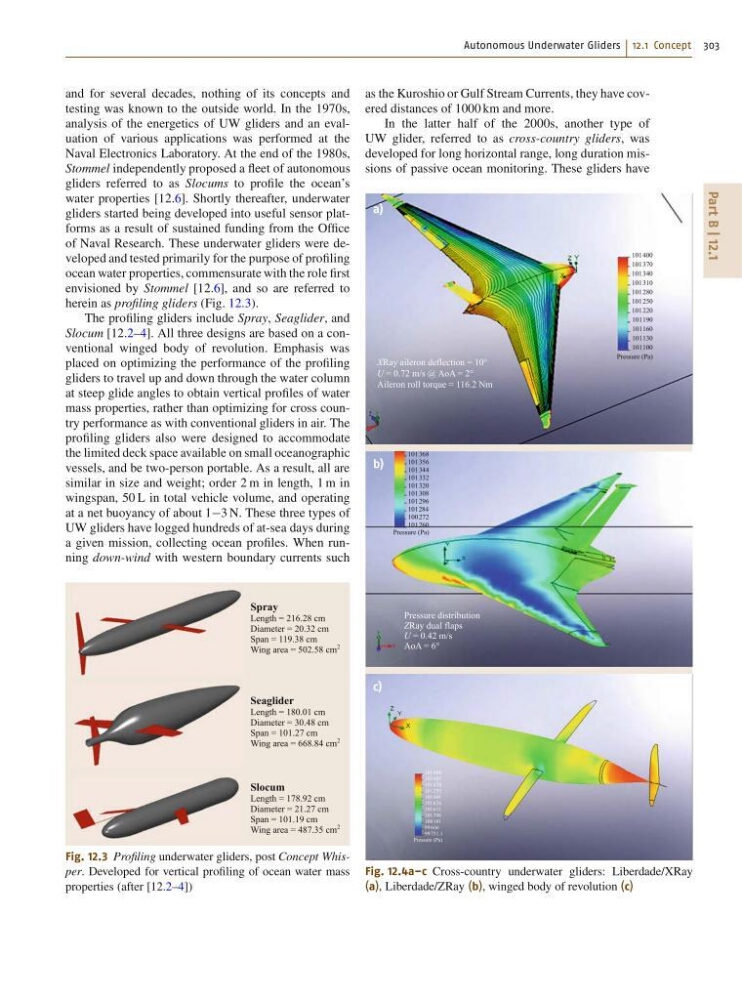
In the latter half of the 2000s, another type of
UW glider, referred to as cross-country gliders, was
developed for long horizontal range, long duration missions of passive ocean monitoring. These gliders have
XRay aileron deflection = 10°
U = 0.72 m/s @ AoA = 2°
Aileron roll torque = 116.2 Nm
Pressure distribution
ZRay dual flaps
U = 0.42 m/s
AoA = 6°
a)
b)
c)
101400
101370
101340
101310
101280
101250
101220
101190
101160
101130
101100
Pressure (Pa)
101900
101685
101470
101255
101041
101826
101611
101396
100181
99 666
99751.1
Pressure (Pa)
101368
101356
101344
101332
101320
101308
101296
101284
100272
101260
Pressure (Pa)
Fig. 12.4a–c Cross-country underwater gliders: Liberdade/XRay
(a), Liberdade/ZRay (b), winged body of revolution (c)
Part B | 12.1
and for several decades, nothing of its concepts and
testing was known to the outside world. In the 1970s,
analysis of the energetics of UW gliders and an evaluation of various applications was performed at the
Naval Electronics Laboratory. At the end of the 1980s,
Stommel independently proposed a fleet of autonomous
gliders referred to as Slocums to profile the ocean’s
water properties [12.6]. Shortly thereafter, underwater
gliders started being developed into useful sensor platforms as a result of sustained funding from the Office
of Naval Research. These underwater gliders were developed and tested primarily for the purpose of profiling
ocean water properties, commensurate with the role first
envisioned by Stommel [12.6], and so are referred to
herein as profiling gliders (Fig. 12.3).
The profiling gliders include Spray, Seaglider, and
Slocum [12.2–4]. All three designs are based on a conventional winged body of revolution. Emphasis was
placed on optimizing the performance of the profiling
gliders to travel up and down through the water column
at steep glide angles to obtain vertical profiles of water
mass properties, rather than optimizing for cross country performance as with conventional gliders in air. The
profiling gliders also were designed to accommodate
the limited deck space available on small oceanographic
vessels, and be two-person portable. As a result, all are
similar in size and weight; order 2 m in length, 1 m in
wingspan, 50 L in total vehicle volume, and operating
at a net buoyancy of about 13 N. These three types of
UW gliders have logged hundreds of at-sea days during
a given mission, collecting ocean profiles. When running down-wind with western boundary currents such
Spray
Length = 216.28 cm
Diameter = 20.32 cm
Span = 119.38 cm
Wing area = 502.58 cm
2
Seaglider
Length = 180.01 cm
Diameter = 30.48 cm
Span = 101.27 cm
Wing area = 668.84 cm
2
Slocum
Length = 178.92 cm
Diameter = 21.27 cm
Span = 101.19 cm
Wing area = 487.35 cm
2
Fig. 12.3 Profiling underwater gliders, post Concept Whisper. Developed for vertical profiling of ocean water mass
properties (after [12.2–4])
as the Kuroshio or Gulf Stream Currents, they have covered distances of 1000 km and more.
In the latter half of the 2000s, another type of
UW glider, referred to as cross-country gliders, was
developed for long horizontal range, long duration missions of passive ocean monitoring. These gliders have
XRay aileron deflection = 10°
U = 0.72 m/s @ AoA = 2°
Aileron roll torque = 116.2 Nm
Pressure distribution
ZRay dual flaps
U = 0.42 m/s
AoA = 6°
a)
b)
c)
101400
101370
101340
101310
101280
101250
101220
101190
101160
101130
101100
Pressure (Pa)
101900
101685
101470
101255
101041
101826
101611
101396
100181
99 666
99751.1
Pressure (Pa)
101368
101356
101344
101332
101320
101308
101296
101284
100272
101260
Pressure (Pa)
Fig. 12.4a–c Cross-country underwater gliders: Liberdade/XRay
(a), Liberdade/ZRay (b), winged body of revolution (c)