

Control Theory and Applications References 275
Part A | 10
D-gain
Derivative
Rudder
position
Heading
error
Nomoto transfer function
Yaw
disturbance
torque
I-gain
P-gain
Integrator
du/dt
219.1623
14.4311
a)
0
1
s
1
s
0.002 305 s + 0.000 115 5
s
2 + 0.097 34 s + 0.000 175 4
Transfer function
from yaw disturbance torque
to yaw rate
9.43 ×10
–13
s + 2.91 × 10
–14
s
2 + 0.097 34 s + 0.000 175 4
D-gain
Derivative
Rudder
position
Heading
error
Nomoto transfer function
Yaw
disturbance
torque
P-gain
du/dt
219.162
14.4311
b)
1
s
0.6585
555.56 s + 1
Transfer function
from yaw disturbance torque
to yaw rate
1.663 × 10
–10
555.56 s + 1
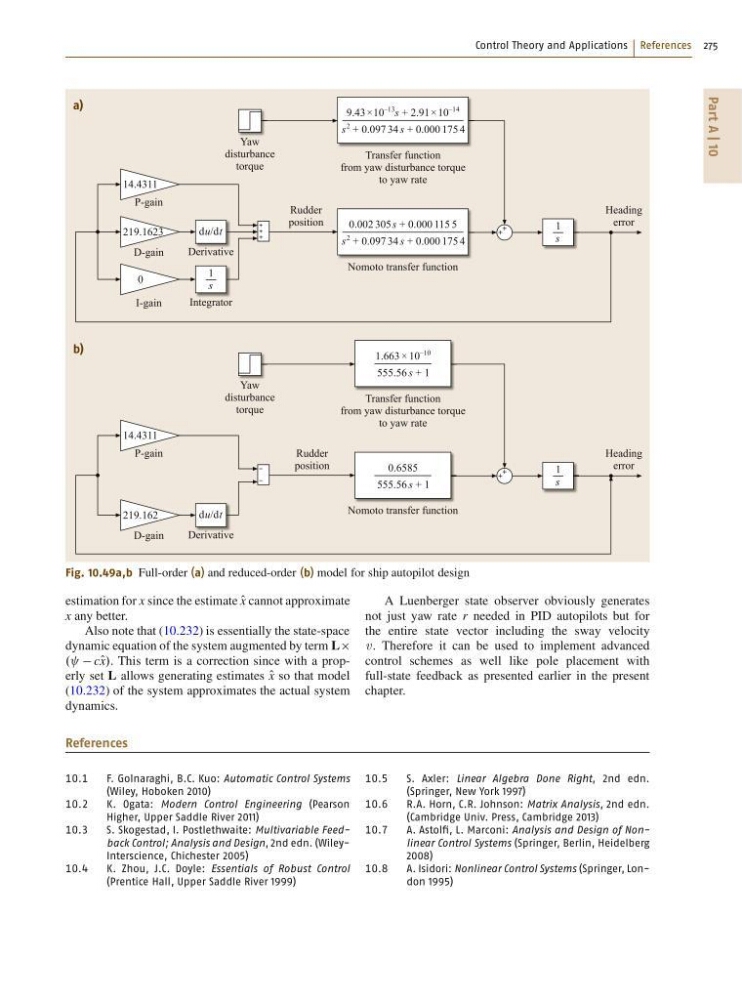
Fig. 10.49a,b Full-order (a) and reduced-order (b) model for ship autopilot design
estimation for x since the estimate O
x cannot approximate
x any better.
Also note that (10.232) is essentially the state-space
dynamic equation of the system augmented by term L
. cO x/. This term is a correction since with a properly set L allows generating estimates O
x so that model
(10.232) of the system approximates the actual system
dynamics.
A Luenberger state observer obviously generates
not just yaw rate r needed in PID autopilots but for
the entire state vector including the sway velocity
v . Therefore it can be used to implement advanced
control schemes as well like pole placement with
full-state feedback as presented earlier in the present
chapter.
References
10.1
F. Golnaraghi, B.C. Kuo: Automatic Control Systems
(Wiley, Hoboken 2010)
10.2
K. Ogata: Modern Control Engineering (Pearson
Higher, Upper Saddle River 2011)
10.3
S. Skogestad, I. Postlethwaite: Multivariable Feedback Control; Analysis and Design, 2nd edn. (WileyInterscience, Chichester 2005)
10.4
K. Zhou, J.C. Doyle: Essentials of Robust Control
(Prentice Hall, Upper Saddle River 1999)
10.5
S. Axler: Linear Algebra Done Right, 2nd edn.
(Springer, New York 1997)
10.6
R.A. Horn, C.R. Johnson: Matrix Analysis, 2nd edn.
(Cambridge Univ. Press, Cambridge 2013)
10.7
A. Astolfi, L. Marconi: Analysis and Design of Nonlinear Control Systems (Springer, Berlin, Heidelberg
2008)
10.8
A. Isidori: Nonlinear Control Systems (Springer, London 1995)
Part A | 10
D-gain
Derivative
Rudder
position
Heading
error
Nomoto transfer function
Yaw
disturbance
torque
I-gain
P-gain
Integrator
du/dt
219.1623
14.4311
a)
0
1
s
1
s
0.002 305 s + 0.000 115 5
s
2 + 0.097 34 s + 0.000 175 4
Transfer function
from yaw disturbance torque
to yaw rate
9.43 ×10
–13
s + 2.91 × 10
–14
s
2 + 0.097 34 s + 0.000 175 4
D-gain
Derivative
Rudder
position
Heading
error
Nomoto transfer function
Yaw
disturbance
torque
P-gain
du/dt
219.162
14.4311
b)
1
s
0.6585
555.56 s + 1
Transfer function
from yaw disturbance torque
to yaw rate
1.663 × 10
–10
555.56 s + 1
Fig. 10.49a,b Full-order (a) and reduced-order (b) model for ship autopilot design
estimation for x since the estimate O
x cannot approximate
x any better.
Also note that (10.232) is essentially the state-space
dynamic equation of the system augmented by term L
. cO x/. This term is a correction since with a properly set L allows generating estimates O
x so that model
(10.232) of the system approximates the actual system
dynamics.
A Luenberger state observer obviously generates
not just yaw rate r needed in PID autopilots but for
the entire state vector including the sway velocity
v . Therefore it can be used to implement advanced
control schemes as well like pole placement with
full-state feedback as presented earlier in the present
chapter.
References
10.1
F. Golnaraghi, B.C. Kuo: Automatic Control Systems
(Wiley, Hoboken 2010)
10.2
K. Ogata: Modern Control Engineering (Pearson
Higher, Upper Saddle River 2011)
10.3
S. Skogestad, I. Postlethwaite: Multivariable Feedback Control; Analysis and Design, 2nd edn. (WileyInterscience, Chichester 2005)
10.4
K. Zhou, J.C. Doyle: Essentials of Robust Control
(Prentice Hall, Upper Saddle River 1999)
10.5
S. Axler: Linear Algebra Done Right, 2nd edn.
(Springer, New York 1997)
10.6
R.A. Horn, C.R. Johnson: Matrix Analysis, 2nd edn.
(Cambridge Univ. Press, Cambridge 2013)
10.7
A. Astolfi, L. Marconi: Analysis and Design of Nonlinear Control Systems (Springer, Berlin, Heidelberg
2008)
10.8
A. Isidori: Nonlinear Control Systems (Springer, London 1995)