

Part A | 10.3
260 Part A Fundamentals
0
2
4
6
8 10
T = 0.1 s
12 14 16 18 20
W (rps)
Time T
15
10
5
0
0
2
4
6
8 10 12 14 16 18 20
u (m/s)
1.5
1
0.5
0
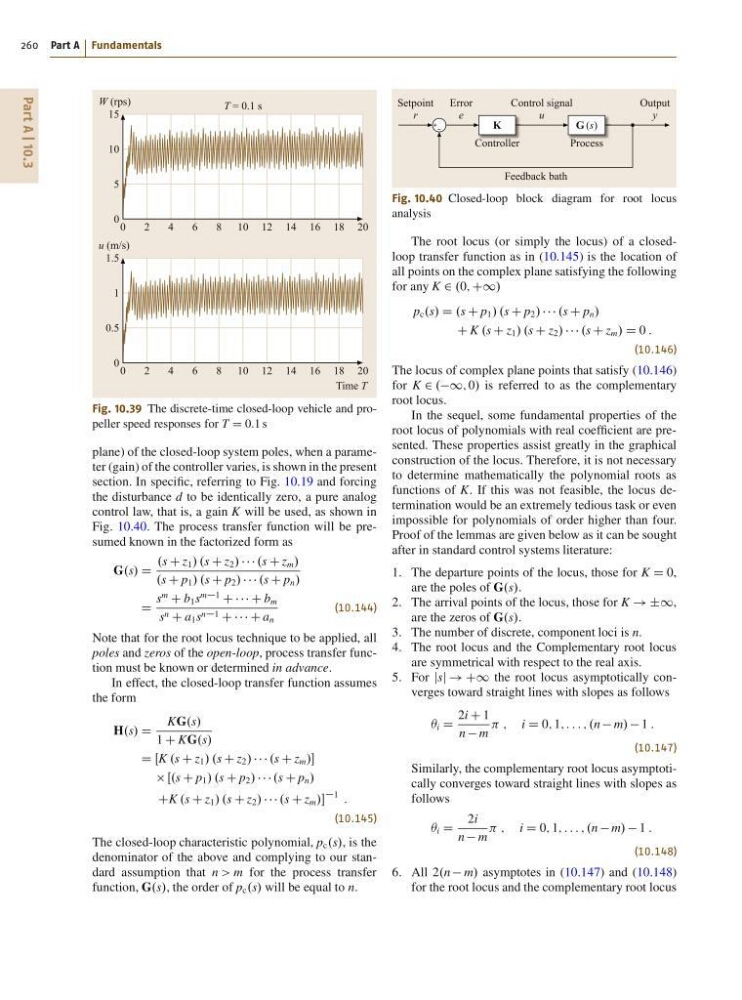
Fig. 10.39 The discrete-time closed-loop vehicle and propeller speed responses for T D 0:1 s
plane) of the closed-loop system poles, when a parameter (gain) of the controller varies, is shown in the present
section. In specific, referring to Fig. 10.19 and forcing
the disturbance d to be identically zero, a pure analog
control law, that is, a gain K will be used, as shown in
Fig. 10.40. The process transfer function will be presumed known in the factorized form as
G.s/ D
.s C z 1 / .s C z 2 / .s C z m /
.s C p 1 / .s C p 2 / .s C p n /
D
s
m
C b 1 s
m1
C C C C C b m
s n C a 1 s n1 C C C C C a n
(10.144)
Note that for the root locus technique to be applied, all
poles and zeros of the open-loop, process transfer function must be known or determined in advance.
In effect, the closed-loop transfer function assumes
the form
H.s/ D
KG.s/
1 C KG.s/
D ŒK .s C z 1 / .s C z 2 / .s C z m /
Œ.s C p 1 / .s C p 2 / .s C p n /
CK .s C z 1 / .s C z 2 / .s C z m /
1 :
(10.145)
The closed-loop characteristic polynomial, p c .s/, is the
denominator of the above and complying to our standard assumption that n > m for the process transfer
function, G.s/, the order of p c .s/ will be equal to n.
Controller
Feedback bath
Setpoint
r
Output
y
Error
e
Control signal
u
K
Process
G (s)
Fig. 10.40 Closed-loop block diagram for root locus
analysis
The root locus (or simply the locus) of a closedloop transfer function as in (10.145) is the location of
all points on the complex plane satisfying the following
for any K 2 .0; C1/
p c .s/ D .s C p 1 / .s C p 2 / .s C p n /
C K .s C z 1 / .s C z 2 / .s C z m / D 0 :
(10.146)
The locus of complex plane points that satisfy (10.146)
for K 2 .1; 0/ is referred to as the complementary
root locus.
In the sequel, some fundamental properties of the
root locus of polynomials with real coefficient are presented. These properties assist greatly in the graphical
construction of the locus. Therefore, it is not necessary
to determine mathematically the polynomial roots as
functions of K. If this was not feasible, the locus determination would be an extremely tedious task or even
impossible for polynomials of order higher than four.
Proof of the lemmas are given below as it can be sought
after in standard control systems literature:
1. The departure points of the locus, those for K D 0,
are the poles of G.s/.
2. The arrival points of the locus, those for K ! ˙1,
are the zeros of G.s/.
3. The number of discrete, component loci is n.
4. The root locus and the Complementary root locus
are symmetrical with respect to the real axis.
5. For jsj ! C1 the root locus asymptotically converges toward straight lines with slopes as follows
 i D
2i C 1
n m
; i D 0; 1; : : : ; .n m/ 1 :
(10.147)
Similarly, the complementary root locus asymptotically converges toward straight lines with slopes as
follows
 i D
2i
n m
; i D 0; 1; : : : ; .n m/ 1 :
(10.148)
6. All 2.n m/ asymptotes in (10.147) and (10.148)
for the root locus and the complementary root locus
260 Part A Fundamentals
0
2
4
6
8 10
T = 0.1 s
12 14 16 18 20
W (rps)
Time T
15
10
5
0
0
2
4
6
8 10 12 14 16 18 20
u (m/s)
1.5
1
0.5
0
Fig. 10.39 The discrete-time closed-loop vehicle and propeller speed responses for T D 0:1 s
plane) of the closed-loop system poles, when a parameter (gain) of the controller varies, is shown in the present
section. In specific, referring to Fig. 10.19 and forcing
the disturbance d to be identically zero, a pure analog
control law, that is, a gain K will be used, as shown in
Fig. 10.40. The process transfer function will be presumed known in the factorized form as
G.s/ D
.s C z 1 / .s C z 2 / .s C z m /
.s C p 1 / .s C p 2 / .s C p n /
D
s
m
C b 1 s
m1
C C C C C b m
s n C a 1 s n1 C C C C C a n
(10.144)
Note that for the root locus technique to be applied, all
poles and zeros of the open-loop, process transfer function must be known or determined in advance.
In effect, the closed-loop transfer function assumes
the form
H.s/ D
KG.s/
1 C KG.s/
D ŒK .s C z 1 / .s C z 2 / .s C z m /
Œ.s C p 1 / .s C p 2 / .s C p n /
CK .s C z 1 / .s C z 2 / .s C z m /
1 :
(10.145)
The closed-loop characteristic polynomial, p c .s/, is the
denominator of the above and complying to our standard assumption that n > m for the process transfer
function, G.s/, the order of p c .s/ will be equal to n.
Controller
Feedback bath
Setpoint
r
Output
y
Error
e
Control signal
u
K
Process
G (s)
Fig. 10.40 Closed-loop block diagram for root locus
analysis
The root locus (or simply the locus) of a closedloop transfer function as in (10.145) is the location of
all points on the complex plane satisfying the following
for any K 2 .0; C1/
p c .s/ D .s C p 1 / .s C p 2 / .s C p n /
C K .s C z 1 / .s C z 2 / .s C z m / D 0 :
(10.146)
The locus of complex plane points that satisfy (10.146)
for K 2 .1; 0/ is referred to as the complementary
root locus.
In the sequel, some fundamental properties of the
root locus of polynomials with real coefficient are presented. These properties assist greatly in the graphical
construction of the locus. Therefore, it is not necessary
to determine mathematically the polynomial roots as
functions of K. If this was not feasible, the locus determination would be an extremely tedious task or even
impossible for polynomials of order higher than four.
Proof of the lemmas are given below as it can be sought
after in standard control systems literature:
1. The departure points of the locus, those for K D 0,
are the poles of G.s/.
2. The arrival points of the locus, those for K ! ˙1,
are the zeros of G.s/.
3. The number of discrete, component loci is n.
4. The root locus and the Complementary root locus
are symmetrical with respect to the real axis.
5. For jsj ! C1 the root locus asymptotically converges toward straight lines with slopes as follows
 i D
2i C 1
n m
; i D 0; 1; : : : ; .n m/ 1 :
(10.147)
Similarly, the complementary root locus asymptotically converges toward straight lines with slopes as
follows
 i D
2i
n m
; i D 0; 1; : : : ; .n m/ 1 :
(10.148)
6. All 2.n m/ asymptotes in (10.147) and (10.148)
for the root locus and the complementary root locus