

Part A | 10.1
228 Part A Fundamentals
a system. Typical examples of engineering systems include electric networks, internal combustion engines,
turbines, etc. Commonly, a system can be subdivided
to subsystems with respect to its complexity. A marine
engine, for example, includes its turbocharger, which
in turn includes the turbine and the air compressor,
the cylinders, the crankshaft. etc. All these subsystems
may be regarded as systems with their own inputs and
outputs. However, the engine is also a subsystem of
a higher complexity system, that is, the propulsion plant
or the vessel.
Recently the concept of system has been generalized in order to include, except technological or physical systems, biological systems, economical systems,
administrative systems, etc. In correspondence the concept of signals has been expanded in order to include
inputs and outputs to such systems.
Automatic Control and Feedback
The concept of control is directly related to that of feedback [10.1–3]. Specifically, Wiener defines automatic
control as the method of controlling a system by applying as inputs the system’s past responses. A similar
description is given by the IEEE (Institute of Electrical
and Electronics Engineers): An automatic control system, such as the cruise control system in automobiles,
implements in the controller a decision process, also
called the control law, that dictates the appropriate control actions to be taken for the speed to be maintained
within acceptable tolerances. These decisions are taken
based on how different the actual speed is from the desired, called the error, and on the knowledge of the car’s
response to fuel increase and decrease. This knowledge
is typically captured in a mathematical model. Information about the actual speed is fed back to the controller
by sensors, and the control decisions are implemented
via a device, the actuator, that increases or decreases the
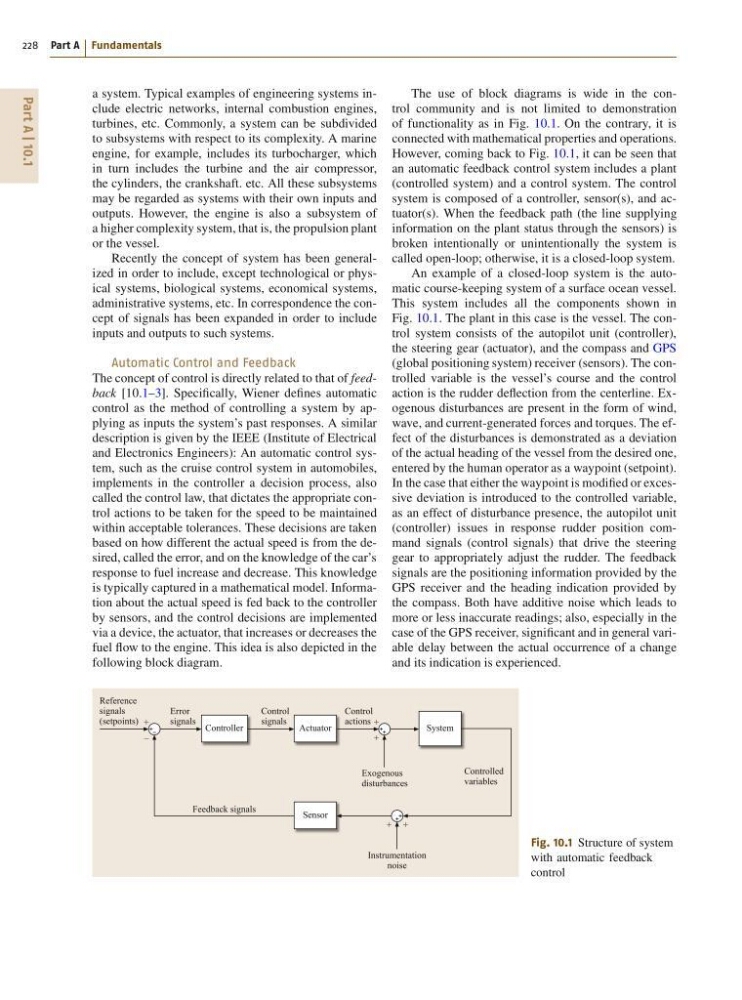
fuel flow to the engine. This idea is also depicted in the
following block diagram.
Control
signals
Control
actions
Controlled
variables
Exogenous
disturbances
Instrumentation
noise
Feedback signals
Controller
+
–
+
+
Reference
signals
(setpoints)
Error
signals
Actuator
+ +
Sensor
System
Fig. 10.1 Structure of system
with automatic feedback
control
The use of block diagrams is wide in the control community and is not limited to demonstration
of functionality as in Fig. 10.1. On the contrary, it is
connected with mathematical properties and operations.
However, coming back to Fig. 10.1, it can be seen that
an automatic feedback control system includes a plant
(controlled system) and a control system. The control
system is composed of a controller, sensor(s), and actuator(s). When the feedback path (the line supplying
information on the plant status through the sensors) is
broken intentionally or unintentionally the system is
called open-loop; otherwise, it is a closed-loop system.
An example of a closed-loop system is the automatic course-keeping system of a surface ocean vessel.
This system includes all the components shown in
Fig. 10.1. The plant in this case is the vessel. The control system consists of the autopilot unit (controller),
the steering gear (actuator), and the compass and GPS
(global positioning system) receiver (sensors). The controlled variable is the vessel’s course and the control
action is the rudder deflection from the centerline. Exogenous disturbances are present in the form of wind,
wave, and current-generated forces and torques. The effect of the disturbances is demonstrated as a deviation
of the actual heading of the vessel from the desired one,
entered by the human operator as a waypoint (setpoint).
In the case that either the waypoint is modified or excessive deviation is introduced to the controlled variable,
as an effect of disturbance presence, the autopilot unit
(controller) issues in response rudder position command signals (control signals) that drive the steering
gear to appropriately adjust the rudder. The feedback
signals are the positioning information provided by the
GPS receiver and the heading indication provided by
the compass. Both have additive noise which leads to
more or less inaccurate readings; also, especially in the
case of the GPS receiver, significant and in general variable delay between the actual occurrence of a change
and its indication is experienced.
228 Part A Fundamentals
a system. Typical examples of engineering systems include electric networks, internal combustion engines,
turbines, etc. Commonly, a system can be subdivided
to subsystems with respect to its complexity. A marine
engine, for example, includes its turbocharger, which
in turn includes the turbine and the air compressor,
the cylinders, the crankshaft. etc. All these subsystems
may be regarded as systems with their own inputs and
outputs. However, the engine is also a subsystem of
a higher complexity system, that is, the propulsion plant
or the vessel.
Recently the concept of system has been generalized in order to include, except technological or physical systems, biological systems, economical systems,
administrative systems, etc. In correspondence the concept of signals has been expanded in order to include
inputs and outputs to such systems.
Automatic Control and Feedback
The concept of control is directly related to that of feedback [10.1–3]. Specifically, Wiener defines automatic
control as the method of controlling a system by applying as inputs the system’s past responses. A similar
description is given by the IEEE (Institute of Electrical
and Electronics Engineers): An automatic control system, such as the cruise control system in automobiles,
implements in the controller a decision process, also
called the control law, that dictates the appropriate control actions to be taken for the speed to be maintained
within acceptable tolerances. These decisions are taken
based on how different the actual speed is from the desired, called the error, and on the knowledge of the car’s
response to fuel increase and decrease. This knowledge
is typically captured in a mathematical model. Information about the actual speed is fed back to the controller
by sensors, and the control decisions are implemented
via a device, the actuator, that increases or decreases the
fuel flow to the engine. This idea is also depicted in the
following block diagram.
Control
signals
Control
actions
Controlled
variables
Exogenous
disturbances
Instrumentation
noise
Feedback signals
Controller
+
–
+
+
Reference
signals
(setpoints)
Error
signals
Actuator
+ +
Sensor
System
Fig. 10.1 Structure of system
with automatic feedback
control
The use of block diagrams is wide in the control community and is not limited to demonstration
of functionality as in Fig. 10.1. On the contrary, it is
connected with mathematical properties and operations.
However, coming back to Fig. 10.1, it can be seen that
an automatic feedback control system includes a plant
(controlled system) and a control system. The control
system is composed of a controller, sensor(s), and actuator(s). When the feedback path (the line supplying
information on the plant status through the sensors) is
broken intentionally or unintentionally the system is
called open-loop; otherwise, it is a closed-loop system.
An example of a closed-loop system is the automatic course-keeping system of a surface ocean vessel.
This system includes all the components shown in
Fig. 10.1. The plant in this case is the vessel. The control system consists of the autopilot unit (controller),
the steering gear (actuator), and the compass and GPS
(global positioning system) receiver (sensors). The controlled variable is the vessel’s course and the control
action is the rudder deflection from the centerline. Exogenous disturbances are present in the form of wind,
wave, and current-generated forces and torques. The effect of the disturbances is demonstrated as a deviation
of the actual heading of the vessel from the desired one,
entered by the human operator as a waypoint (setpoint).
In the case that either the waypoint is modified or excessive deviation is introduced to the controlled variable,
as an effect of disturbance presence, the autopilot unit
(controller) issues in response rudder position command signals (control signals) that drive the steering
gear to appropriately adjust the rudder. The feedback
signals are the positioning information provided by the
GPS receiver and the heading indication provided by
the compass. Both have additive noise which leads to
more or less inaccurate readings; also, especially in the
case of the GPS receiver, significant and in general variable delay between the actual occurrence of a change
and its indication is experienced.