

Digital Signal Processing 9.2 Digital Filters 207
Part A | 9.2
z
–1
z
–1
z
–1
z
–1
x (n)
y (n)
h (0)
h (1)
h (M–1)
h (M )
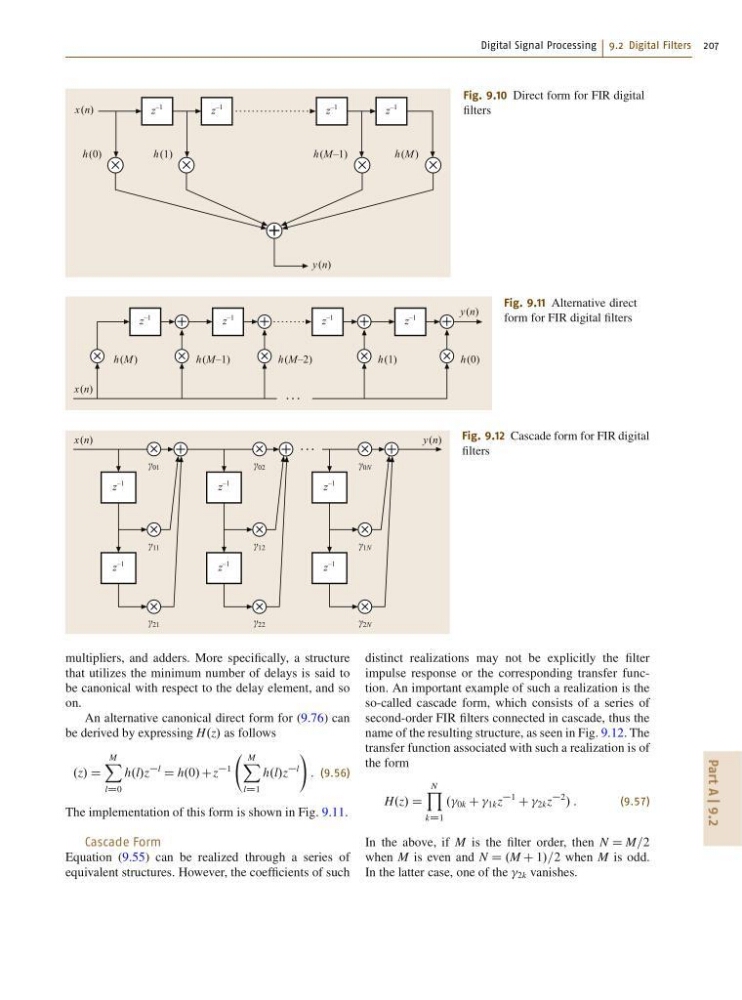
Fig. 9.10 Direct form for FIR digital
filters
z
–1
z
–1
z
–1
z
–1
x (n)
y (n)
h (M–1)
h (M–2)
h (1)
h (0)
h (M )
Fig. 9.11 Alternative direct
form for FIR digital filters
z
–1
z
–1
γ 01
γ 11
γ 21
z
–1
z
–1
γ 0N
γ 1N
γ 2N
z
–1
z
–1
γ 02
γ 12
γ 22
x (n)
y (n)
Fig. 9.12 Cascade form for FIR digital
filters
multipliers, and adders. More specifically, a structure
that utilizes the minimum number of delays is said to
be canonical with respect to the delay element, and so
on.
An alternative canonical direct form for (9.76) can
be derived by expressing H.z/ as follows
.z/ D
M
X
lD0
h.l/z
l
D h.0/Cz
1
M
X
lD1
h.l/z
l
!
: (9.56)
The implementation of this form is shown in Fig. 9.11.
Cascade Form
Equation (9.55) can be realized through a series of
equivalent structures. However, the coefficients of such
distinct realizations may not be explicitly the filter
impulse response or the corresponding transfer function. An important example of such a realization is the
so-called cascade form, which consists of a series of
second-order FIR filters connected in cascade, thus the
name of the resulting structure, as seen in Fig. 9.12. The
transfer function associated with such a realization is of
the form
H.z/ D
N
Y
kD1
.. 0k C 1k z
1
C 2k z
2
/ :
(9.57)
In the above, if M is the filter order, then N D M=2
when M is even and N D .M C 1/=2 when M is odd.
In the latter case, one of the 2k vanishes.
Part A | 9.2
z
–1
z
–1
z
–1
z
–1
x (n)
y (n)
h (0)
h (1)
h (M–1)
h (M )
Fig. 9.10 Direct form for FIR digital
filters
z
–1
z
–1
z
–1
z
–1
x (n)
y (n)
h (M–1)
h (M–2)
h (1)
h (0)
h (M )
Fig. 9.11 Alternative direct
form for FIR digital filters
z
–1
z
–1
γ 01
γ 11
γ 21
z
–1
z
–1
γ 0N
γ 1N
γ 2N
z
–1
z
–1
γ 02
γ 12
γ 22
x (n)
y (n)
Fig. 9.12 Cascade form for FIR digital
filters
multipliers, and adders. More specifically, a structure
that utilizes the minimum number of delays is said to
be canonical with respect to the delay element, and so
on.
An alternative canonical direct form for (9.76) can
be derived by expressing H.z/ as follows
.z/ D
M
X
lD0
h.l/z
l
D h.0/Cz
1
M
X
lD1
h.l/z
l
!
: (9.56)
The implementation of this form is shown in Fig. 9.11.
Cascade Form
Equation (9.55) can be realized through a series of
equivalent structures. However, the coefficients of such
distinct realizations may not be explicitly the filter
impulse response or the corresponding transfer function. An important example of such a realization is the
so-called cascade form, which consists of a series of
second-order FIR filters connected in cascade, thus the
name of the resulting structure, as seen in Fig. 9.12. The
transfer function associated with such a realization is of
the form
H.z/ D
N
Y
kD1
.. 0k C 1k z
1
C 2k z
2
/ :
(9.57)
In the above, if M is the filter order, then N D M=2
when M is even and N D .M C 1/=2 when M is odd.
In the latter case, one of the 2k vanishes.