

Part A | 8.7
188 Part A Fundamentals
wavelength, as indicated in Fig. 8.9. The region in close
vicinity to a time-harmonic dipole for which the static
equations are sufficiently accurate is sometimes called
the quasi-DC (direct current) range.
The equations for electric and magnetic dipoles in
an unbounded ocean are sufficient if the range between
the source and observation point is small in comparison to their distances from the sea surface or seafloor.
If this is not the case, then reflections from one or both
of the interfaces must be accounted for in the magnetic
and electric field formulations. Since the dipole sources
are close to an interface, simple plane wave reflection
coefficients cannot be used. A more complete and, unfortunately, more complex treatment are required.
8.7 Magnetic and Electric Dipoles in a Bounded Ocean
In this section, magnetic and electric dipoles submerged
in a bounded ocean will be considered. What is meant
by a bounded ocean is that the separation between
the source and observation point are comparable to
their distance from either the sea surface or bottom.
The change in conductivity between the seawater and
air or the seafloor produces an interface that modifies
the spreading and propagation of fields generated by
submerged magnetic and electric sources. The effects
of the interfaces are accounted for in the descriptive
equations by satisfying the boundary conditions along
them. Therefore, mathematical solutions to the inhomogeneous wave equations must be in a form that will
easily accommodate solving for the boundary conditions when a source is near an interface.
Because of their close proximity to one of the
ocean’s interface, the solution to the problem of a submerged magnetic or electric dipole will also depend
on their orientation with respect to the sea surface or
seafloor. As a result, there are four types of dipoles
that must be addressed separately when computing
their electric and magnetic fields in a bounded ocean.
They are; the vertical electric dipole (VED), vertical
magnetic dipole (VMD), horizontal magnetic dipole
(HMD), and the horizontal electric dipole (HED). The
equations for the in-water fields from a subsurface
time-harmonic VED in a deep ocean (only the surface
interface) will be derived to demonstrate the analysis
method. References will then be cited where solutions
to the other source types can be found.
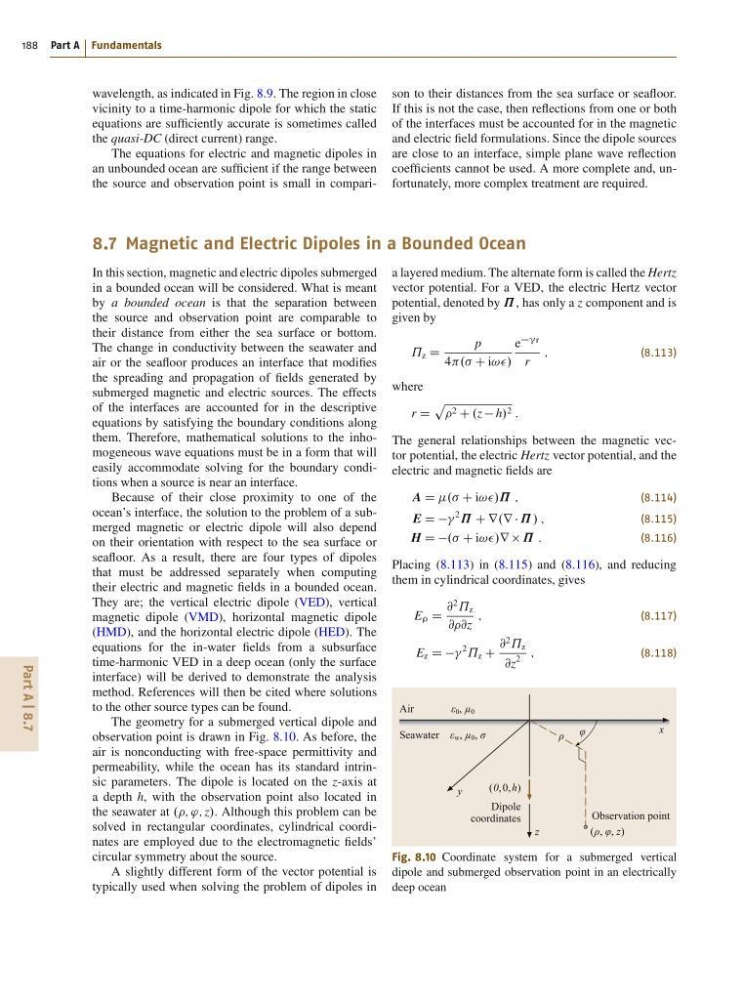
The geometry for a submerged vertical dipole and
observation point is drawn in Fig. 8.10. As before, the
air is nonconducting with free-space permittivity and
permeability, while the ocean has its standard intrinsic parameters. The dipole is located on the z-axis at
a depth h, with the observation point also located in
the seawater at ..; '; z/. Although this problem can be
solved in rectangular coordinates, cylindrical coordinates are employed due to the electromagnetic fields’
circular symmetry about the source.
A slightly different form of the vector potential is
typically used when solving the problem of dipoles in
a layered medium. The alternate form is called the Hertz
vector potential. For a VED, the electric Hertz vector
potential, denoted by ˘ , has only a z component and is
given by
˘ z D
p
4 C i!!/
e
”r
r
;
(8.113)
where
r D
p
2 C .z h/ 2 :
The general relationships between the magnetic vector potential, the electric Hertz vector potential, and the
electric and magnetic fields are
A D .. C i!!/˘ ;
(8.114)
E D D
2
˘ C r.r r ˘ / ;
(8.115)
H D D.. C i!!/r r ˘ :
(8.116)
Placing (8.113) in (8.115) and (8.116), and reducing
them in cylindrical coordinates, gives
E ¡ D
@
2
˘ z
@@@z
;
(8.117)
E z D D
2
˘ z C
@
2
˘ z
@z
2
;
(8.118)
x
y
z
Seawater ε w , μ 0 , σ
ε 0 , μ 0
Dipole
coordinates
Observation point
(ρ, φ, z)
(0,0,h)
ρ φ
Air
Fig. 8.10 Coordinate system for a submerged vertical
dipole and submerged observation point in an electrically
deep ocean
188 Part A Fundamentals
wavelength, as indicated in Fig. 8.9. The region in close
vicinity to a time-harmonic dipole for which the static
equations are sufficiently accurate is sometimes called
the quasi-DC (direct current) range.
The equations for electric and magnetic dipoles in
an unbounded ocean are sufficient if the range between
the source and observation point is small in comparison to their distances from the sea surface or seafloor.
If this is not the case, then reflections from one or both
of the interfaces must be accounted for in the magnetic
and electric field formulations. Since the dipole sources
are close to an interface, simple plane wave reflection
coefficients cannot be used. A more complete and, unfortunately, more complex treatment are required.
8.7 Magnetic and Electric Dipoles in a Bounded Ocean
In this section, magnetic and electric dipoles submerged
in a bounded ocean will be considered. What is meant
by a bounded ocean is that the separation between
the source and observation point are comparable to
their distance from either the sea surface or bottom.
The change in conductivity between the seawater and
air or the seafloor produces an interface that modifies
the spreading and propagation of fields generated by
submerged magnetic and electric sources. The effects
of the interfaces are accounted for in the descriptive
equations by satisfying the boundary conditions along
them. Therefore, mathematical solutions to the inhomogeneous wave equations must be in a form that will
easily accommodate solving for the boundary conditions when a source is near an interface.
Because of their close proximity to one of the
ocean’s interface, the solution to the problem of a submerged magnetic or electric dipole will also depend
on their orientation with respect to the sea surface or
seafloor. As a result, there are four types of dipoles
that must be addressed separately when computing
their electric and magnetic fields in a bounded ocean.
They are; the vertical electric dipole (VED), vertical
magnetic dipole (VMD), horizontal magnetic dipole
(HMD), and the horizontal electric dipole (HED). The
equations for the in-water fields from a subsurface
time-harmonic VED in a deep ocean (only the surface
interface) will be derived to demonstrate the analysis
method. References will then be cited where solutions
to the other source types can be found.
The geometry for a submerged vertical dipole and
observation point is drawn in Fig. 8.10. As before, the
air is nonconducting with free-space permittivity and
permeability, while the ocean has its standard intrinsic parameters. The dipole is located on the z-axis at
a depth h, with the observation point also located in
the seawater at ..; '; z/. Although this problem can be
solved in rectangular coordinates, cylindrical coordinates are employed due to the electromagnetic fields’
circular symmetry about the source.
A slightly different form of the vector potential is
typically used when solving the problem of dipoles in
a layered medium. The alternate form is called the Hertz
vector potential. For a VED, the electric Hertz vector
potential, denoted by ˘ , has only a z component and is
given by
˘ z D
p
4 C i!!/
e
”r
r
;
(8.113)
where
r D
p
2 C .z h/ 2 :
The general relationships between the magnetic vector potential, the electric Hertz vector potential, and the
electric and magnetic fields are
A D .. C i!!/˘ ;
(8.114)
E D D
2
˘ C r.r r ˘ / ;
(8.115)
H D D.. C i!!/r r ˘ :
(8.116)
Placing (8.113) in (8.115) and (8.116), and reducing
them in cylindrical coordinates, gives
E ¡ D
@
2
˘ z
@@@z
;
(8.117)
E z D D
2
˘ z C
@
2
˘ z
@z
2
;
(8.118)
x
y
z
Seawater ε w , μ 0 , σ
ε 0 , μ 0
Dipole
coordinates
Observation point
(ρ, φ, z)
(0,0,h)
ρ φ
Air
Fig. 8.10 Coordinate system for a submerged vertical
dipole and submerged observation point in an electrically
deep ocean