

Ocean Electromagnetics 8.3 Plane Wave Propagation 181
Part A | 8.3
The term Á is called the intrinsic impedance of the
medium and has the units of . For a plane wave, the
orthogonal electric and magnetic field components perpendicular to the propagation direction are related by
the media’s impedance.
In this section, only the ULF and ELF bands will
be considered. Using the seawater dielectric permittivity constant from above, !" at the high end of the ELF
band (3 kHz) is equal to 1:337 10
5 , which is much
less than the water conductivity of 2:5 to 6. Therefore, the i!" term will be dropped for electromagnetic
frequencies up through the ELF band. In fact, displacement currents in seawater do not become appreciable
until frequencies approach the high megahertz region.
At ELF frequencies and below, the seawater’s attenuation constant is equal to its phase constant. Eliminating the i!" in (8.38) gives
D
p
i!!! ;
(8.43a)
D
r !!!
2
.1 C i/ ;
(8.43b)
˛ D ˇ D
r !!!
2
:
(8.43c)
The distance at which the wave attenuates to e
1 is
called the skin depth, and is denoted by the term ı. The
skin depth is the reciprocal of the attenuation constant,
ı D
1
˛
, which for seawater is
ı D
s
2
!!!
:
(8.44)
The field’s wavelength is related to the propagation
by D
2
ˇ
, and in this case can be written as
D 2
s
2
!!!
;
(8.45)
while the speed of an electromagnetic wave v , is equal
to f , and in seawater is given by
v D
s
2!
:
(8.46)
Finally, the intrinsic impedance of seawater at ELF frequencies and below is expressed as
Á D
r
i!!
:
(8.47)
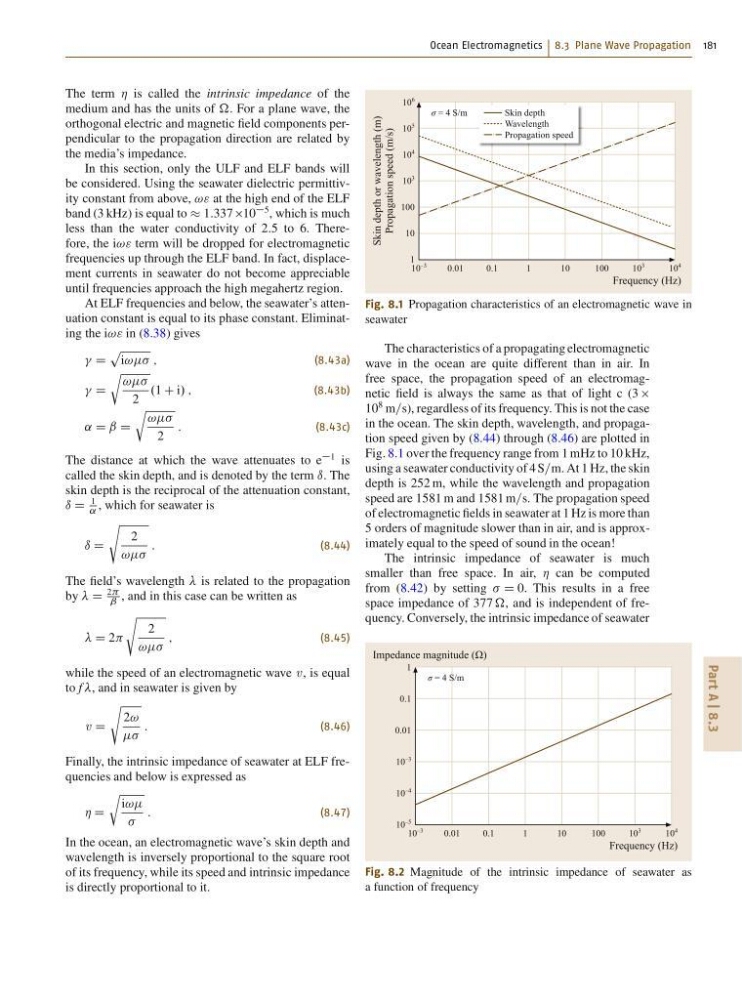
In the ocean, an electromagnetic wave’s skin depth and
wavelength is inversely proportional to the square root
of its frequency, while its speed and intrinsic impedance
is directly proportional to it.
Skin depth
Wavelength
Propagation speed
10
–3
0.01
σ = 4 S/m
0.1
1
10
100
10
3
10
4
Skin depth or wavelength (m)
Propagation speed (m/s)
Frequency (Hz)
10
6
10
5
10
4
10
3
100
10
1
Fig. 8.1 Propagation characteristics of an electromagnetic wave in
seawater
The characteristics of a propagating electromagnetic
wave in the ocean are quite different than in air. In
free space, the propagation speed of an electromagnetic field is always the same as that of light c (3
10
8 m=s), regardless of its frequency. This is not the case
in the ocean. The skin depth, wavelength, and propagation speed given by (8.44) through (8.46) are plotted in
Fig. 8.1 over the frequency range from 1 mHz to 10 kHz,
using a seawater conductivity of 4 S=m. At 1 Hz, the skin
depth is 252 m, while the wavelength and propagation
speed are 1581 m and 1581 m=s. The propagation speed
of electromagnetic fields in seawater at 1 Hz is more than
5 orders of magnitude slower than in air, and is approximately equal to the speed of sound in the ocean!
The intrinsic impedance of seawater is much
smaller than free space. In air, Á can be computed
from (8.42) by setting D 0. This results in a free
space impedance of 377 , and is independent of frequency. Conversely, the intrinsic impedance of seawater
10
–3
0.01
σ = 4 S/m
0.1
1
10
100
10
3
10
4
Impedance magnitude (Ω)
Frequency (Hz)
1
0.1
0.01
10
–3
10
–4
10
–5
Fig. 8.2 Magnitude of the intrinsic impedance of seawater as
a function of frequency
Part A | 8.3
The term Á is called the intrinsic impedance of the
medium and has the units of . For a plane wave, the
orthogonal electric and magnetic field components perpendicular to the propagation direction are related by
the media’s impedance.
In this section, only the ULF and ELF bands will
be considered. Using the seawater dielectric permittivity constant from above, !" at the high end of the ELF
band (3 kHz) is equal to 1:337 10
5 , which is much
less than the water conductivity of 2:5 to 6. Therefore, the i!" term will be dropped for electromagnetic
frequencies up through the ELF band. In fact, displacement currents in seawater do not become appreciable
until frequencies approach the high megahertz region.
At ELF frequencies and below, the seawater’s attenuation constant is equal to its phase constant. Eliminating the i!" in (8.38) gives
D
p
i!!! ;
(8.43a)
D
r !!!
2
.1 C i/ ;
(8.43b)
˛ D ˇ D
r !!!
2
:
(8.43c)
The distance at which the wave attenuates to e
1 is
called the skin depth, and is denoted by the term ı. The
skin depth is the reciprocal of the attenuation constant,
ı D
1
˛
, which for seawater is
ı D
s
2
!!!
:
(8.44)
The field’s wavelength is related to the propagation
by D
2
ˇ
, and in this case can be written as
D 2
s
2
!!!
;
(8.45)
while the speed of an electromagnetic wave v , is equal
to f , and in seawater is given by
v D
s
2!
:
(8.46)
Finally, the intrinsic impedance of seawater at ELF frequencies and below is expressed as
Á D
r
i!!
:
(8.47)
In the ocean, an electromagnetic wave’s skin depth and
wavelength is inversely proportional to the square root
of its frequency, while its speed and intrinsic impedance
is directly proportional to it.
Skin depth
Wavelength
Propagation speed
10
–3
0.01
σ = 4 S/m
0.1
1
10
100
10
3
10
4
Skin depth or wavelength (m)
Propagation speed (m/s)
Frequency (Hz)
10
6
10
5
10
4
10
3
100
10
1
Fig. 8.1 Propagation characteristics of an electromagnetic wave in
seawater
The characteristics of a propagating electromagnetic
wave in the ocean are quite different than in air. In
free space, the propagation speed of an electromagnetic field is always the same as that of light c (3
10
8 m=s), regardless of its frequency. This is not the case
in the ocean. The skin depth, wavelength, and propagation speed given by (8.44) through (8.46) are plotted in
Fig. 8.1 over the frequency range from 1 mHz to 10 kHz,
using a seawater conductivity of 4 S=m. At 1 Hz, the skin
depth is 252 m, while the wavelength and propagation
speed are 1581 m and 1581 m=s. The propagation speed
of electromagnetic fields in seawater at 1 Hz is more than
5 orders of magnitude slower than in air, and is approximately equal to the speed of sound in the ocean!
The intrinsic impedance of seawater is much
smaller than free space. In air, Á can be computed
from (8.42) by setting D 0. This results in a free
space impedance of 377 , and is independent of frequency. Conversely, the intrinsic impedance of seawater
10
–3
0.01
σ = 4 S/m
0.1
1
10
100
10
3
10
4
Impedance magnitude (Ω)
Frequency (Hz)
1
0.1
0.01
10
–3
10
–4
10
–5
Fig. 8.2 Magnitude of the intrinsic impedance of seawater as
a function of frequency