

Mechanics of Ocean Waves 4.5 Shallow Water Wave Theories 89
Part A | 4.5
U r = 1.24
U r = 0.6
0
2
4
8
6
10 12 14 16 18 20
η (m)
t (s)
0.08
0.06
0.04
0.02
0
–0.02
–0.04
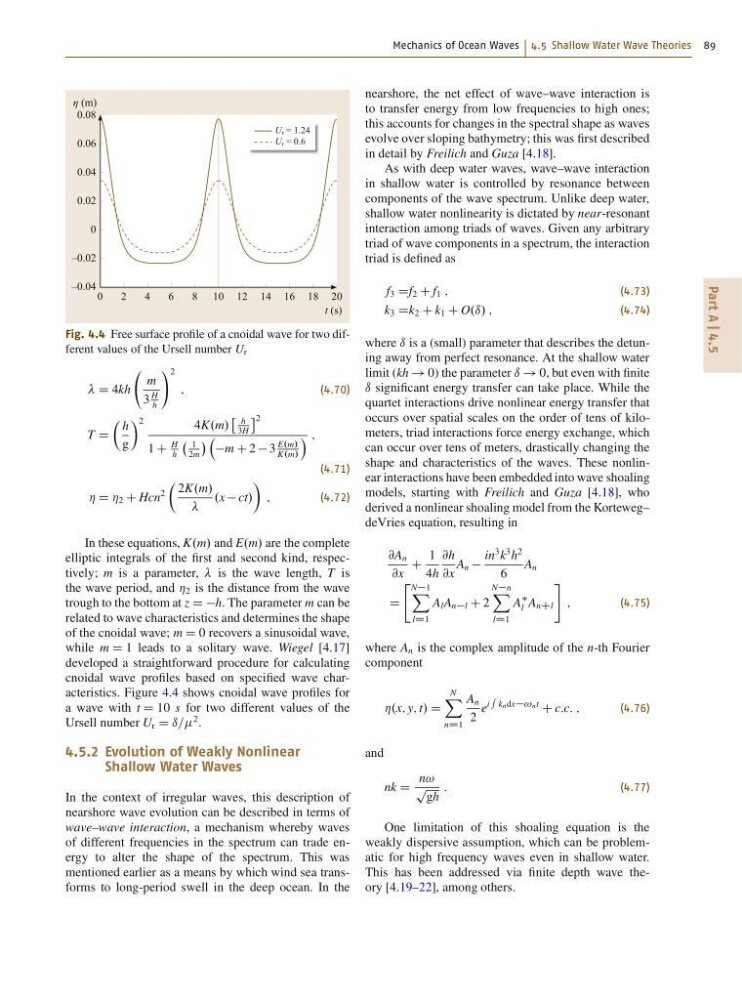
Fig. 4.4 Free surface profile of a cnoidal wave for two different values of the Ursell number U r
D 4kh
m
3
H
h
! 2
;
(4.70)
T D
 h
g
à 2
4K.m/
h
3H
2
1 C
H
h
1
2m
m C 2 3
E.m/
K.m/
Á ;
(4.71)
Á D Á 2 C Hcn
2
 2K.m/
.x ct/
Ã
;
(4.72)
In these equations, K.m/ and E.m/ are the complete
elliptic integrals of the first and second kind, respectively; m is a parameter, is the wave length, T is
the wave period, and Á 2 is the distance from the wave
trough to the bottom at z D Dh. The parameter m can be
related to wave characteristics and determines the shape
of the cnoidal wave; m D 0 recovers a sinusoidal wave,
while m D 1 leads to a solitary wave. Wiegel [4.17]
developed a straightforward procedure for calculating
cnoidal wave profiles based on specified wave characteristics. Figure 4.4 shows cnoidal wave profiles for
a wave with t D 10 s for two different values of the
Ursell number U r D ı==
2 .
4.5.2 Evolution of Weakly Nonlinear
Shallow Water Waves
In the context of irregular waves, this description of
nearshore wave evolution can be described in terms of
wave–wave interaction, a mechanism whereby waves
of different frequencies in the spectrum can trade energy to alter the shape of the spectrum. This was
mentioned earlier as a means by which wind sea transforms to long-period swell in the deep ocean. In the
nearshore, the net effect of wave–wave interaction is
to transfer energy from low frequencies to high ones;
this accounts for changes in the spectral shape as waves
evolve over sloping bathymetry; this was first described
in detail by Freilich and Guza [4.18].
As with deep water waves, wave–wave interaction
in shallow water is controlled by resonance between
components of the wave spectrum. Unlike deep water,
shallow water nonlinearity is dictated by near-resonant
interaction among triads of waves. Given any arbitrary
triad of wave components in a spectrum, the interaction
triad is defined as
f 3 Df 2 C f 1 ;
(4.73)
k 3 Dk 2 C k 1 C O.ı/ ;
(4.74)
where ı is a (small) parameter that describes the detuning away from perfect resonance. At the shallow water
limit (kh ! 0) the parameter ı ! 0, but even with finite
ı significant energy transfer can take place. While the
quartet interactions drive nonlinear energy transfer that
occurs over spatial scales on the order of tens of kilometers, triad interactions force energy exchange, which
can occur over tens of meters, drastically changing the
shape and characteristics of the waves. These nonlinear interactions have been embedded into wave shoaling
models, starting with Freilich and Guza [4.18], who
derived a nonlinear shoaling model from the Korteweg–
deVries equation, resulting in
@A n
@x
C
1
4h
@h
@x
A n
in
3 k
3 h
2
6
A n
D
" N1 X
lD1
A l A nl C 2
Nn X
lD1
A
l A nCl
#
;
(4.75)
where A n is the complex amplitude of the n-th Fourier
component
Á.x; y; t/ D
N
X
nD1
A n
2
e
i
R
kndx!nt
C c:c: ;
(4.76)
and
nk D
n!
p
gh
:
(4.77)
One limitation of this shoaling equation is the
weakly dispersive assumption, which can be problematic for high frequency waves even in shallow water.
This has been addressed via finite depth wave theory [4.19–22], among others.
Part A | 4.5
U r = 1.24
U r = 0.6
0
2
4
8
6
10 12 14 16 18 20
η (m)
t (s)
0.08
0.06
0.04
0.02
0
–0.02
–0.04
Fig. 4.4 Free surface profile of a cnoidal wave for two different values of the Ursell number U r
D 4kh
m
3
H
h
! 2
;
(4.70)
T D
 h
g
à 2
4K.m/
h
3H
2
1 C
H
h
1
2m
m C 2 3
E.m/
K.m/
Á ;
(4.71)
Á D Á 2 C Hcn
2
 2K.m/
.x ct/
Ã
;
(4.72)
In these equations, K.m/ and E.m/ are the complete
elliptic integrals of the first and second kind, respectively; m is a parameter, is the wave length, T is
the wave period, and Á 2 is the distance from the wave
trough to the bottom at z D Dh. The parameter m can be
related to wave characteristics and determines the shape
of the cnoidal wave; m D 0 recovers a sinusoidal wave,
while m D 1 leads to a solitary wave. Wiegel [4.17]
developed a straightforward procedure for calculating
cnoidal wave profiles based on specified wave characteristics. Figure 4.4 shows cnoidal wave profiles for
a wave with t D 10 s for two different values of the
Ursell number U r D ı==
2 .
4.5.2 Evolution of Weakly Nonlinear
Shallow Water Waves
In the context of irregular waves, this description of
nearshore wave evolution can be described in terms of
wave–wave interaction, a mechanism whereby waves
of different frequencies in the spectrum can trade energy to alter the shape of the spectrum. This was
mentioned earlier as a means by which wind sea transforms to long-period swell in the deep ocean. In the
nearshore, the net effect of wave–wave interaction is
to transfer energy from low frequencies to high ones;
this accounts for changes in the spectral shape as waves
evolve over sloping bathymetry; this was first described
in detail by Freilich and Guza [4.18].
As with deep water waves, wave–wave interaction
in shallow water is controlled by resonance between
components of the wave spectrum. Unlike deep water,
shallow water nonlinearity is dictated by near-resonant
interaction among triads of waves. Given any arbitrary
triad of wave components in a spectrum, the interaction
triad is defined as
f 3 Df 2 C f 1 ;
(4.73)
k 3 Dk 2 C k 1 C O.ı/ ;
(4.74)
where ı is a (small) parameter that describes the detuning away from perfect resonance. At the shallow water
limit (kh ! 0) the parameter ı ! 0, but even with finite
ı significant energy transfer can take place. While the
quartet interactions drive nonlinear energy transfer that
occurs over spatial scales on the order of tens of kilometers, triad interactions force energy exchange, which
can occur over tens of meters, drastically changing the
shape and characteristics of the waves. These nonlinear interactions have been embedded into wave shoaling
models, starting with Freilich and Guza [4.18], who
derived a nonlinear shoaling model from the Korteweg–
deVries equation, resulting in
@A n
@x
C
1
4h
@h
@x
A n
in
3 k
3 h
2
6
A n
D
" N1 X
lD1
A l A nl C 2
Nn X
lD1
A
l A nCl
#
;
(4.75)
where A n is the complex amplitude of the n-th Fourier
component
Á.x; y; t/ D
N
X
nD1
A n
2
e
i
R
kndx!nt
C c:c: ;
(4.76)
and
nk D
n!
p
gh
:
(4.77)
One limitation of this shoaling equation is the
weakly dispersive assumption, which can be problematic for high frequency waves even in shallow water.
This has been addressed via finite depth wave theory [4.19–22], among others.