

Mechanics of Ocean Waves 4.4 Weakly Nonlinear Deep Water Wave Theories 85
Part A | 4.4
η
η 1
η 2
0
2
4
6
ε = 0.4
8
10 12 14 16 18 20
η (m)
t (s)
15
10
5
0
–5
–10
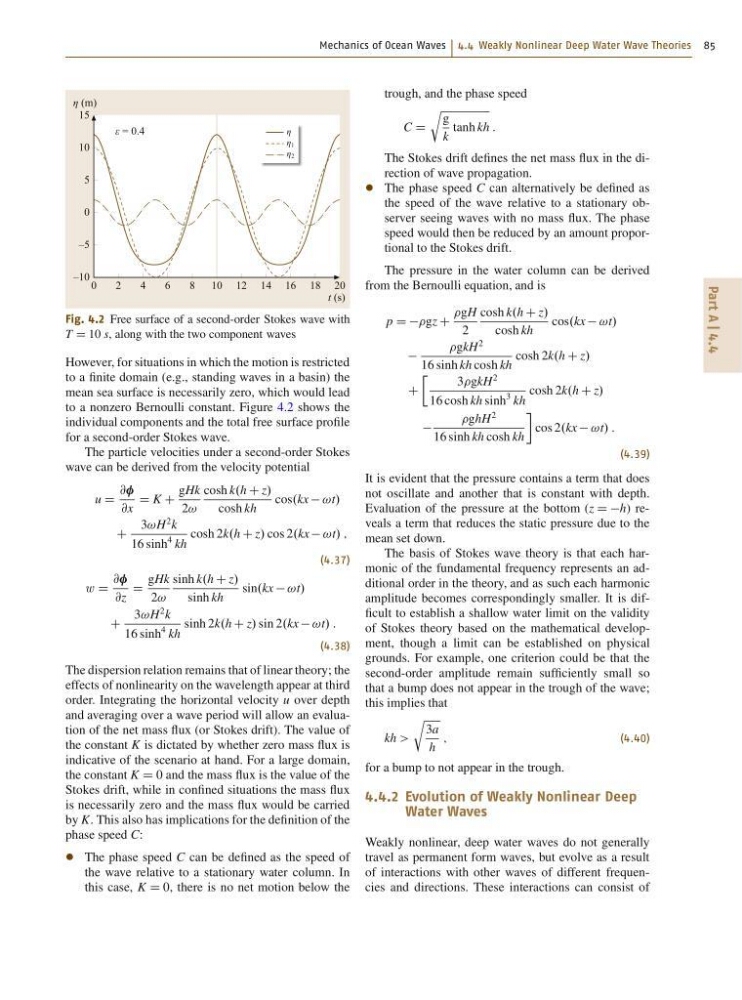
Fig. 4.2 Free surface of a second-order Stokes wave with
T D 10 s, along with the two component waves
However, for situations in which the motion is restricted
to a finite domain (e.g., standing waves in a basin) the
mean sea surface is necessarily zero, which would lead
to a nonzero Bernoulli constant. Figure 4.2 shows the
individual components and the total free surface profile
for a second-order Stokes wave.
The particle velocities under a second-order Stokes
wave can be derived from the velocity potential
u D
@
@x
D K C
gHk
2!
cosh k.h C z/
cosh kh
cos.kx !t/
C
3!H
2 k
16 sinh
4 kh
cosh 2k.h C z/ cos 2.kx !t/ ;
(4.37)
w D
@
@z
D
gHk
2!
sinh k.h C z/
sinh kh
sin.kx !t/
C
3!H
2 k
16 sinh
4 kh
sinh 2k.h C z/ sin 2.kx !t/ :
(4.38)
The dispersion relation remains that of linear theory; the
effects of nonlinearity on the wavelength appear at third
order. Integrating the horizontal velocity u over depth
and averaging over a wave period will allow an evaluation of the net mass flux (or Stokes drift). The value of
the constant K is dictated by whether zero mass flux is
indicative of the scenario at hand. For a large domain,
the constant K D 0 and the mass flux is the value of the
Stokes drift, while in confined situations the mass flux
is necessarily zero and the mass flux would be carried
by K. This also has implications for the definition of the
phase speed C:
The phase speed C can be defined as the speed of
the wave relative to a stationary water column. In
this case, K D 0, there is no net motion below the
trough, and the phase speed
C D
r
g
k
tanh kh :
The Stokes drift defines the net mass flux in the direction of wave propagation.
The phase speed C can alternatively be defined as
the speed of the wave relative to a stationary observer seeing waves with no mass flux. The phase
speed would then be reduced by an amount proportional to the Stokes drift.
The pressure in the water column can be derived
from the Bernoulli equation, and is
p D Dgz C
gH
2
cosh k.h C z/
cosh kh
cos.kx !t/
gkH
2
16 sinh kh cosh kh
cosh 2k.h C z/
C
Ä
3gkH
2
16 cosh kh sinh
3 kh
cosh 2k.h C z/
ghH
2
16 sinh kh cosh kh
cos 2.kx !t/ :
(4.39)
It is evident that the pressure contains a term that does
not oscillate and another that is constant with depth.
Evaluation of the pressure at the bottom (z D Dh) reveals a term that reduces the static pressure due to the
mean set down.
The basis of Stokes wave theory is that each harmonic of the fundamental frequency represents an additional order in the theory, and as such each harmonic
amplitude becomes correspondingly smaller. It is difficult to establish a shallow water limit on the validity
of Stokes theory based on the mathematical development, though a limit can be established on physical
grounds. For example, one criterion could be that the
second-order amplitude remain sufficiently small so
that a bump does not appear in the trough of the wave;
this implies that
kh >
r
3a
h
;
(4.40)
for a bump to not appear in the trough.
4.4.2 Evolution of Weakly Nonlinear Deep
Water Waves
Weakly nonlinear, deep water waves do not generally
travel as permanent form waves, but evolve as a result
of interactions with other waves of different frequencies and directions. These interactions can consist of
Part A | 4.4
η
η 1
η 2
0
2
4
6
ε = 0.4
8
10 12 14 16 18 20
η (m)
t (s)
15
10
5
0
–5
–10
Fig. 4.2 Free surface of a second-order Stokes wave with
T D 10 s, along with the two component waves
However, for situations in which the motion is restricted
to a finite domain (e.g., standing waves in a basin) the
mean sea surface is necessarily zero, which would lead
to a nonzero Bernoulli constant. Figure 4.2 shows the
individual components and the total free surface profile
for a second-order Stokes wave.
The particle velocities under a second-order Stokes
wave can be derived from the velocity potential
u D
@
@x
D K C
gHk
2!
cosh k.h C z/
cosh kh
cos.kx !t/
C
3!H
2 k
16 sinh
4 kh
cosh 2k.h C z/ cos 2.kx !t/ ;
(4.37)
w D
@
@z
D
gHk
2!
sinh k.h C z/
sinh kh
sin.kx !t/
C
3!H
2 k
16 sinh
4 kh
sinh 2k.h C z/ sin 2.kx !t/ :
(4.38)
The dispersion relation remains that of linear theory; the
effects of nonlinearity on the wavelength appear at third
order. Integrating the horizontal velocity u over depth
and averaging over a wave period will allow an evaluation of the net mass flux (or Stokes drift). The value of
the constant K is dictated by whether zero mass flux is
indicative of the scenario at hand. For a large domain,
the constant K D 0 and the mass flux is the value of the
Stokes drift, while in confined situations the mass flux
is necessarily zero and the mass flux would be carried
by K. This also has implications for the definition of the
phase speed C:
The phase speed C can be defined as the speed of
the wave relative to a stationary water column. In
this case, K D 0, there is no net motion below the
trough, and the phase speed
C D
r
g
k
tanh kh :
The Stokes drift defines the net mass flux in the direction of wave propagation.
The phase speed C can alternatively be defined as
the speed of the wave relative to a stationary observer seeing waves with no mass flux. The phase
speed would then be reduced by an amount proportional to the Stokes drift.
The pressure in the water column can be derived
from the Bernoulli equation, and is
p D Dgz C
gH
2
cosh k.h C z/
cosh kh
cos.kx !t/
gkH
2
16 sinh kh cosh kh
cosh 2k.h C z/
C
Ä
3gkH
2
16 cosh kh sinh
3 kh
cosh 2k.h C z/
ghH
2
16 sinh kh cosh kh
cos 2.kx !t/ :
(4.39)
It is evident that the pressure contains a term that does
not oscillate and another that is constant with depth.
Evaluation of the pressure at the bottom (z D Dh) reveals a term that reduces the static pressure due to the
mean set down.
The basis of Stokes wave theory is that each harmonic of the fundamental frequency represents an additional order in the theory, and as such each harmonic
amplitude becomes correspondingly smaller. It is difficult to establish a shallow water limit on the validity
of Stokes theory based on the mathematical development, though a limit can be established on physical
grounds. For example, one criterion could be that the
second-order amplitude remain sufficiently small so
that a bump does not appear in the trough of the wave;
this implies that
kh >
r
3a
h
;
(4.40)
for a bump to not appear in the trough.
4.4.2 Evolution of Weakly Nonlinear Deep
Water Waves
Weakly nonlinear, deep water waves do not generally
travel as permanent form waves, but evolve as a result
of interactions with other waves of different frequencies and directions. These interactions can consist of