

Part A | 4.4
84 Part A Fundamentals
w D
@
@z
D
gkH
2!
sinh k.z C h/
cosh kh
sin.kx !t/
gka
!
O.1/ D
g
!
O.1/ ;
(4.28)
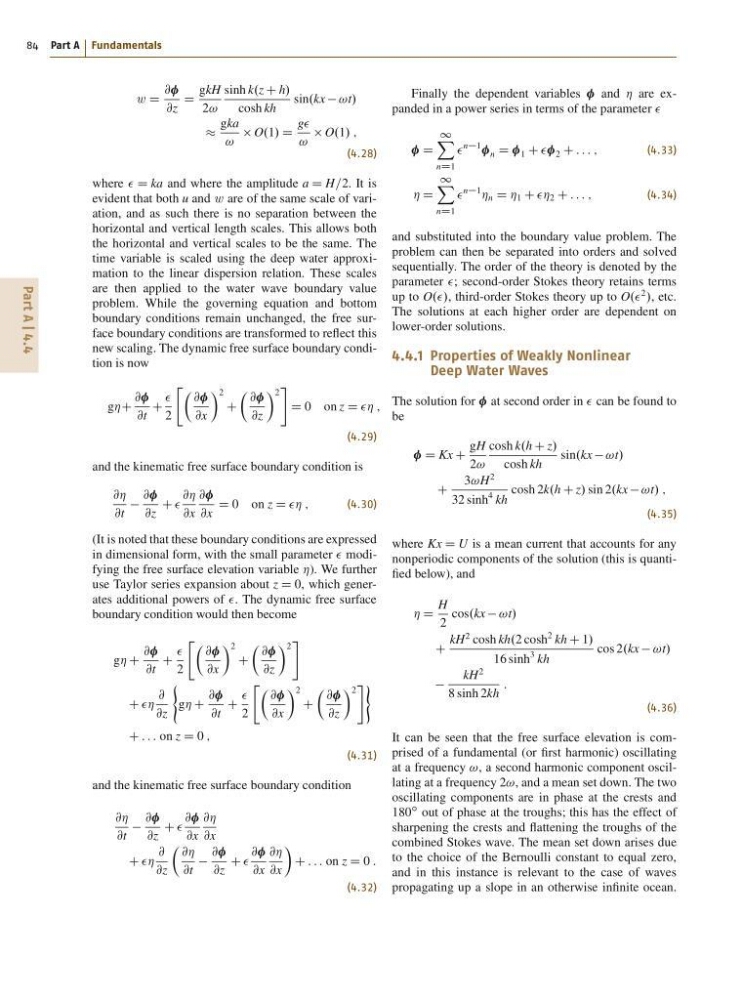
where D ka and where the amplitude a D H=2. It is
evident that both u and w are of the same scale of variation, and as such there is no separation between the
horizontal and vertical length scales. This allows both
the horizontal and vertical scales to be the same. The
time variable is scaled using the deep water approximation to the linear dispersion relation. These scales
are then applied to the water wave boundary value
problem. While the governing equation and bottom
boundary conditions remain unchanged, the free surface boundary conditions are transformed to reflect this
new scaling. The dynamic free surface boundary condition is now
gÁC
@
@t
C
2
" Â @
@x
à 2
C
 @
@z
à 2
#
D 0 onz D Á ;
(4.29)
and the kinematic free surface boundary condition is
@Á
@t
@
@z
C
@Á
@x
@
@x
D 0 on z D Á ;
(4.30)
(It is noted that these boundary conditions are expressed
in dimensional form, with the small parameter modifying the free surface elevation variable Á). We further
use Taylor series expansion about z D 0, which generates additional powers of . The dynamic free surface
boundary condition would then become
gÁ C
@
@t
C
2
" Â @
@x
à 2
C
 @
@z
à 2
#
C Á
@
@z
(
gÁ C
@
@t
C
2
" Â @
@x
à 2
C
 @
@z
à 2
#)
C : : : on z D 0 ;
(4.31)
and the kinematic free surface boundary condition
@Á
@t
@
@z
C
@
@x
@Á
@x
C Á
@
@z
 @Á
@t
@
@z
C
@
@x
@Á
@x
Ã
C : : : on z D 0 :
(4.32)
Finally the dependent variables and Á are expanded in a power series in terms of the parameter
D
1
X
nD1
n1
n D 1 C 2 C : : : ;
(4.33)
Á D
1
X
nD1
n1
Á n D Á 1 C Á 2 C : : : ;
(4.34)
and substituted into the boundary value problem. The
problem can then be separated into orders and solved
sequentially. The order of the theory is denoted by the
parameter ; second-order Stokes theory retains terms
up to O../, third-order Stokes theory up to O..
2
/, etc.
The solutions at each higher order are dependent on
lower-order solutions.
4.4.1 Properties of Weakly Nonlinear
Deep Water Waves
The solution for at second order in can be found to
be
D Kx C
gH
2!
cosh k.h C z/
cosh kh
sin.kx !t/
C
3!H
2
32 sinh
4 kh
cosh 2k.h C z/ sin 2.kx !t/ ;
(4.35)
where Kx D U is a mean current that accounts for any
nonperiodic components of the solution (this is quantified below), and
Á D
H
2
cos.kx !t/
C
kH
2 cosh kh.2 cosh
2 kh C 1/
16 sinh
3 kh
cos 2.kx !t/
kH
2
8 sinh 2kh
:
(4.36)
It can be seen that the free surface elevation is comprised of a fundamental (or first harmonic) oscillating
at a frequency !, a second harmonic component oscillating at a frequency 2!, and a mean set down. The two
oscillating components are in phase at the crests and
180
ı out of phase at the troughs; this has the effect of
sharpening the crests and flattening the troughs of the
combined Stokes wave. The mean set down arises due
to the choice of the Bernoulli constant to equal zero,
and in this instance is relevant to the case of waves
propagating up a slope in an otherwise infinite ocean.
84 Part A Fundamentals
w D
@
@z
D
gkH
2!
sinh k.z C h/
cosh kh
sin.kx !t/
gka
!
O.1/ D
g
!
O.1/ ;
(4.28)
where D ka and where the amplitude a D H=2. It is
evident that both u and w are of the same scale of variation, and as such there is no separation between the
horizontal and vertical length scales. This allows both
the horizontal and vertical scales to be the same. The
time variable is scaled using the deep water approximation to the linear dispersion relation. These scales
are then applied to the water wave boundary value
problem. While the governing equation and bottom
boundary conditions remain unchanged, the free surface boundary conditions are transformed to reflect this
new scaling. The dynamic free surface boundary condition is now
gÁC
@
@t
C
2
" Â @
@x
à 2
C
 @
@z
à 2
#
D 0 onz D Á ;
(4.29)
and the kinematic free surface boundary condition is
@Á
@t
@
@z
C
@Á
@x
@
@x
D 0 on z D Á ;
(4.30)
(It is noted that these boundary conditions are expressed
in dimensional form, with the small parameter modifying the free surface elevation variable Á). We further
use Taylor series expansion about z D 0, which generates additional powers of . The dynamic free surface
boundary condition would then become
gÁ C
@
@t
C
2
" Â @
@x
à 2
C
 @
@z
à 2
#
C Á
@
@z
(
gÁ C
@
@t
C
2
" Â @
@x
à 2
C
 @
@z
à 2
#)
C : : : on z D 0 ;
(4.31)
and the kinematic free surface boundary condition
@Á
@t
@
@z
C
@
@x
@Á
@x
C Á
@
@z
 @Á
@t
@
@z
C
@
@x
@Á
@x
Ã
C : : : on z D 0 :
(4.32)
Finally the dependent variables and Á are expanded in a power series in terms of the parameter
D
1
X
nD1
n1
n D 1 C 2 C : : : ;
(4.33)
Á D
1
X
nD1
n1
Á n D Á 1 C Á 2 C : : : ;
(4.34)
and substituted into the boundary value problem. The
problem can then be separated into orders and solved
sequentially. The order of the theory is denoted by the
parameter ; second-order Stokes theory retains terms
up to O../, third-order Stokes theory up to O..
2
/, etc.
The solutions at each higher order are dependent on
lower-order solutions.
4.4.1 Properties of Weakly Nonlinear
Deep Water Waves
The solution for at second order in can be found to
be
D Kx C
gH
2!
cosh k.h C z/
cosh kh
sin.kx !t/
C
3!H
2
32 sinh
4 kh
cosh 2k.h C z/ sin 2.kx !t/ ;
(4.35)
where Kx D U is a mean current that accounts for any
nonperiodic components of the solution (this is quantified below), and
Á D
H
2
cos.kx !t/
C
kH
2 cosh kh.2 cosh
2 kh C 1/
16 sinh
3 kh
cos 2.kx !t/
kH
2
8 sinh 2kh
:
(4.36)
It can be seen that the free surface elevation is comprised of a fundamental (or first harmonic) oscillating
at a frequency !, a second harmonic component oscillating at a frequency 2!, and a mean set down. The two
oscillating components are in phase at the crests and
180
ı out of phase at the troughs; this has the effect of
sharpening the crests and flattening the troughs of the
combined Stokes wave. The mean set down arises due
to the choice of the Bernoulli constant to equal zero,
and in this instance is relevant to the case of waves
propagating up a slope in an otherwise infinite ocean.